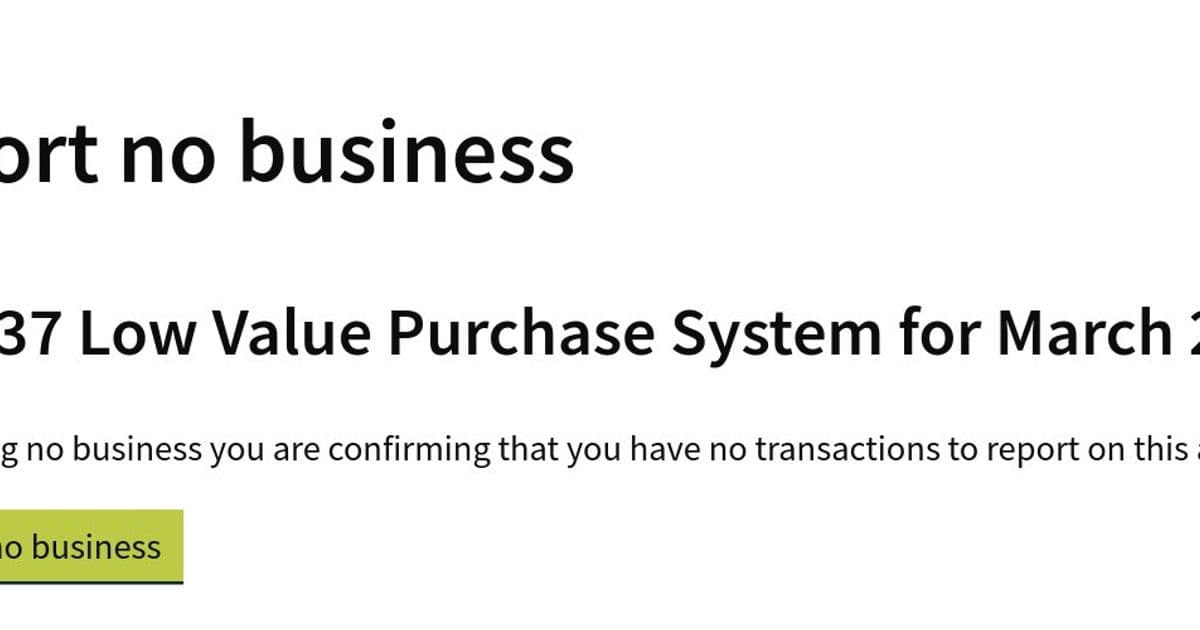
A Freedom of Information request shows that over 95 % of monthly reports to the Government Commercial Agency are “no‑business” filings, translating to more than two full days of wasted time each month for small firms that never sell under the RM6237 framework.
The UK Government’s Low‑Value Purchase System is a Time Sink for Small Suppliers
Running a small business is already a juggling act. When you try to sell to a public sector buyer, you suddenly face a maze of forms, compliance checks, tender portals and a litany of other requirements. The RM6237 Low‑Value Purchase System was introduced to cut through that complexity: if a department needs to buy something below a set threshold, it can simply reach out to any registered supplier and place an order, bypassing the usual tender process.
In theory that sounds like a win‑win – less paperwork for the buyer, faster access to goods for the government, and a cheap entry point for small suppliers. In practice, there’s a hidden cost that most of us only notice when we have nothing to report.
The “No‑Business” Reporting Loop
Every month, every supplier on the RM6237 register must log into the Government Commercial Agency (GCA) portal and confirm whether they have made any sales. The process is the same whether you sold 1,000 paperclips or nothing at all: you receive an MFA code, click through a handful of screens, and submit a “No Business” declaration.
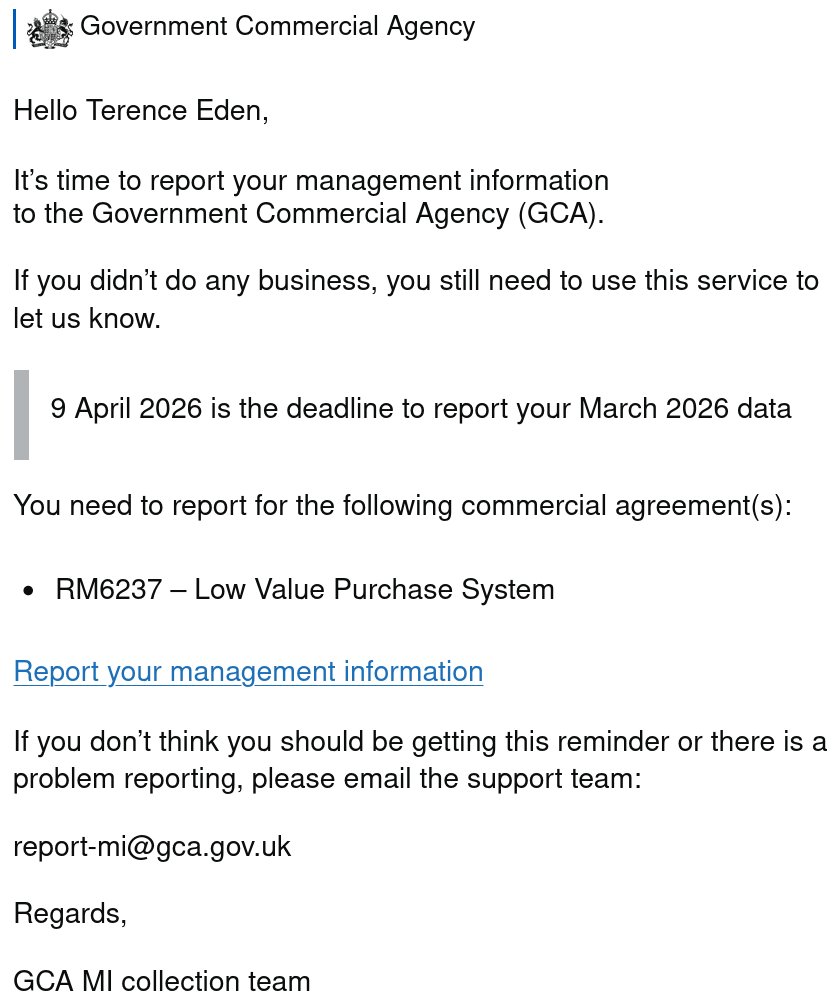
For a busy small‑business owner, that two‑minute ritual feels like a needless chore. I filed a Freedom of Information request to see how many suppliers are actually using the system each month, and the GCA responded – albeit with a PDF rather than a machine‑readable file. The numbers are striking:
| Month | Total Returns | Nil Returns | Nil‑Return % |
|---|---|---|---|
| Mar‑25 | 768 | 729 | 94.9 % |
| Apr‑25 | 902 | 876 | 97.1 % |
| May‑25 | 948 | 923 | 97.4 % |
| Jun‑25 | 1,322 | 1,270 | 96.1 % |
| Jul‑25 | 1,406 | 1,355 | 96.4 % |
| Aug‑25 | 1,369 | 1,326 | 96.9 % |
| Sep‑25 | 1,416 | 1,362 | 96.2 % |
| Oct‑25 | 1,610 | 1,556 | 96.6 % |
| Nov‑25 | 1,713 | 1,654 | 96.6 % |
| Dec‑25 | 1,645 | 1,590 | 96.7 % |
| Jan‑26 | 1,536 | 1,487 | 96.8 % |
| Feb‑26 | 1,588 | 1,531 | 96.4 % |
What does this mean?
- Roughly 96 % of the monthly submissions are “no business”.
- Only about 59 suppliers each month actually report a sale through RM6237.
- Assuming a conservative two minutes per submission, the collective waste adds up to over two full days of labour every month – that’s more than 24 hours of time that could be spent on product development, marketing, or serving real customers.
Why the Burden falls on Suppliers
The logic behind the reporting requirement is understandable: the GCA wants visibility into how the framework is being used. However, the current design places the onus on the seller to confirm inactivity, while the buyer never has to account for what they have spent.
A more efficient model would flip the responsibility:
- Buyers log their spend – each department that makes a purchase under RM6237 could simply upload a short CSV of vendor name, amount and date.
- Suppliers receive a summary – the GCA could then generate a consolidated report for each supplier, showing only the months where they actually received business.
- Zero‑activity months disappear – if a supplier had no sales, they would receive no notification at all, eliminating the need for a “no‑business” click‑through.
Such a shift would align reporting effort with actual economic activity, reducing friction for the majority of registered firms.
The Missing Feedback Loop
After submitting the “no‑business” form, the portal asks users to rate their experience. When I asked for the underlying scores, the GCA replied that the data is anonymised and only available as a service‑wide view, with no granular breakdown for RM6237. This lack of transparency makes it hard to gauge how much the process irritates users, and it removes any incentive for the agency to improve the workflow.
Bottom Line
The RM6237 framework itself addresses a genuine need: providing a fast, low‑bureaucracy route for small suppliers to sell to the public sector. Yet the mandatory monthly “no‑business” filing creates a disproportionate administrative load. With over 1,500 firms logging in each month just to confirm zero sales, the system is effectively a time‑drain that yields little insight.
If the GCA were to redesign the reporting flow – shifting responsibility to buyers, providing real‑time spend data, and exposing feedback metrics – the framework could live up to its promise without costing small businesses valuable hours.
If you run a small firm that’s registered on RM6237, you now have the numbers to back up a request for change. The data is public, the waste is measurable, and the solution is straightforward.
Comments
Please log in or register to join the discussion