Gary Marcus exposes what he calls a rigged competition between OpenAI and Anthropic, revealing how Sam Altman's public support for Dario Amodei was a calculated deception while secretly negotiating a deal with Trump that would eliminate Anthropic as a competitor.
The whole thing was a scam. The fix was in, and Dario never had a chance.
GARY MARCUS FEB 28, 2026
Probably you already saw how it all turned out. On the very same day that Altman offered public support to Amodei, he signed a deal to take away Amodei's business, with a deal that wasn't all that different. You can't get more Altman than that.
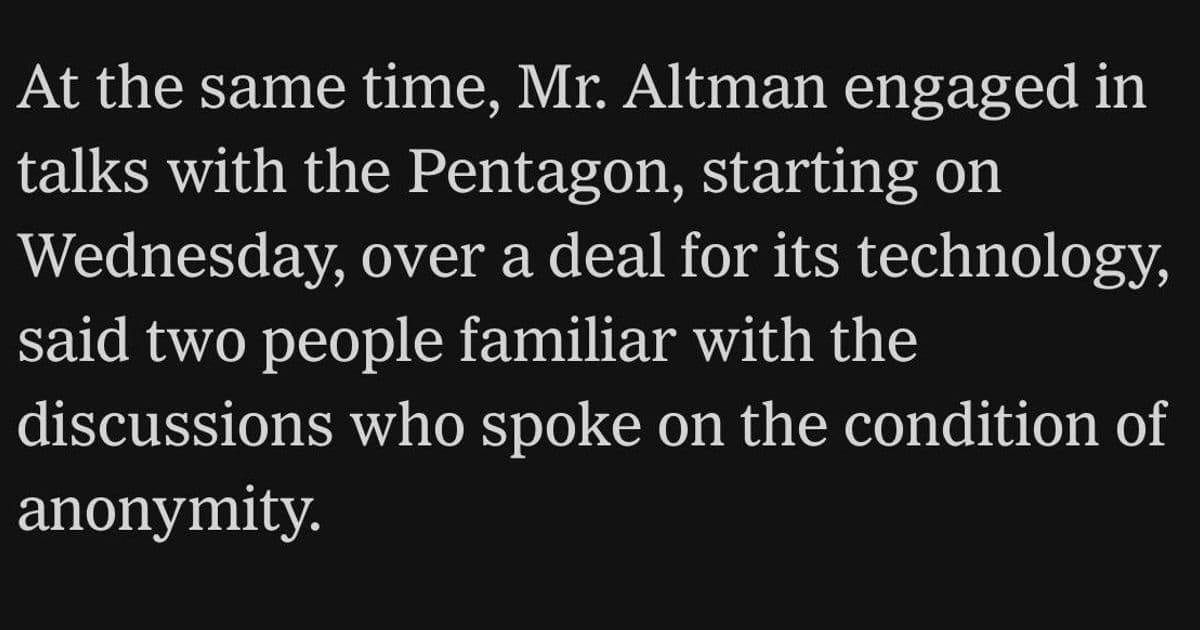
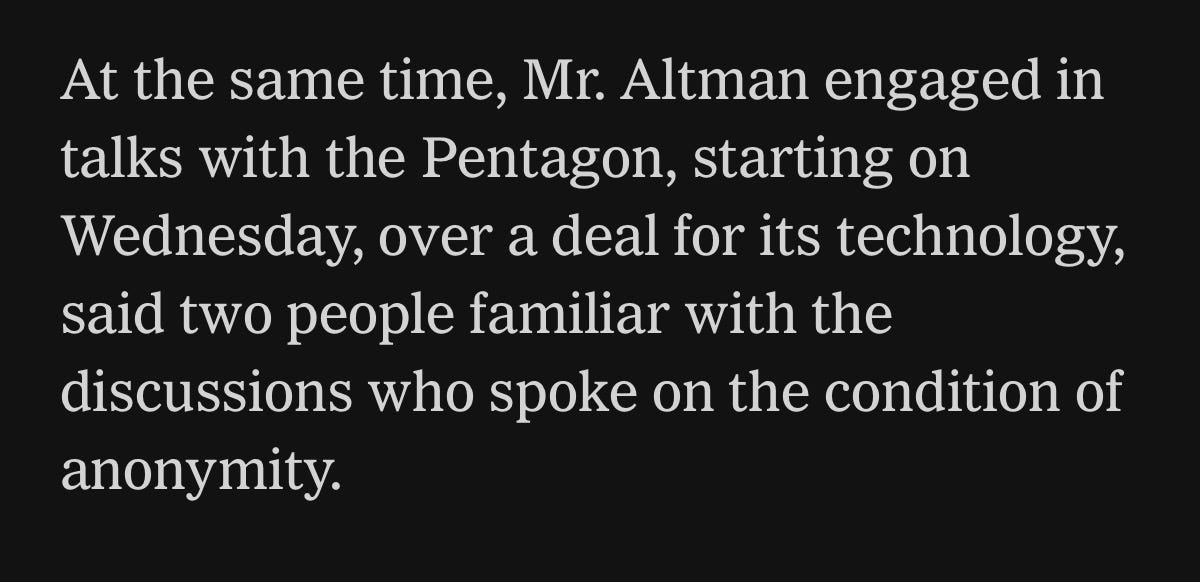
But here's the kicker: Per The New York Times, Altman had secretly been working on the deal since Wednesday - before he announced his support for Dario - before Trump had denounced Anthropic - but after Brockman had donated $25M to Trump's PAC
It was all theatre. Dario never had a chance.
It's one thing for the government to reject Anthropic's terms—and entirely another to banish them permanently and, absurdly and punitively declare them a supply chain risk. Worse, they did it in favor of someone else who took pretty similar terms and happened to have given more campaign contributions.
Anthropic deserves a chance at EXACTLY the same terms; anything else reeks of corruption.
I am no fan of Amodei. I think he often overhypes things, many of which I have publicly challenged. The company ripped off a lot of writer's work (per the $1.5B settlement), and recently walked back its core safety pledge. But I believe in fair play. This wasn't that.
In capitalism, the market decides. In oligarchy, connections and donations decide. It sure looks like the US is transitioning from the former to the latter.
The timeline here is damning. While Altman was publicly positioning himself as a supporter of competition in the AI space, he was simultaneously engineering a deal that would eliminate his primary competitor. The sequence of events—Brockman's $25M donation to Trump's PAC, followed by Altman's secret negotiations, culminating in the simultaneous public support and private betrayal—paints a picture of calculated political maneuvering.
What makes this particularly concerning is the government's role. Declaring Anthropic a supply chain risk while simultaneously greenlighting a nearly identical deal for OpenAI isn't just inconsistent policy—it's the kind of selective enforcement that undermines the entire concept of fair competition. When the rules can be bent or broken based on political contributions, we're no longer operating in a market economy but something closer to crony capitalism.
The implications extend far beyond this single incident. If the AI industry's future is being shaped not by technological merit or market forces but by political connections and campaign donations, then the entire promise of AI as a transformative technology is at risk. We're not just talking about which company gets to dominate the market—we're talking about whether the development of one of the most important technologies in human history will be guided by innovation or influence.
Marcus's critique cuts through the typical Silicon Valley rhetoric about disruption and innovation to expose what he sees as the raw mechanics of power in the AI industry. Whether you agree with his assessment of Amodei or not, the pattern he describes—public support masking private betrayal, timed to coincide with political donations—represents exactly the kind of behavior that erodes public trust in both the tech industry and democratic institutions.
The question now is whether this represents an isolated incident or the beginning of a new normal where AI development is increasingly dictated by political connections rather than technological progress. If it's the latter, then the entire conversation about AI safety, ethics, and governance needs to be reframed—not as a technical challenge, but as a political one.
Comments
Please log in or register to join the discussion