
After MinIO Inc. archived its popular open-source object storage repository, leaving thousands of users without support, a community fork has emerged to maintain the project with full functionality including the previously removed admin console.
On February 12, 2026, MinIO's GitHub repository was officially archived and marked as "no longer maintained." The project, once boasting 60k stars and over a billion Docker pulls, became a digital tombstone. This wasn't a sudden death but the culmination of an 18-month deliberate wind-down that saw the company methodically dismantle the open-source ecosystem it built after raising $126M at a billion-dollar valuation.
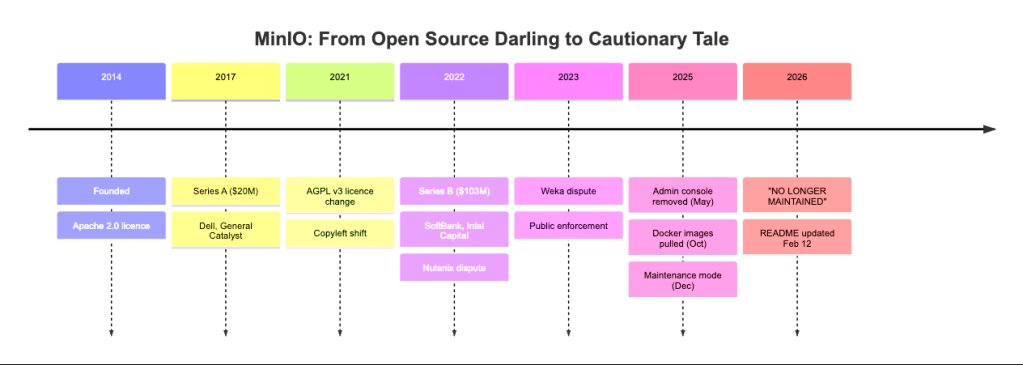
The timeline reveals a concerning pattern: from switching licenses in 2021, to legal actions against Nutanix and Weka in 2022-2023, to removing the admin console from the community edition in 2025, stopping binary distribution in October 2025, and finally announcing maintenance mode in December 2025 before archiving the repository in February 2026.
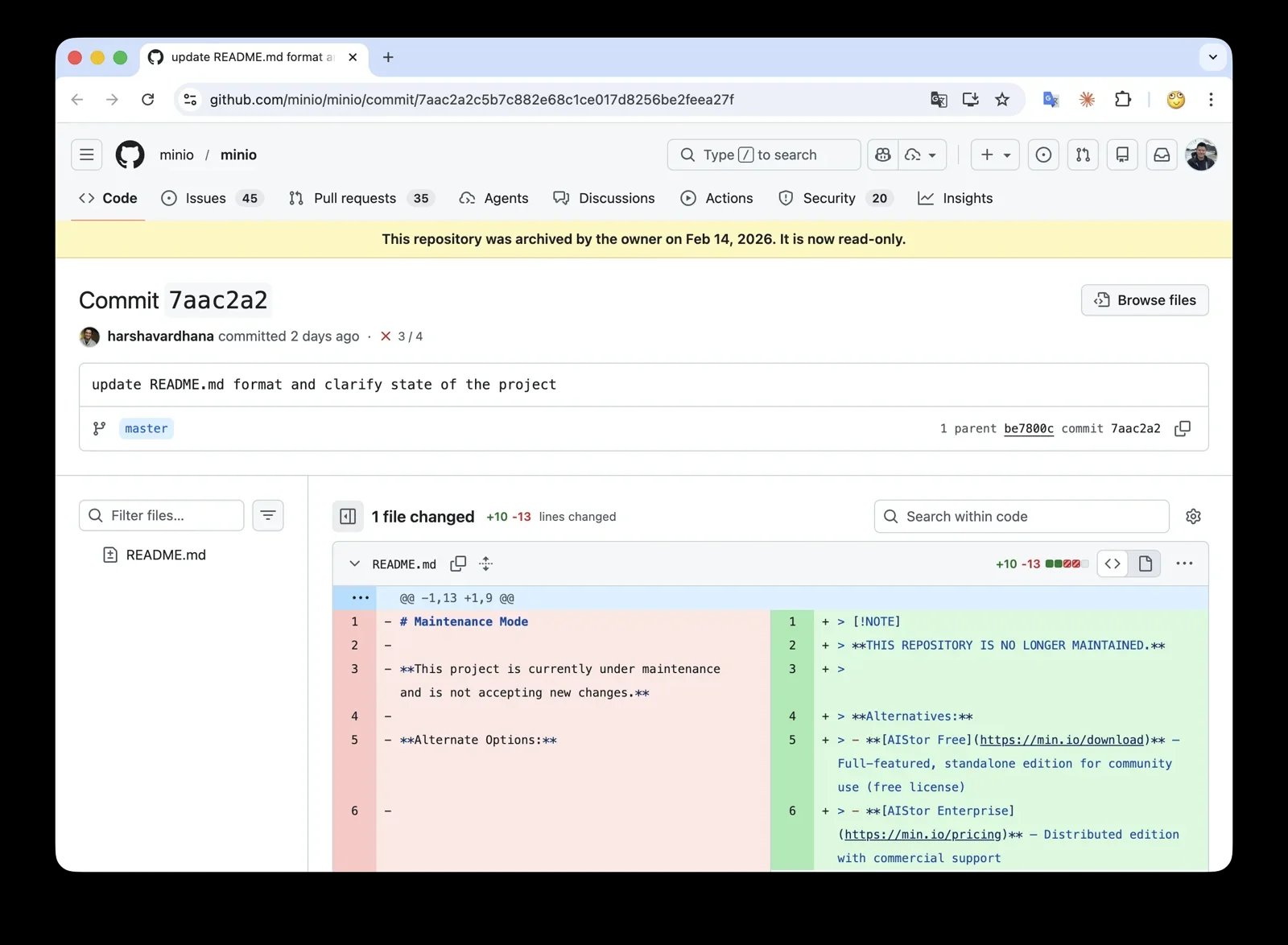
"Normally this is where the story ends — a collective sigh, and everyone moves on," writes the maintainer of a new community fork. "But I want to tell a different story. Not an obituary — a resurrection."
The resurrection comes in the form of pgsty/minio, a community fork that restores the full functionality of the original open-source project. This fork addresses three critical issues left by the original project's abandonment:
- Restored Admin Console
In May 2025, MinIO stripped the full admin console from the community edition, leaving only a bare-bones object browser. User management, bucket policies, access control, and lifecycle management features were removed, essentially requiring users to pay for the enterprise edition (~$100,000) to regain functionality.
The community fork brings back these features by reverting the minio/console submodule to its previous version. "The ironic part: this didn't even require reverse engineering," explains the maintainer. "You just revert the minio/console submodule to the previous version. That's literally all MinIO did — they swapped a dependency version to replace the full console with a stripped-down one. The code was always there. We put it back."
- Rebuilt Binary Distribution
In October 2025, MinIO stopped distributing pre-built binaries and Docker images, leaving only source code. This created significant challenges for most users who rely on stable artifacts for Dockerfiles, Ansible playbooks, or CI/CD pipelines.
The community fork provides:
- Docker Images available on Docker Hub
- RPM/DEB packages for major Linux distributions
- A fully automated CI/CD pipeline ensuring ongoing supply chain stability
Users can simply swap minio/minio for pgsty/minio in their Docker configurations or install the packages from the GitHub Release page.
- Restored Community Edition Documentation
MinIO's official documentation was also at risk, with links redirecting to their commercial product AIStor. The community fork has restored the documentation with all content preserved and ongoing maintenance.
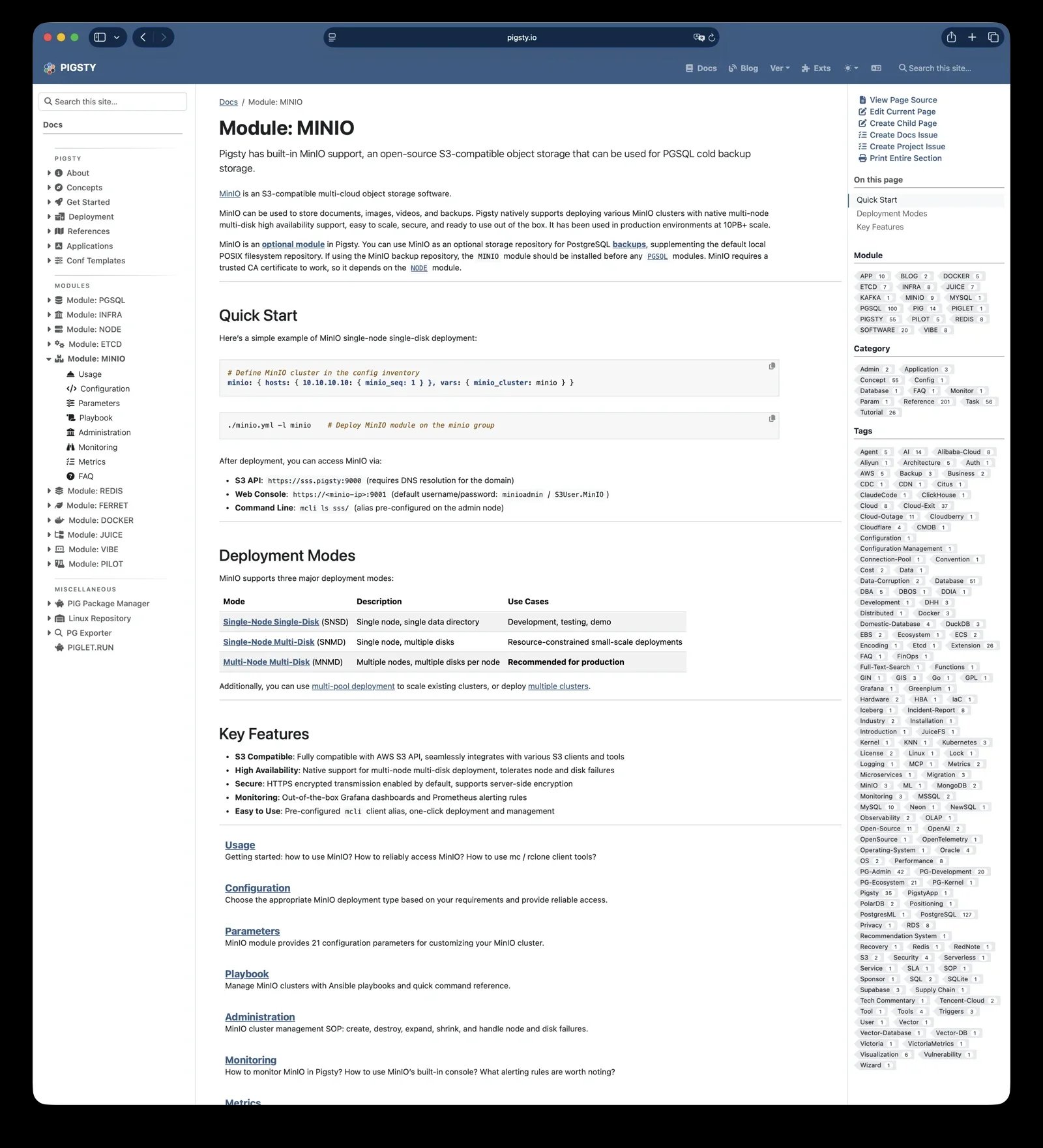
The maintainer emphasizes that this is more than just a backup fork. "MinIO is a production component in Pigsty, and many users run it as their PostgreSQL backup repository. We run our own builds — if something breaks, we find out first and fix it first. We've been dogfooding these builds in production for three months now."
The project operates under clear principles: no new features, just supply chain continuity; production-ready builds, not an archive; bug fixes and CVE tracking; and careful handling of trademark issues.
"MinIO Inc. can archive a GitHub repo, but they can't archive the demand behind 60k stars, or the dependency graph behind a billion Docker pulls," writes the maintainer. "That demand doesn't disappear — it just finds its way out."
The economics of open-source maintenance have also changed with AI coding tools. "With tools like Claude Code, the cost of locating and fixing bugs in a complex Go project has dropped by more than an order of magnitude," explains the maintainer. "What used to require a dedicated team to maintain a complex infrastructure project can now be handled by one experienced engineer with an AI copilot."
This situation reflects a broader pattern in the open-source ecosystem where companies abandon projects after building significant community followings. Similar to HashiCorp's Terraform being forked into OpenTofu, MinIO's fork benefits from clear licensing under AGPL, which provides stronger protections for community forks than some other licenses.
The resurrection of MinIO through community effort demonstrates a fundamental principle of open-source: while companies may abandon projects, they cannot revoke the licenses granted to the community. "AGPL was MinIO's own choice," notes the maintainer. "They switched from Apache 2.0 to AGPL to use it as leverage in their disputes with Nutanix and Weka — keeping the 'open source' label while adding enforcement teeth. But open-source licenses cut both ways — the same license now guarantees the community's right to fork."
For organizations currently running MinIO, the migration path is straightforward. "If you're using Docker, just swap minio/minio for pgsty/minio. For native Linux installs, grab RPM/DEB packages from the GitHub Release page. You can also use pig (the PG extension package manager) for easy installation," the maintainer explains.
The community fork represents a significant development in the open-source storage landscape, offering a lifeline to organizations that built their infrastructure around MinIO's object storage capabilities. While the original project may be archived, its code and functionality live on through community stewardship, demonstrating the resilience of open-source principles even when commercial interests diverge.
The situation also raises important questions about the sustainability of open-source business models and the responsibilities companies have to the communities that help build and maintain their products. As Percona founder Peter Zaitsev noted, "open-source infrastructure sustainability" is a growing concern in the international developer community.
For now, organizations running MinIO have a path forward through the community fork, which promises to maintain the project as a stable, production-ready component without the enterprise pricing model that made the original project's abandonment particularly problematic for many users.
Comments
Please log in or register to join the discussion