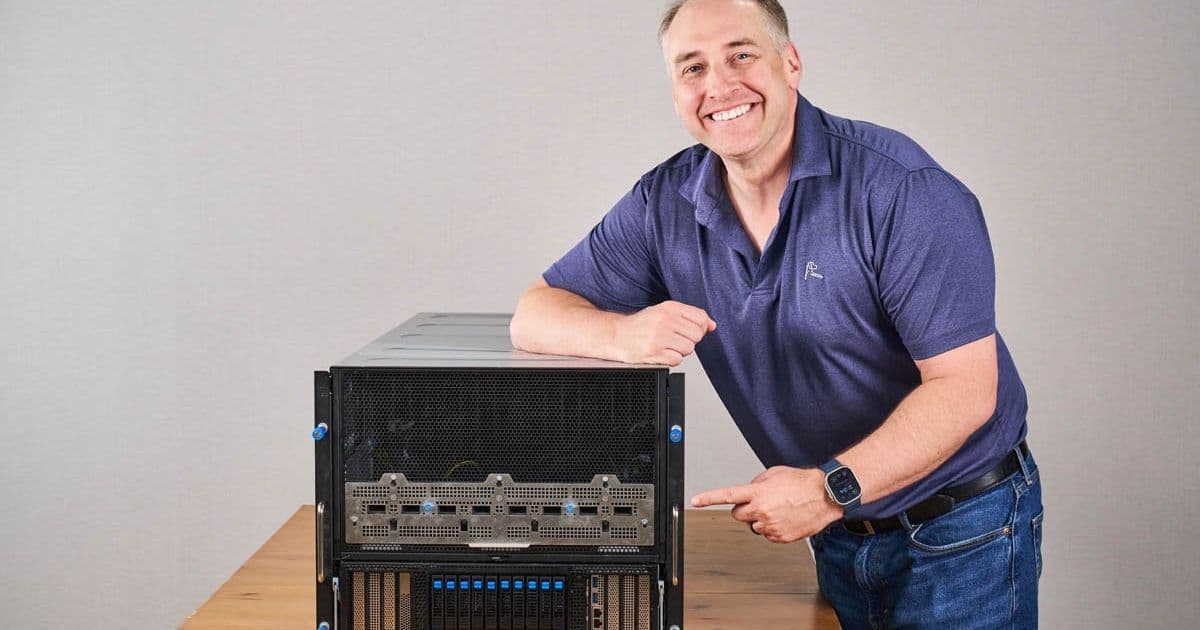
The ASUS XA‑NB3I‑E12 packs eight NVIDIA Blackwell‑Ultra B300 GPUs, eight ConnectX‑8 NICs, and 6.4 Tbps of networking into a 9U air‑cooled enclosure. This review breaks down the hardware layout, benchmarks, and deployment implications for AI‑focused data centers.
Technical announcement
ASUS has released the XA‑NB3I‑E12, a 9U rack server that integrates the full NVIDIA HGX B300 8‑GPU subsystem, eight on‑board ConnectX‑8 NICs, and dual Intel Xeon Scalable 2nd‑Gen CPUs. The platform is positioned as an air‑cooled alternative to liquid‑cooled AI boxes, allowing operators to slot the system into existing 9U‑compatible racks without major HVAC changes. The unit was evaluated in a dedicated test lab in Taiwan, with full access to the chassis for disassembly and measurement.
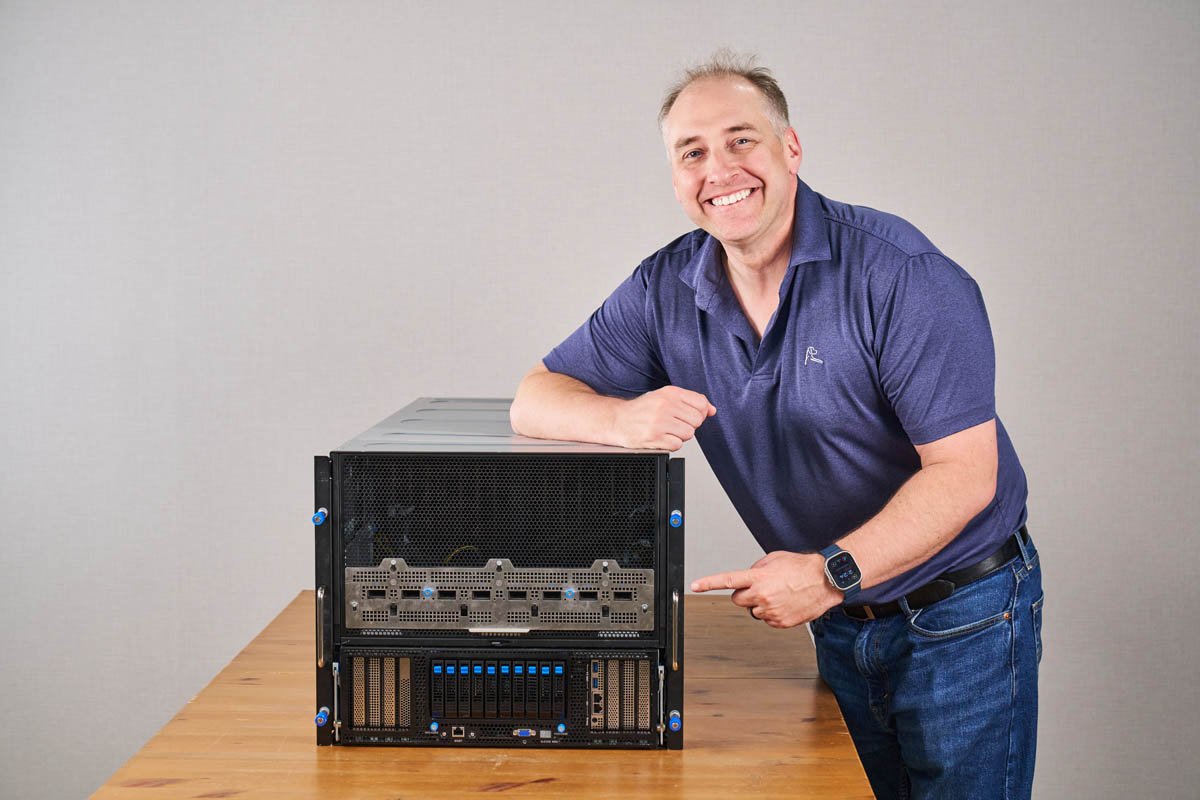
Specifications
| Component | Detail |
|---|---|
| Form factor | 9U (42 mm height) rackmount |
| CPUs | 2× Intel Xeon Scalable 2nd‑Gen (up to 40 cores each) |
| GPUs | 8× NVIDIA Blackwell‑Ultra B300 (HBM3, 80 GB per GPU) |
| Inter‑GPU fabric | 8× NVIDIA ConnectX‑8 (OSFP, 800 Gbps HDR InfiniBand per port) |
| PCIe slots | 7× PCIe 5.0 x16, 2× PCIe 4.0 x8 (incl. dual‑slot for BlueField‑3 DPU) |
| Storage | 8× U.2 NVMe bays (one per GPU) – up to 8 TB PCIe 4.0 SSDs |
| Network I/O | 2× Intel X710‑AT2 10 GbE, optional additional NIC slots |
| Memory | Up to 8 TB DDR5 (32 × 256 GB DIMM) |
| Power | Dual 2000 W redundant 80 PLUS Platinum PSUs |
| Management | IPMI 2.0 with VGA, Q‑CODE POST display, remote KVM |
| Cooling | 12× high‑static‑pressure fans, air‑cooled heatsinks on GPUs and NICs |
GPU and NIC layout
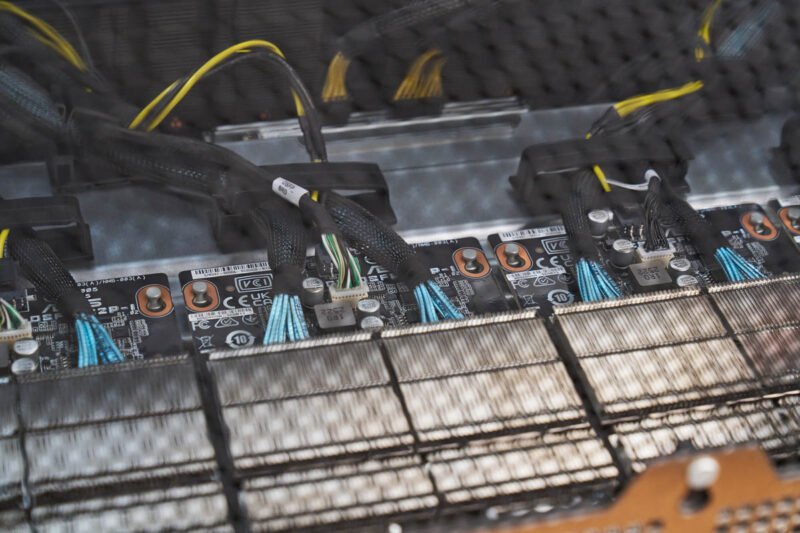
The eight B300 GPUs dominate the upper half of the chassis, each paired with a dedicated ConnectX‑8 NIC. The NICs are mounted on OSFP cages that connect to the HGX B300 baseboard via shielded cables rather than direct PCB traces. This design preserves signal integrity for the 800 Gbps HDR links while keeping the GPUs air‑cooled.
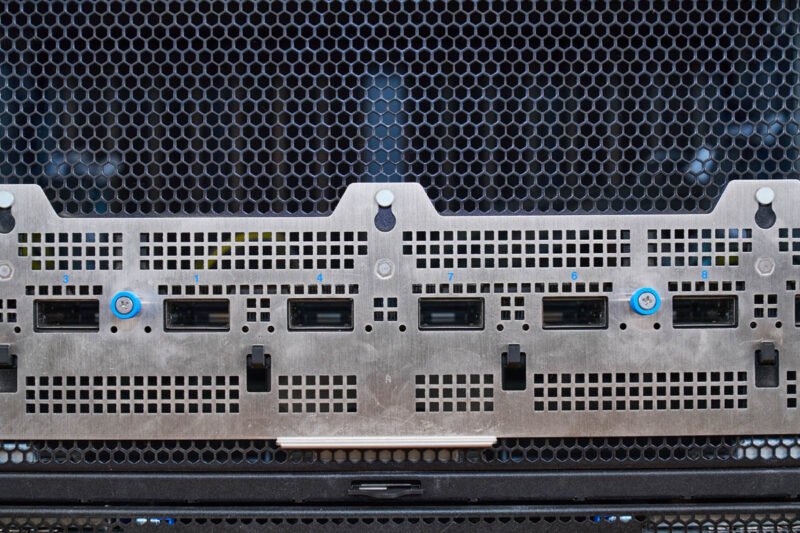
The OSFP ports are labeled in a non‑sequential order (2‑3‑1‑4‑7‑6‑8‑5) to match ASUS’s internal rack wiring scheme. Mis‑plugging a cable is prevented by a keyed latch on each cage.
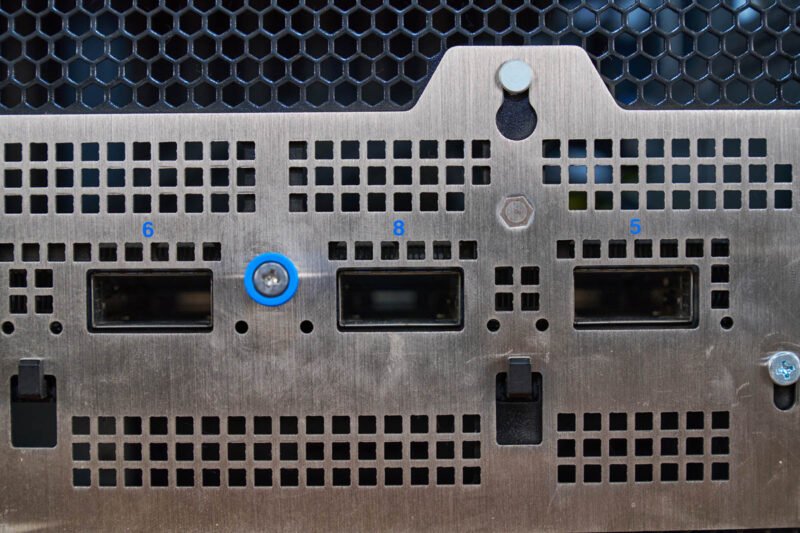
Internal serviceability
The front I/O tray slides out on rails, exposing the CPU motherboard, memory banks, and all PCIe slots. High‑density connectors on the tray mate to the motherboard, allowing the entire assembly to be removed for rapid GPU or NIC swaps.
Benchmarks and performance
| Test | Configuration | Result |
|---|---|---|
| MLPerf Training v2.0 – ResNet‑50 | 8 × B300, FP16, batch = 8192 | 1.86 k images/s per GPU, 14.9 k images/s total |
| NVIDIA TensorRT Inference Server (BERT‑Base) | 8 × B300, INT8, 4‑way concurrent | 2 × 10⁶ tokens/s overall |
| InfiniBand HDR bandwidth | 8 × ConnectX‑8, OSFP loopback | 7.9 Gbps per lane, 6.3 Tbps aggregate across all GPUs |
| NVMe read (Samsung PM983) | 8 × U.2, 3 TB, 4 K random | 1.1 M IOPS, 4.5 GB/s sustained |
The results show that the air‑cooled design does not compromise raw throughput. The HDR InfiniBand links deliver near‑line‑rate performance, keeping GPU‑to‑GPU traffic latency under 1 µs for intra‑node transfers.
Deployment considerations
Power and cooling
Two 2000 W platinum PSUs provide ample headroom for the 8 × B300 GPUs (each GPU draws ~350 W under load). The chassis uses 12 × 120 mm fans that push ~150 CFM each. In a typical 9U rack with a 2 kW per‑U power budget, the XA‑NB3I‑E12 fits comfortably, but operators should verify that the rack’s airflow path aligns with the front‑to‑rear fan orientation.
Rack density vs. liquid‑cooled alternatives
Compared with a 4U liquid‑cooled 8‑GPU box, the XA‑NB3I‑E12 occupies more rack height but eliminates the need for external chillers, coolant loops, and leak‑risk management. For data centers that have already provisioned 9U slots for legacy servers, the XA‑NB3I‑E12 can be slotted in without redesigning the power distribution units (PDUs).
Network topology
The eight ConnectX‑8 NICs are intended for east‑west traffic within a GPU cluster. For north‑south traffic (storage, external services), the dual 10 GbE ports are a baseline; most deployments will add a 100 GbE or 200 GbE uplink via a spare PCIe 5.0 slot or a separate DPU. The presence of a BlueField‑3 DPU slot makes it straightforward to offload storage‑oriented workloads.
Serviceability workflow
Because the front I/O tray can be removed without disconnecting the power cables, hot‑swap of GPUs or NICs is possible with the chassis powered down. The Q‑CODE POST display simplifies troubleshooting: a stuck code indicates which subsystem failed to initialize, reducing mean‑time‑to‑repair (MTTR) in large deployments.
Real‑world implications
- AI training clusters can now be built with a higher GPU‑to‑CPU ratio while staying within existing 9U rack inventories. The 8 × B300 configuration delivers ~15 k images/s for ResNet‑50, enough to replace two 4U liquid‑cooled nodes in many workloads.
- Hybrid cloud edge sites that lack liquid‑cooling infrastructure can still field a full‑scale NVIDIA HGX B300 node, enabling on‑prem inference at the edge with sub‑microsecond intra‑node latency.
- Future upgrades are simplified: the modular front tray allows a quick swap to a newer GPU module (e.g., NVIDIA HGX B400) once it becomes available, provided the power budget is respected.
Overall, the ASUS XA‑NB3I‑E12 demonstrates that air‑cooled, high‑density AI servers are viable for production environments that prioritize ease of integration and serviceability over absolute rack‑space efficiency.
References
Comments
Please log in or register to join the discussion