
Public opinion polling reveals Americans are giving mixed marks on Trump's handling of Venezuela's economic crisis and his renewed interest in purchasing Greenland, with partisan divides shaping perceptions of these unconventional foreign policy moves.
Recent polling data from the Pew Research Center shows American voters are split on President Trump's approach to Venezuela, with 48% approving and 47% disapproving of his handling of the situation. The numbers reflect deep partisan divides, as 82% of Republicans approve while only 14% of Democrats share that view. This split comes as the administration continues to tighten sanctions against the Maduro regime, recently announcing additional measures targeting Venezuelan oil exports and financial transactions.
The economic pressure campaign has yielded mixed results. According to the International Monetary Fund, Venezuela's economy contracted by 35% in 2023, with inflation remaining above 200% despite the sanctions. However, humanitarian organizations report that these measures have exacerbated food and medicine shortages, affecting an estimated 7.1 million Venezuelans who require humanitarian assistance. The administration argues that economic pressure remains the most effective tool for promoting democratic transition, though critics point to the lack of tangible political progress since sanctions intensified in 2019.
Market analysts note that U.S. energy companies have lost significant market share in Venezuela as a result of the sanctions. Before the current restrictions, American firms held approximately 15% of Venezuela's oil production contracts. That share has dropped to near zero, creating opportunities for Chinese and Russian state-owned enterprises to expand their presence in the region. The geopolitical implications extend beyond energy, as Venezuela's debt to China now exceeds $60 billion, giving Beijing considerable leverage in Caracas.
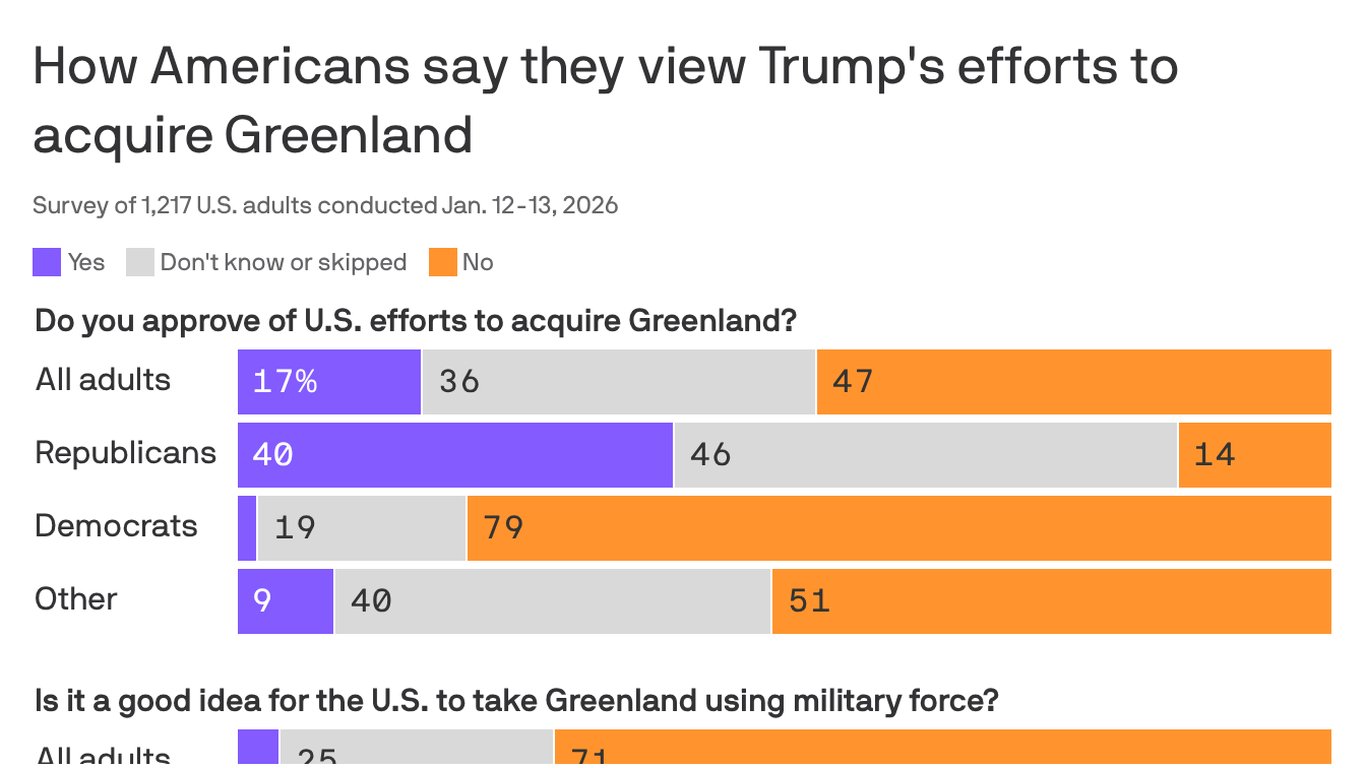
On a completely different front, Trump's renewed interest in purchasing Greenland has generated surprising polling numbers. A YouGov survey found that 37% of Americans support the idea, while 45% oppose it and 18% remain undecided. Support is strongest among voters aged 18-29 (48% in favor) and weakest among those 65 and older (29% support). The proposal, initially floated in 2019 and revived during the 2024 campaign, has faced immediate rejection from Danish officials, who maintain Greenland is not for sale.
The strategic rationale behind the Greenland interest centers on Arctic resources and military positioning. Greenland holds an estimated 1.7 billion barrels of oil and 148 billion cubic feet of natural gas, according to the U.S. Geological Survey. The island also contains rare earth minerals essential for electronics manufacturing, with deposits estimated at 38.5 million tons. From a military perspective, Greenland's location provides crucial monitoring capabilities for Russian submarine movements in the North Atlantic and offers proximity to potential Arctic shipping routes that could become ice-free by 2050.
Financial analysts estimate the purchase price would likely exceed $1 trillion, considering Greenland's land area (2.16 million square kilometers) and resource potential. For context, the U.S. purchased Alaska from Russia in 1867 for $7.2 million, equivalent to about $150 million today. The economic burden would require significant congressional approval and would likely necessitate cuts to other federal programs or increased borrowing. Denmark's GDP stands at approximately $400 billion, making any potential sale economically unrealistic from Copenhagen's perspective.
The contrasting public reception to these two foreign policy initiatives reveals broader attitudes toward American intervention. Venezuela policy maintains stronger support among older voters and those prioritizing national security, while the Greenland proposal appeals more to younger demographics interested in resource acquisition and strategic positioning. Both issues demonstrate how unconventional foreign policy approaches can generate distinct voter coalitions that don't align neatly with traditional party lines.
International relations experts note that these policies reflect a transactional approach to foreign affairs, where territorial and economic considerations take precedence over diplomatic norms. The Venezuela sanctions represent a continuation of decades-long U.S. intervention in Latin America, while the Greenland proposal marks a departure from post-WWII norms against territorial acquisition. Both strategies carry significant risks: sanctions could further destabilize Venezuela's economy and drive migration northward, while territorial acquisition attempts could strain relationships with NATO allies like Denmark.
The economic implications extend to global markets. Venezuelan sanctions have contributed to higher oil prices, benefiting U.S. shale producers while increasing costs for American consumers. The Greenland proposal, while unlikely to materialize, has already prompted increased investment in Arctic exploration by other nations, potentially accelerating competition for resources in the region. These developments suggest that regardless of implementation, Trump's foreign policy positions are already influencing market dynamics and international relations.
Looking ahead, the administration faces the challenge of balancing these ambitious foreign policy goals with domestic priorities and international law. The Venezuela sanctions require ongoing diplomatic coordination with regional partners, while the Greenland interest demands delicate handling of relations with a NATO ally. Both issues will likely remain prominent in public discourse as the administration seeks to demonstrate decisive action on the global stage while managing the economic and diplomatic consequences of its choices.
Comments
Please log in or register to join the discussion