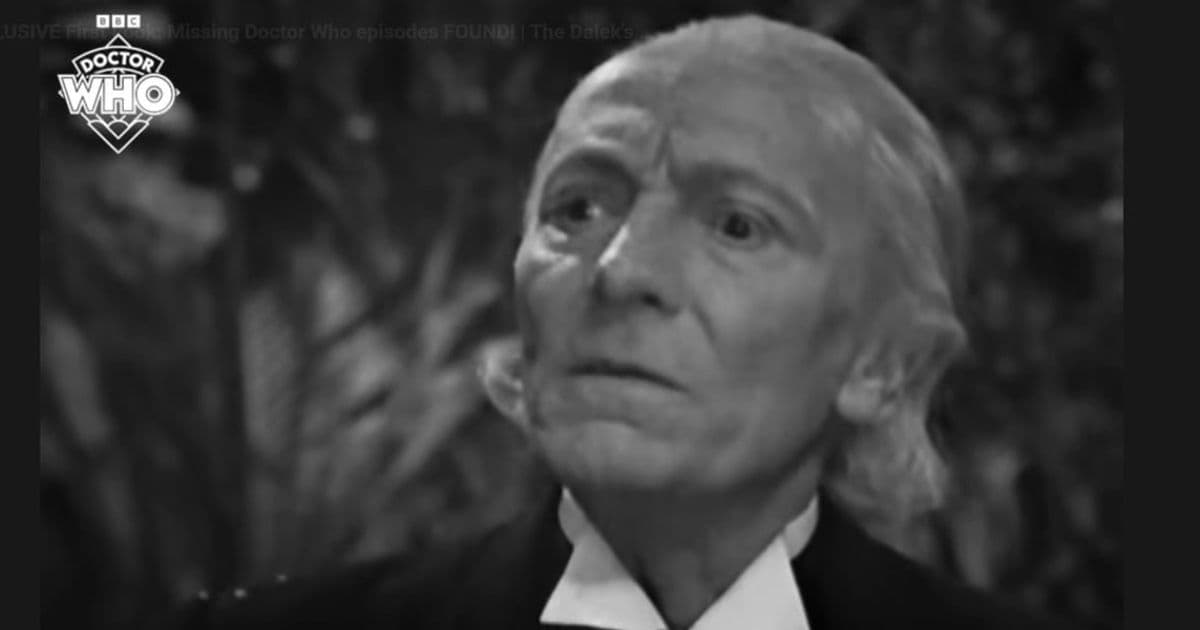
Two missing Doctor Who episodes from 1965 have been discovered in a private collection, offering fans a rare glimpse into early Dalek adventures starring William Hartnell.
Two missing episodes of the classic British sci-fi series Doctor Who have been discovered in a private collection, marking a significant find for television archivists and fans alike.

The episodes, titled "The Nightmare Begins" and "Devil's Planet," were part of the show's third season in 1965 and represent a rare recovery of early Doctor Who material that was long thought lost forever. The discovery was announced by Film Is Fabulous!, a film preservation organization, which found the episodes among the collection of a deceased enthusiast.
According to the preservation group, the episodes are "16mm telerecordings" - physical film copies that were created for international distribution. These telerecordings were made by pointing a film camera at a video monitor displaying the broadcast, a common practice in the 1960s for sending shows to overseas broadcasters who couldn't receive the original television signal.
Both episodes star William Hartnell, the first actor to portray the Doctor, and were originally broadcast in November 1965. They were part of "The Daleks' Master Plan," a 12-episode serial that formed the longest story arc of the third season. The plot centered on the Doctor discovering and defeating a Dalek plot to destroy humanity using a planet-killing time weapon.
The collector who preserved these episodes "cherished the films for many years," according to Film Is Fabulous!, which noted that "we owe him a huge debt of gratitude for preserving these episodes of Doctor Who that might otherwise have been lost to history."
This discovery is particularly significant given the BBC's troubled history with archiving its early television output. During the 1960s and 1970s, the broadcaster lacked a formal archiving policy and routinely erased videotapes to save money and reuse the expensive media. This practice led to the loss of over 90 Doctor Who episodes, including nine from "The Daleks' Master Plan" serial of which these two episodes are a part.
The scale of these losses puts the discovery in perspective. While fans will celebrate finding these two episodes, nine episodes from the same serial remain missing, along with more than 90 other Doctor Who episodes from various seasons. The total number of missing episodes from the show's first six seasons stands at over 100.
For context, the BBC's archival practices weren't unique to Doctor Who. The broadcaster's approach was similar to other television networks of the era, all of which faced the same economic pressures and technological limitations. As Film Is Fabulous! noted, even NASA likely erased its best footage of the first moon landing to reuse tapes, demonstrating how routine this practice was even for events of global significance.
The last major discovery of lost Doctor Who episodes occurred in 2013, when 106 episodes were found at the Ethiopian Radio and Television Agency. Like this recent find, that discovery consisted of episodes that had been sent to foreign broadcasters for transmission outside the UK. These international copies often survived because foreign broadcasters maintained their own archives, while the BBC did not.
Film Is Fabulous! plans to stage a screening of the newly discovered episodes on Saturday, April 4, with details about the event to be revealed soon. The BBC has announced that it will upload the episodes to its iPlayer streaming service at Easter, making them available to UK viewers.
However, international fans may face challenges accessing the episodes, as iPlayer is geo-blocked. Whovians outside the United Kingdom may need to use a virtual private network (VPN) to view the recovered episodes, though the legality and terms of service implications of such access vary by jurisdiction.
The discovery of these episodes represents more than just a nostalgic find for fans. It's a reminder of the fragility of early television history and the importance of preservation efforts by private collectors and specialized organizations. As media moves increasingly to digital formats, the story of these recovered Doctor Who episodes serves as a cautionary tale about the need for robust archiving policies and the value of physical media preservation.
For Doctor Who enthusiasts, the find offers a rare opportunity to experience a piece of the show's history that was thought lost forever. For television historians, it provides valuable insight into early production techniques and the international distribution of British television in the 1960s. And for preservationists, it demonstrates the ongoing value of their work in recovering cultural artifacts that might otherwise be lost to time.
Comments
Please log in or register to join the discussion