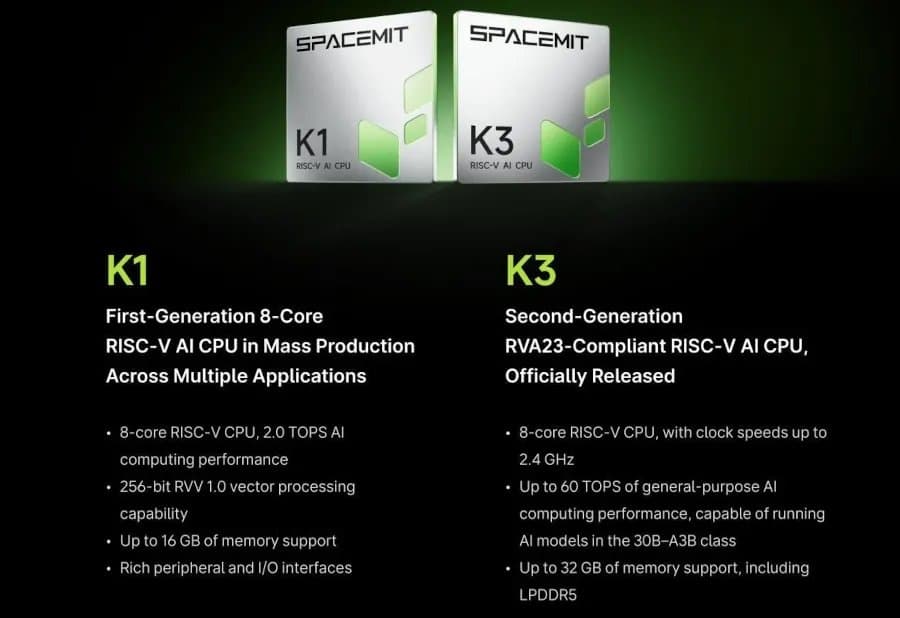
Ubuntu officially adds support for SpacemiT's K3 RISC-V SoC, marking a milestone as one of the first production-ready RVA23-compatible platforms, while clarifying compatibility requirements for future Ubuntu releases.
Canonical and SpacemiT have announced official Ubuntu Linux support for SpacemiT's K3 RISC-V system-on-chip (SoC). The K3 represents a significant milestone as one of the first commercially available SoCs compliant with the RISC-V RVA23 profile. This hardware alignment resolves a critical compatibility gap for Ubuntu's evolving RISC-V strategy. Ubuntu 25.10 (released October 2025) raised its RISC-V baseline requirement to the RVA23 specification, effectively ending support for older RISC-V boards like the SiFive HiFive Unmatched or VisionFive 2 on newer Ubuntu releases. Those devices remain confined to Ubuntu 24.04 LTS.
The RVA23 profile defines mandatory ISA extensions for RISC-V processors targeting application-class workloads, including Vector 1.0 (V), Bit Manipulation (B), and Scalar Cryptography (K) extensions. Prior to the K3's arrival, Ubuntu 25.10 RISC-V relied heavily on QEMU emulation for testing due to the absence of physical RVA23 hardware. The SpacemiT K3 brings tangible hardware to this ecosystem, featuring eight RVA23-compliant cores clocked up to 2.4 GHz and support for up to 32GB of LPDDR5 memory. Notably, SpacemiT claims a general-purpose AI performance of 60 TOPS (Tera Operations Per Second) for the chip, positioning it for edge computing and embedded AI tasks.
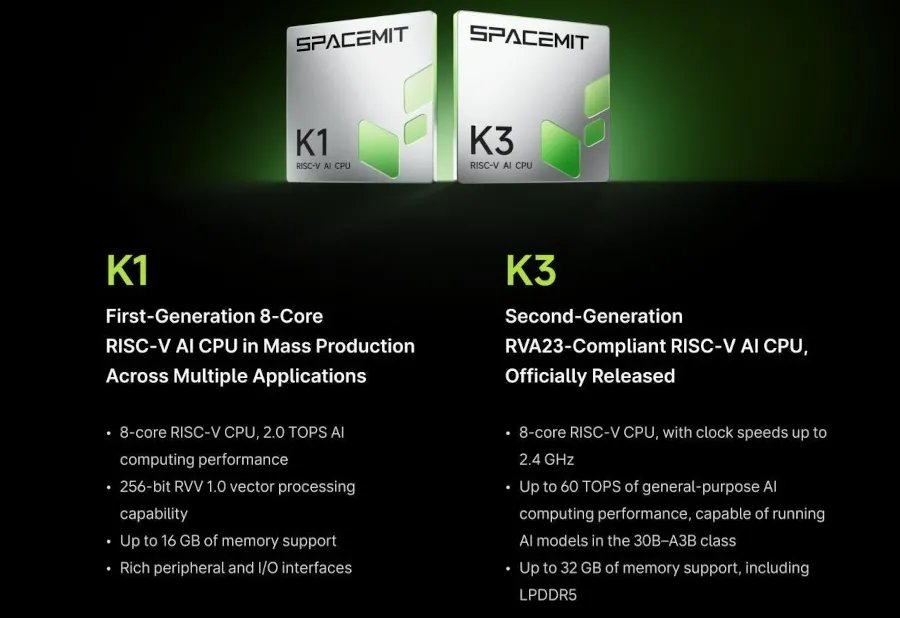
Performance Implications The K3's specifications suggest a substantial performance uplift over previous-generation RISC-V silicon:
| Specification | SpacemiT K3 | Typical Previous-Gen RISC-V (e.g., JH7110) |
|---|---|---|
| CPU Cores | 8 (RVA23-compliant) | 4-6 (RV64GC) |
| Max Clock Speed | 2.4 GHz | 1.5 GHz |
| Memory Support | Up to 32GB LPDDR5 | Up to 16GB LPDDR4 |
| AI Performance | 60 TOPS | Not Applicable |
| ISA Profile | RVA23 | RV64GC (Basic) |
The inclusion of the Vector (V) extension is particularly impactful, enabling hardware-accelerated SIMD operations critical for scientific computing, machine learning inference, and media processing. The 60 TOPS AI figure likely leverages this vector unit alongside fixed-function accelerators.
Build Compatibility Guidance For developers and homelab users, this announcement clarifies Ubuntu's RISC-V roadmap:
- Ubuntu 24.04 LTS: Remains the only option for non-RVA23 hardware like SpacemiT's earlier K1 SoC or SiFive boards. Canonical will support this release until April 2029.
- Ubuntu 25.10+: Requires RVA23 compliance. The K3 is currently the only announced production SoC meeting this requirement.
- Ubuntu 26.04 LTS (April 2026): Will fully support K3 hardware out-of-the-box, providing a stable platform for development.
SpacemiT has indicated plans to provide review hardware to press outlets. When available, expect comprehensive benchmarks on Phoronix comparing the K3's real-world Linux performance against ARM and x86 alternatives in workloads like compilation, database operations, and AI inference. For developers eager to experiment, Ubuntu's RISC-V port supports cross-compilation for the K3 today. Hardware availability timelines remain unconfirmed, but interested parties should monitor SpacemiT's official channels for board announcements.
The K3's arrival validates Ubuntu's RVA23 strategy and signals RISC-V's maturation into application-ready territory. With LTS support and modern architectural features, it offers a viable path for developers targeting RISC-V in AI/edge deployments.
Comments
Please log in or register to join the discussion