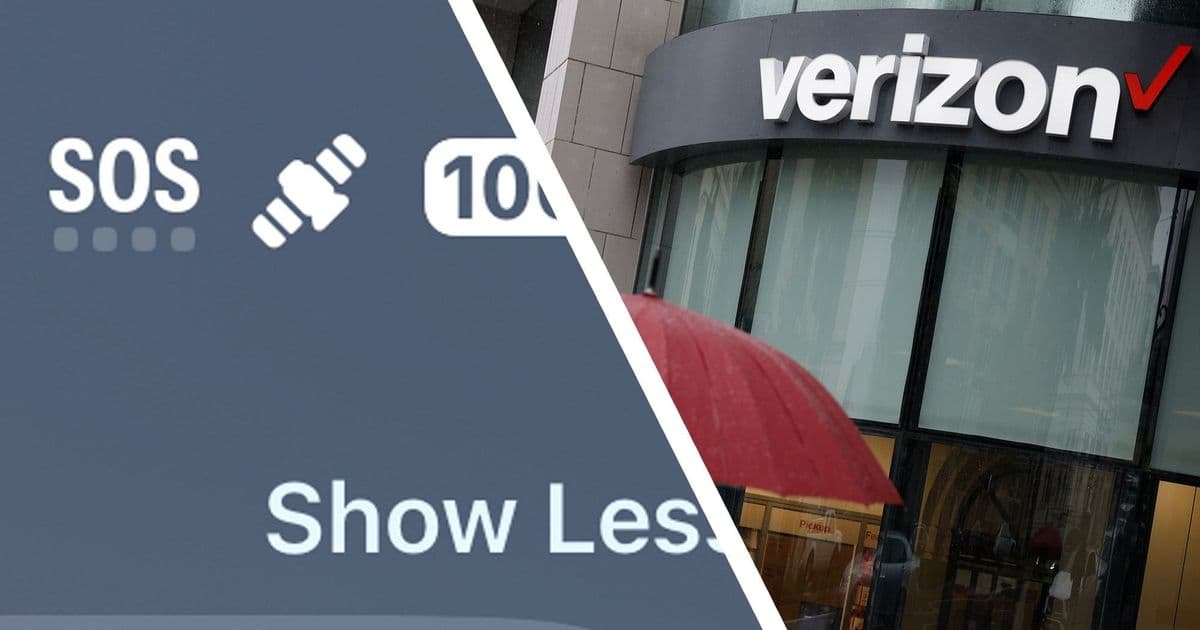
The January 14-15, 2026 Verizon outage that left millions without service for nearly a full day reveals deeper systemic vulnerabilities in carrier networks and highlights the growing disconnect between consumer expectations and infrastructure realities.
The outage began around 12:30 PM ET on January 14, 2026, with reports flooding social media and Down Detector as customers across the United States found their phones displaying "SOS" instead of network bars. What started as isolated complaints quickly escalated into a nationwide crisis, peaking at over 180,000 reported incidents. For nearly 10 hours, Verizon customers lost access to voice calls, text messages, and mobile data—a complete severance from the digital world that many rely on for work, emergencies, and daily life.
The technical manifestation was stark: iPhones showed SOS indicators, Android devices displayed "no service," and even basic emergency connectivity became unreliable. New York City's emergency notification system explicitly warned that the outage could affect 911 calls, advising citizens to use landlines, other carriers, or visit police stations directly. This wasn't merely an inconvenience; it represented a critical failure of a utility that has become as essential as electricity or water for modern life.
Verizon's response timeline reveals a familiar pattern of corporate crisis management. Initial acknowledgment came shortly after 1 PM ET, followed by a four-hour silence. At 9 PM ET—nearly eight hours into the outage—the company issued its most substantive statement: "Today, we let many of our customers down and for that, we are truly sorry. They expect more from us. We are working non-stop and making progress. Our teams will continue to work through the night until service is restored for all impacted customers. We will make this right - for any customer affected, we will provide account credits and share updates soon."
The promise of credits, while necessary, underscores a troubling normalization of failure. As Carolina Milanesi, President and Principal Analyst at Creative Strategies, Inc., observed: "Sadly, we are getting accustomed to outages, whether they are network Verizon today, ATT in 2024, AWS at the end of 2025, and I fear this is the new reality as cyber attacks increase and reliance on major cloud and AI providers increases." Her comment points to a broader industry trend where large-scale infrastructure failures have become increasingly common, yet systemic solutions remain elusive.
What makes this outage particularly significant is its timing and scale. This was Verizon's first major outage since October 2024, suggesting either improved reliability or simply a longer period between catastrophic failures. The 10-hour duration places it among the most prolonged carrier outages in recent memory, rivaling AT&T's February 2024 outage that lasted approximately 12 hours. Both incidents share similar characteristics: widespread geographic impact, initial communication delays, and eventual restoration through what appears to be manual intervention rather than automated failover systems.
The recovery process itself was telling. Service didn't return uniformly; it trickled back in patches. Some customers saw brief flashes of connectivity—5G bars appearing for a minute before disappearing again. Others experienced partial restoration where data worked but voice didn't, or vice versa. This staggered recovery suggests that Verizon's network architecture lacks robust redundancy at the core level, forcing engineers to manually rebuild routing paths and re-establish connections across thousands of cell towers.
Competing carriers seized the opportunity to highlight their own stability. T-Mobile posted on X (formerly Twitter): "T-Mobile’s network is keeping our customers connected, and we’ve confirmed that our network is operating normally and as expected. However due to Verizon’s reported outage, our customers may not be able to reach someone with Verizon service at this time." AT&T took a more sarcastic approach: "Our network? Solid. If you’re experiencing issues, it’s not us.....it’s the other guys." While marketing opportunism is expected, these responses also reveal the fragmented nature of carrier interoperability—when one network fails, cross-carrier communication breaks down, amplifying the isolation of affected customers.
The outage exposed critical vulnerabilities in modern communication infrastructure. First, the reliance on single-carrier networks creates single points of failure. Second, the lack of seamless failover to satellite or alternative networks for non-emergency use leaves customers completely disconnected. Third, the communication gap between carriers and customers during crises remains stubbornly wide, with updates coming sporadically and often after significant delays.
There's also the question of root cause, which Verizon has yet to disclose. Industry speculation ranges from software configuration errors to hardware failures, cyberattacks, or even maintenance-related issues. The absence of transparency is concerning, particularly for a critical infrastructure provider. Without understanding what went wrong, customers and regulators cannot assess whether the failure was preventable or part of a larger pattern of underinvestment in network resilience.
The human impact extended beyond missed calls and texts. Live sporting events, like the New Jersey Devils game, had to advise fans to save tickets to digital wallets in advance, anticipating connectivity issues. Krispy Kreme offered free donuts as a "sweet backup plan"—a lighthearted gesture that nonetheless highlights how deeply network failures disrupt daily commerce and social life. One anonymous commenter on Down Detector captured the paradox: "Today we learned to disconnect and appreciate and some of us even met some pretty cool people." It's a poignant reminder that while digital connectivity is essential, its absence can force unexpected human connection.
For developers and tech professionals, this outage serves as a stark reminder of infrastructure dependencies. Modern applications—whether mobile apps, cloud services, or IoT devices—assume constant connectivity. When that foundation crumbles, even well-designed systems fail. The incident should prompt questions about fallback strategies, offline functionality, and multi-carrier redundancy for critical services.
Verizon's eventual restoration at 10:24 PM ET on January 15, 2026, brought relief but not resolution. The company promised account credits and a deeper investigation, but the pattern is clear: large carriers continue to prioritize rapid recovery over transparent root-cause analysis and systemic improvement. As Milanesi noted, we're becoming "accustomed to outages," which may be the most troubling outcome of all. When failures become normalized, the incentive to invest in truly resilient infrastructure diminishes, leaving consumers vulnerable to the next inevitable collapse.
The Verizon outage of January 2026 will likely fade from headlines within days, but its lessons should persist. In an era where digital connectivity is synonymous with economic participation, social connection, and even personal safety, network reliability cannot be treated as a luxury. It is a utility, and utilities require rigorous standards, transparent accountability, and continuous investment in resilience. Until the industry treats connectivity with the seriousness it deserves, we're all just one outage away from being disconnected from the modern world.
Comments
Please log in or register to join the discussion