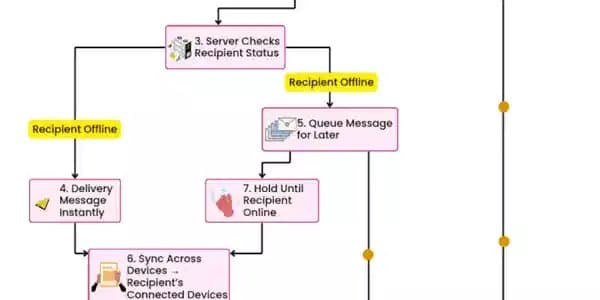
A deep dive into WhatsApp's real-time messaging system, revealing how encryption, server architecture, and delivery mechanisms work together to create the seamless experience users take for granted.
When you tap "Send" on WhatsApp, you're triggering one of the most sophisticated distributed systems in the world. What feels like a simple instant message is actually a carefully orchestrated dance of encryption, server communication, and delivery mechanisms working in perfect harmony. Let's pull back the curtain on this real-time messaging marvel.
The Encryption First Approach
Unlike many messaging systems that encrypt data in transit, WhatsApp pioneered end-to-end encryption (E2EE) where the magic happens before your message ever leaves your device. The moment your finger touches "Send," WhatsApp's Signal Protocol springs into action.
Your message is encrypted locally using the recipient's public key. This means the plaintext never exists outside your device. Even if someone intercepted the network traffic or compromised WhatsApp's servers, they'd only see encrypted gibberish. The encryption keys never touch WhatsApp's servers—they exist only on the sender's and recipient's devices.
This design choice represents a fundamental trade-off: WhatsApp sacrifices the ability to provide certain features (like message search or AI-powered suggestions) in exchange for absolute privacy. It's a deliberate architectural decision that prioritizes user security over convenience.
The Server's Role: Orchestrator, Not Reader
Once encrypted, your message travels to the nearest WhatsApp server cluster. These servers act as sophisticated traffic controllers rather than message readers. They handle routing, delivery status tracking, and device synchronization—but crucially, they cannot decrypt your message content.
The server architecture employs a global network of data centers strategically positioned to minimize latency. When you send a message, it's routed to the closest data center, which then coordinates with other centers if the recipient is in a different region.
This distributed approach enables WhatsApp to maintain sub-second delivery times even across continents. The system uses a combination of load balancers, message queues, and connection pools to handle billions of messages daily without breaking a sweat.
The Online/Offline Intelligence
WhatsApp's servers perform real-time presence detection to determine the recipient's status. This isn't just a simple online/offline flag—the system tracks:
- Active sessions across all linked devices
- Network connectivity quality
- Device battery status (to optimize delivery timing)
- User-defined "last seen" preferences
The server's decision tree is remarkably sophisticated. If the recipient is online on multiple devices, WhatsApp employs a conflict resolution strategy to ensure message consistency. If they're offline, the message enters a persistent queue with exponential backoff retry logic.
The Delivery Queue: Where Messages Wait Patiently
When recipients are offline, WhatsApp doesn't just store messages in a simple database. The system uses a distributed message queue with built-in persistence and retry mechanisms. Each message is stored with:
- Multiple encryption layers
- Delivery attempt tracking
- Time-to-live metadata
- Priority flags based on message type
The queue system is designed for eventual consistency—messages will be delivered when the recipient reconnects, regardless of how long they've been offline. This is why you might see messages from days ago suddenly appear when someone gets back online.
The Multi-Device Synchronization Challenge
One of WhatsApp's most impressive architectural feats is its multi-device synchronization. When you link multiple devices to your account, WhatsApp maintains independent encryption keys for each device while ensuring message consistency across all of them.
This creates a complex state management problem. The server must track which devices have received which messages, handle device-specific message deletions, and manage the read receipt propagation across all linked devices. The system uses a combination of vector clocks and version vectors to maintain causality and prevent message duplication or loss.
Read Receipts: The Final Acknowledgment
When a recipient reads your message, their device sends a read receipt back through the same encrypted channel. This acknowledgment triggers a cascade of updates:
- The sender's device updates the message status to "read"
- All linked devices sync this status change
- The server updates delivery statistics
- The UI animates the blue ticks
This entire round-trip happens in milliseconds, creating the seamless experience users expect. The system is designed to handle network partitions gracefully—if a read receipt gets lost, the sender's device will eventually sync the correct status when connectivity is restored.
The Performance Optimization Layer
Behind the scenes, WhatsApp employs aggressive performance optimizations:
- Connection pooling: Devices maintain persistent connections to reduce handshake overhead
- Message compression: Text messages are compressed before encryption to reduce bandwidth
- Adaptive bitrate: For media messages, the system adjusts quality based on network conditions
- Edge caching: Frequently accessed data is cached closer to users
These optimizations allow WhatsApp to deliver billions of messages daily while consuming minimal bandwidth and battery power on user devices.
The Reliability Engineering
WhatsApp's reliability comes from its distributed architecture and fault-tolerant design. The system employs:
- Geographic redundancy: Multiple data centers in each region
- Automatic failover: If one server fails, traffic routes to healthy nodes
- Circuit breakers: Prevent cascading failures during outages
- Graceful degradation: Non-critical features disable before core messaging fails
This engineering excellence is why WhatsApp maintains 99.9% uptime even during peak usage periods like New Year's Eve or major global events.
The Architecture at Scale
The true marvel of WhatsApp's architecture is how it scales. The system handles over 100 billion messages daily with a team of fewer than 50 engineers. This efficiency comes from:
- Stateless service design: Most services don't maintain session state
- Event-driven architecture: Components communicate via message queues
- Microservices decomposition: Each feature runs as an independent service
- Automated deployment: Continuous integration and deployment pipelines
This architectural approach allows WhatsApp to iterate quickly while maintaining the reliability users depend on.
The Trade-offs Made
Every architectural decision involves trade-offs. WhatsApp chose:
- Privacy over features: E2EE means no message search or AI suggestions
- Simplicity over flexibility: The protocol is optimized for messaging, not extensibility
- Reliability over real-time: Messages are eventually consistent rather than strictly ordered
- Centralization over decentralization: All routing goes through WhatsApp servers
These choices reflect WhatsApp's core mission: to provide a simple, reliable, and private messaging experience for everyone.
The Future of Messaging Architecture
WhatsApp's architecture continues to evolve. Recent developments include:
- Multi-device support without phone dependency: Each device maintains its own identity
- Message editing: Allowing users to correct typos within a time window
- View-once media: Messages that disappear after being viewed
- Community features: Group management at scale
Each new feature requires careful architectural consideration to maintain the system's core principles of privacy, reliability, and simplicity.
The next time you tap "Send" on WhatsApp, remember: you're not just sending a message. You're triggering a masterpiece of distributed systems engineering that spans continents, encrypts your words into unbreakable code, and delivers them to your recipient in the blink of an eye. That's the real magic behind those two little ticks.
Comments
Please log in or register to join the discussion