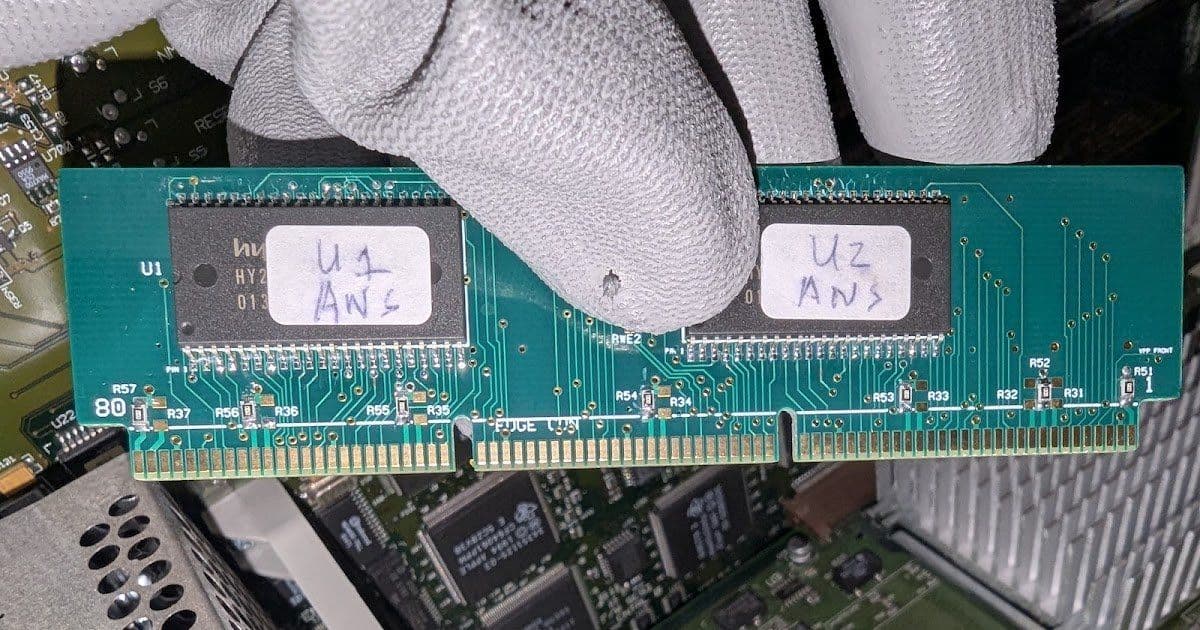
A comprehensive analysis of the unreleased Apple Network Server 2.0 ROMs that enable MacOS booting on Apple's first Unix server, comparing performance and functionality against earlier preproduction ROMs.
The Apple Network Server represents a fascinating chapter in Apple's computing history—a through-and-through Unix server that ultimately never fulfilled its potential. In this installment of our ongoing research into the ANS, we examine the mysterious 2.0 ROMs designed to enable MacOS booting, comparing them against the earlier preproduction versions to understand their functionality, performance, and place in computing history.
Historical Context: The Apple Network Server
The Apple Network Server, launched in 1996, was Apple's first serious foray into the server market, powered by IBM's PowerPC processors and running AIX, IBM's proprietary Unix variant. What makes the ANS particularly intriguing is that it was originally intended to run Novell NetWare and was even demonstrated booting Mac OS with early pre-production ROMs. However, the system's fate changed dramatically when then-CTO Ellen Hancock announced late in its lifecycle that the ANS would be able to boot both Mac OS and Windows NT through ROM upgrades.
Neither of these ROMs was officially released before Steve Jobs convinced Gil Amelio to cancel the entire line. For years, they existed only in rumor, considered vaporware. Yet recently, these ROMs have begun surfacing—first with an ex-Apple employee who possessed both the preproduction Mac OS ROM and the NT ROM on a flash ROM SIMM, and later with another employee who turned up the NT ROM (though more is needed to actually make Windows NT run). The author of this article also discovered they had the preproduction ROM gathering dust in a storage box, setting the stage for this comprehensive testing.
The Unique Architecture of the ANS
What makes the ANS particularly interesting is its hardware, which differs significantly from contemporary Power Macintosh systems:
- Two Symbios Logic 53C825A SCSI-2 Fast and Wide controllers (20MB/s) for internal SCSI bays
- On-board Cirrus Logic 54M30 graphics used in no other Apple product
- Front-mounted LCD display for system status
- Standard HDI-15 video connector (unusual for Apple systems of this era)
These hardware differences present significant challenges for running Mac OS, which never officially supported these components. The preproduction ROMs, while functional, don't contain built-in drivers for this unique hardware, requiring users to work around these limitations.
Testing the 2.0 ROMs: Initial Impressions
Thanks to Jeff Walther, who generously built replica ROM SIMMs for testing, the author was able to evaluate the 2.0 ROMs on their Apple Network Server 700 test rig (named "holmstock"). The testing setup involved removing all external hardware to evaluate the 2.0 ROMs on their own merits.
Several immediate observations emerged:
- The front-mounted LCD display remains completely blank during boot, unlike with AIX or NetBSD which directly support it and display diagnostic information.
- The ROM boots much faster than production ROMs, skipping the extensive Long RAM test.
- The boot sound is truncated compared to regular Mac ROMs.
- The Happy Mac icon appears in color due to the inclusion of Open Firmware 2.0.
The Open Firmware implementation in the 2.0 ROMs includes an "io" word to redirect output, allowing serial console access via the command "ttya io" at 38400bps by default. This represents a significant improvement over earlier firmware implementations.
Device Tree Analysis and Hardware Support
Examining the device tree revealed some interesting differences between the 2.0 ROMs and earlier versions. The 2.0 ROMs include proper device nodes for the Cirrus Logic 54M30 graphics and the Symbios Logic 53C825A SCSI controllers, indicating that Apple had developed drivers for these components.
However, several inconsistencies suggest these ROMs may not have been fully completed:
- The device alias for internal SCSI doesn't actually exist
- The AIX loader package doesn't function properly
- The RAM is never marked as parity, even though parity memory is installed
- The processor speed is incorrectly reported
These issues hint at unfinished development work, which would explain the poor performance observed during testing.
Performance Comparison: 2.0 ROMs vs. Preproduction ROMs
The most striking difference between the 2.0 ROMs and the preproduction 1.1.20 ROMs is performance. Using MacBench 5.0 for comparison, the results were dramatic:
- CPU performance with the 2.0 ROMs was only 35% of the reference G3, compared to 75% with the preproduction ROMs
- FPU performance was 47% with the 2.0 ROMs versus 94% with the preproduction versions
- Graphics performance at millions of colors was 33% with the 2.0 ROMs versus 65% with the preproduction ROMs
- Disk performance was particularly telling: the 2.0 ROMs achieved only 60% of the G3 reference despite using a faster interface, while the preproduction ROMs achieved 89% despite using a slower interface
The performance gap can be largely attributed to the 2.0 ROMs' failure to properly support the L2 cache. Even though the hardware includes 1MB of L2 cache, the 2.0 ROMs don't recognize it, resulting in dramatically reduced performance.
Hardware Compatibility and Limitations
Several hardware compatibility issues emerged during testing:
Color Depth Limitation: Despite having sufficient VRAM, the Cirrus Logic 54M30 is limited to 8-bit color depth (256 colors) in Mac OS. The Network Server Hardware Developer's Notes explain that "This controller implements only a little-endian window into the packed-pixel frame buffer, hence Big Endian operating systems are limited to 8 bits per pixel unless low-level transformation routines are written."
Ethernet Inconsistency: The on-board MACE Ethernet worked inconsistently between ROM versions, sometimes requiring an external 10Mbit Tulip Ethernet card.
RAM Parity Detection: The 2.0 ROMs fail to properly detect parity RAM, even though the hardware supports it. This is significant because on production ROMs, the system would automatically adjust RAM timing to 70ns instead of 60ns if non-parity memory was detected.
Attempting Alternative Operating Systems
The author also explored running alternative operating systems on the ANS, specifically Rhapsody (pre-Mac OS X NeXTSTEP ported to PowerPC) and various versions of Mac OS X.
Rhapsody Testing
With Rhapsody 5.6, the 2.0 ROMs showed more promise than the preproduction ROMs. The system successfully began loading drivers, but ultimately crashed with a kernel panic related to "waitForInterrupt." This suggests that Rhapsody might work with a kernel patch to address the different interrupt setup on the ANS compared to the Power Macintosh 9500.
Mac OS X Testing
Attempts to boot Mac OS X 10.0.3 and 10.2 CDs resulted in a Happy Mac icon followed by system lockup, indicating that these versions aren't compatible with the ANS hardware or firmware.
Conclusion: The Preproduction ROMs Remain Superior
After comprehensive testing, the conclusion is clear: for running Mac OS on the Apple Network Server, the preproduction 1.1.20 ROMs are superior to the 2.0 ROMs. While the 2.0 ROMs offer the convenience of built-in hardware support and more reliable reboots, the performance penalty is too significant to justify their use.
The 2.0 ROMs appear to be unfinished work, with fundamental issues like L2 cache support never resolved. They might have value for specific use cases—such as users wanting the biggest, baddest AppleShare server with multiple SCSI drives—but for general use, the preproduction ROMs provide dramatically better performance.
The author plans to continue investigating these ROMs, attempting to patch Rhapsody to work on the 2.0 ROMs and working on a patched version of Mac OS to fix the reboot problems in the 1.1.20 ROMs. This research represents an important contribution to preserving computing history and understanding the evolution of Apple's server systems.
For those interested in exploring this hardware further, the author has made their testing methodology available, and replica ROM SIMMs can be obtained from Jeff Walther. The Apple Network Server remains a fascinating piece of computing history—Unix-powered, PowerPC-based, and ultimately ahead of its time in many ways, yet ultimately cancelled before reaching its full potential.
Comments
Please log in or register to join the discussion