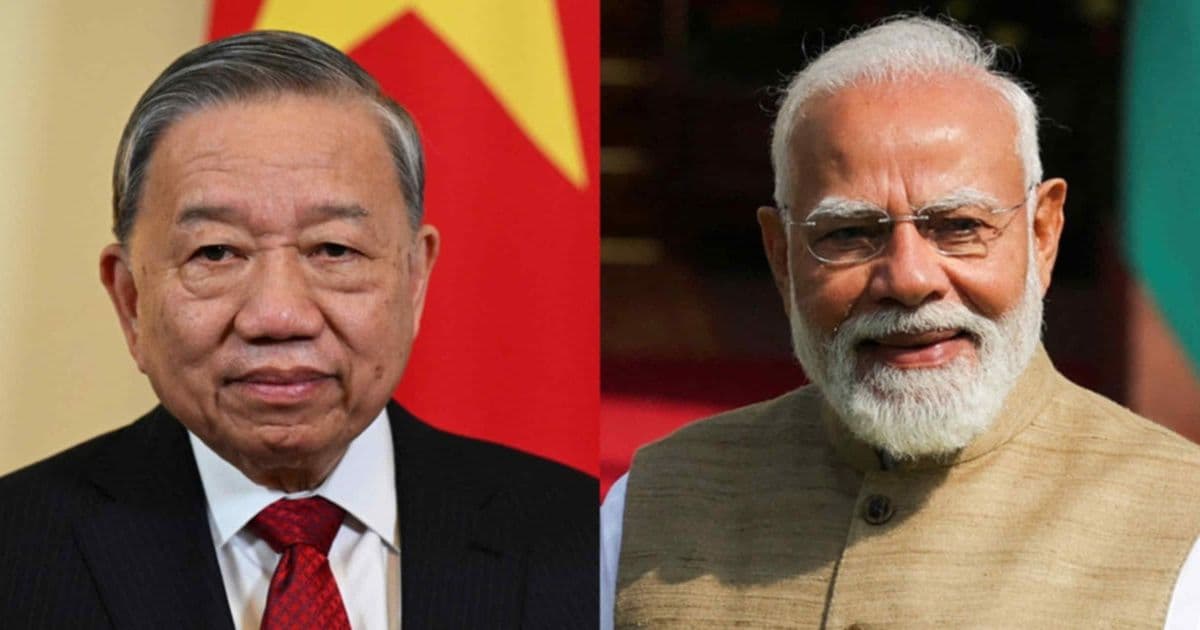
As Vietnamese President To Lam meets with Indian Prime Minister Narendra Modi to strengthen bilateral ties, ASEAN nations grapple with energy security and territorial disputes while Sony outlines its strategy amid global supply chain challenges.
In a week that underscores Asia's complex geopolitical and economic landscape, Vietnamese President To Lam's state visit to India marks a significant deepening of strategic partnership between two key Indo-Pacific nations. The three-day visit, following To Lam's recent meeting with Japanese Prime Minister Sanae Takaichi, demonstrates Vietnam's proactive diplomatic engagement across multiple regional powers.
Vietnam-India Strategic Partnership
The upcoming meeting between To Lam and Modi carries substantial economic weight. Bilateral trade between India and Vietnam reached $15.2 billion in 2025, representing a 23% increase from the previous year, according to India's Ministry of Commerce. This growth trajectory positions Vietnam as one of India's top trading partners in Southeast Asia.
"The engagement between leaders is expected to provide fresh momentum to the robust bilateral relations and open new avenues for cooperation between India and Vietnam," stated an Indian government official ahead of the visit. Key areas expected to feature prominently include defense cooperation, digital technology partnerships, and infrastructure development.
India's strategic importance to Vietnam has grown significantly in recent years, particularly in the context of regional security dynamics. Vietnam has emerged as India's second-largest defense partner in Southeast Asia, with defense trade reaching approximately $1.2 billion since 2020. The strategic partnership also encompasses maritime security cooperation in the Indo-Pacific region, where both nations share concerns about freedom of navigation.
ASEAN Ministerial Meeting: Navigating Regional Challenges
Simultaneously, the Philippines hosts the ASEAN ministerial meeting in Cebu, marking the beginning of this year's ASEAN Summit under the Philippine chairmanship. The summit faces pressing challenges that could reshape regional dynamics.
Energy security tops the agenda as ASEAN nations confront the ongoing Middle East conflict's impact on oil markets. The region's oil import dependency exceeds 90%, with approximately 65% of those imports passing through the Strait of Hormuz. Recent disruptions have already increased shipping costs by an estimated 35%, according to the ASEAN Centre for Energy.
The South China Sea dispute remains another critical focus. ASEAN nations are working toward finalizing a Code of Conduct (COC) to manage territorial claims, though progress has been slow. China's increased military presence in the region, including the deployment of coast guard vessels and fishing militia, has heightened tensions. The Philippines has reported over 200 incidents of Chinese maritime assertiveness in 2025 alone, compared to 156 in the previous year.
Internal challenges further complicate ASEAN's unity. The bloc continues to grapple with the situation in Myanmar following its controversial general election, while the territorial dispute between Thailand and Cambodia over the Preah Vihear temple area remains unresolved. These internal tensions have occasionally hampered ASEAN's ability to present a unified position on external issues.
Sony's Corporate Strategy Amid Market Volatility
In the corporate sector, Sony Group prepares to present its latest business strategy and full-year earnings for the fiscal year ended March 2026. Investors are particularly focused on how the company is navigating the global memory chip shortage that has impacted production of its PlayStation 5 console.
The PlayStation 5, launched in 2020, has faced persistent supply constraints that have limited Sony's ability to capitalize on the growing gaming market. Despite these challenges, the console has sold over 50 million units worldwide as of March 2026, maintaining Sony's position as a market leader. However, the chip shortage has reportedly cost the company an estimated $2 billion in potential revenue since 2021.
Sony's strategy announcement will likely outline how the company is diversifying its supply chain and investing in semiconductor technologies to reduce dependency on external suppliers. The company has allocated approximately ¥500 billion ($3.3 billion) to semiconductor development over the next three years, including partnerships with foundries in Japan and overseas.
Beyond gaming, Sony is expected to emphasize its strategic focus on imaging sensors, which account for approximately 40% of the company's operating profit. The sensors division has benefited from growing demand in automotive applications, with automotive sensor revenue increasing by 65% year-over-year in the latest quarter.
Regional Defense Dynamics
In Istanbul, the biennial SAHA 2026 International Defense & Aerospace Exhibition brings together global defense industry players, with significant representation from Asian nations. The exhibition features 39% Asian companies, reflecting the growing importance of the Asian defense sector.
Notably, Japan, Vietnam, Taiwan, Thailand, South Korea, and Australia are participating for the first time, either through companies or official delegations. This increased participation underscores Asia's expanding role in the global defense market. China's company participation has also increased compared to the 2024 event, despite ongoing geopolitical tensions.
The defense exhibition occurs amid a period of significant military modernization across Asia. Regional defense spending reached $532 billion in 2025, a 7.3% increase from the previous year, according to the Stockholm International Peace Research Institute. This growth reflects heightened security concerns and strategic competition in the Indo-Pacific region.
Economic Indicators and Market Performance
Several key economic indicators will be released during this period, providing insights into Asia's economic trajectory. China's April trade data, scheduled for release one week before a planned visit by U.S. President Donald Trump to Beijing, will be closely watched for signs of export performance amid global uncertainty.
Export growth, a critical economic engine for China, slowed sharply in March as the conflict in Iran weighed on global demand. March exports increased by just 2.1% year-over-year, significantly down from February's 8.7% growth. This deceleration has raised concerns about China's economic recovery and its ability to maintain growth targets.
Meanwhile, Grab's upcoming earnings announcement will scrutinize the Singapore-based ride-hailing platform's approach to balancing profitability and market share. After posting its first full-year net profit in 2025, investors are looking for evidence of sustainable business model. The company's recent implementation of temporary ride surcharges amid higher fuel prices has drawn mixed reactions from users and investors alike.
In India, ballot counting for April elections in four states, including politically crucial West Bengal, will provide insights into the evolving political landscape. Most exit polls give an edge to Prime Minister Narendra Modi's Bharatiya Janata Party in West Bengal, a state it has never ruled before. A victory there would significantly strengthen the BJP's position and potentially reshape India's political dynamics.
As these events unfold, Asia continues to demonstrate its central role in global geopolitics and economics. The convergence of diplomatic engagements, regional cooperation efforts, and corporate strategy announcements highlights the continent's complex interconnections and its growing influence on the world stage.
Comments
Please log in or register to join the discussion