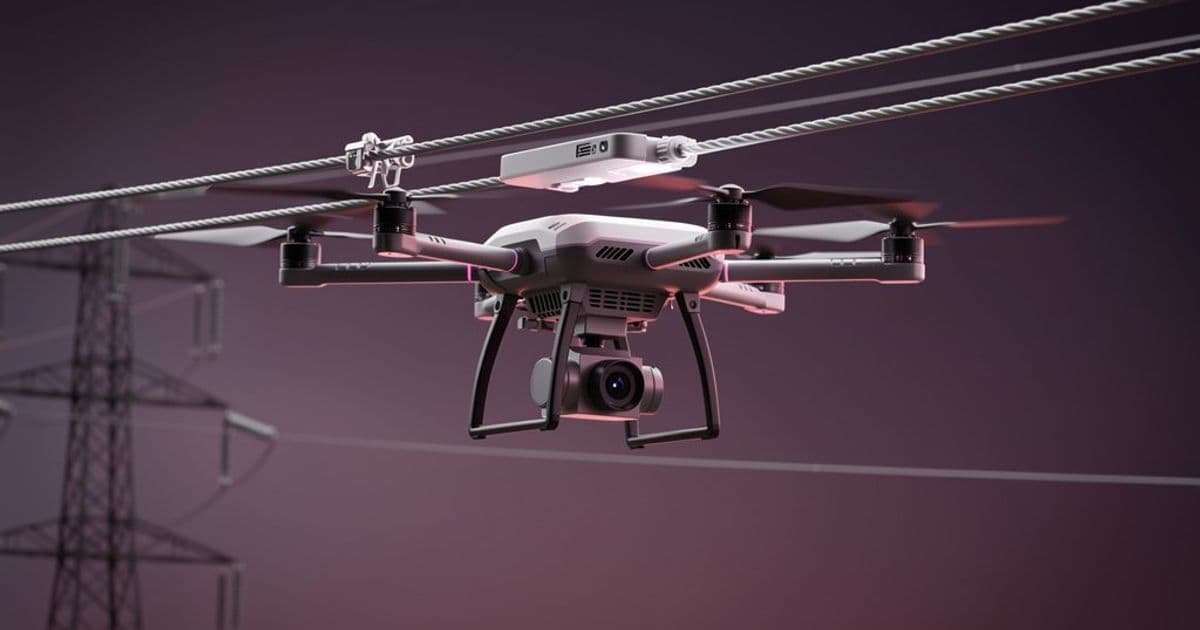
YC-backed Voltair develops drones that recharge from power lines, aiming to enable persistent aerial inspections for utilities and other industries.
The Eaton Fire of 2025, which destroyed nearly 10,000 structures and claimed 19 lives, exemplifies the catastrophic consequences of undetected power line failures. Voltair, a Y Combinator Winter 2026 startup, is developing autonomous drones that address this problem through a novel approach: using high-voltage power lines as charging stations. Their technology allows drones to physically attach to live wires mid-flight, eliminating the need for battery swaps and theoretically enabling unlimited operational range.
Current drone inspection operations face severe limitations due to battery constraints. Most commercial drones offer 20-40 minutes of flight time, requiring frequent returns to base for battery changes. This limitation caps daily coverage and necessitates human intervention, increasing costs and complexity. Voltair's core innovation lies in specialized hardware that enables safe perching and charging directly from energized power lines. According to the company, this approach could increase inspection coverage by 20x compared to traditional methods at equivalent costs.
The technology builds on founder Ronan Nopp's background in aerospace systems, including work with DARPA and the U.S. Air Force. Voltair's prototypes incorporate custom electromagnetic coupling systems that draw power without direct metal-to-metal contact, mitigating arc flash risks. The company claims to have validated charging functionality on actual power lines and conducted approximately 2,000 pole inspections using five prototype units since June.
Utilities represent Voltair's primary initial market, where drone inspections can identify corroded connectors, vegetation encroachment, and structural weaknesses before they cause outages. Beyond power infrastructure, the company plans to expand to rail, telecom, and real estate sectors. A secondary data product offering would provide analytics to insurance firms and energy traders.
Several significant challenges remain:
- Regulatory Hurdles: FAA regulations currently prohibit BVLOS (Beyond Visual Line of Sight) flights without waivers, and perching on critical infrastructure requires utility operator approvals.
- Environmental Factors: High winds, ice accumulation, and electromagnetic interference could disrupt charging operations.
- Scalability: The current prototype-to-production gap requires substantial engineering refinement for all-weather reliability.
- Competition: Established players like Skydio and Percepto offer inspection drones but rely on dock-based charging, limiting their range.
While Voltair's vision of an "infrastructure layer for the physical world" remains aspirational, their technical approach addresses a genuine pain point in industrial inspections. The team combines relevant expertise—CTO Hayden Gosch's power systems background from Schweitzer Engineering Labs complements Nopp's aerospace experience. As utilities face increasing wildfire liability pressures (California's AB 1054 mandates billions in safety investments), automated inspection solutions may find receptive customers. However, real-world deployment will require solving the intricate puzzle of safe, reliable, and regulatory-compliant operation on live power networks.
Comments
Please log in or register to join the discussion