Fraunhofer HHI's VVenC 1.14 release delivers significant ARM performance improvements, with benchmarks showing up to 35% faster 4K encoding on the NVIDIA GB10 SoC, demonstrating the growing maturity of ARM-based video processing.
The open-source VVenC H.266 encoder from Fraunhofer HHI has received another performance-focused update, with version 1.14 delivering substantial ARM-specific optimizations that yield impressive speedups on modern ARM processors. The release focuses heavily on ARM SIMD improvements, particularly around NEON and Scalable Vector Extensions (SVE), which are now enabled by default for capable ARM processors.
For testing, I used the Dell Pro Max GB10, which features NVIDIA's GB10 SoC with ten Arm Cortex-X925 and ten Arm Cortex-A725 cores. This particular SoC supports both SVE and SVE2, making it an ideal testbed for evaluating the new ARM optimizations. The Dell Pro Max GB10 review sample provided by Dell allowed for direct comparison between VVenC 1.13 and 1.14 using identical software stacks and compiler flags.
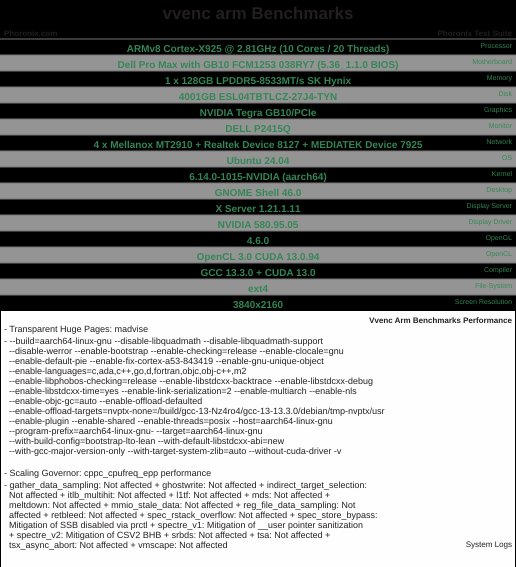
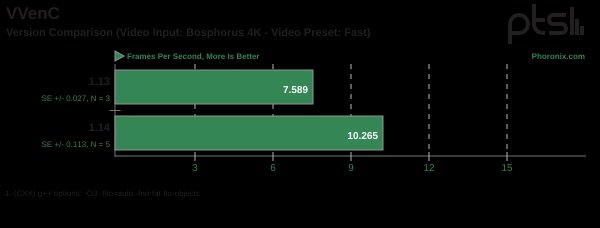
The benchmark results show dramatic improvements. For 4K content at the "fast" preset, VVenC 1.14 achieved approximately 35% higher performance compared to version 1.13. This is particularly noteworthy because VVenC 1.13 already included ARM optimizations - the gains in 1.14 represent an additional layer of performance tuning on top of existing ARM support.
Even with the "faster" preset (which is more demanding than "fast"), the new release still delivered around 7% better performance for 4K encoding. For 1080p content, VVenC 1.14 also showed measurable performance gains, though the percentage improvements were smaller due to the lower computational load of 1080p encoding.
The key optimizations in VVenC 1.14 center around ARM's SIMD capabilities. NEON optimizations have been expanded to better utilize the vector processing units in modern ARM cores, while SVE support has been enhanced and now enabled by default for processors that support it. SVE (Scalable Vector Extensions) is particularly important for ARM's server and high-performance computing roadmap, as it allows for variable-length vector operations that can adapt to different processor implementations.
The NVIDIA GB10's combination of Cortex-X925 (performance cores) and Cortex-A725 (efficiency cores) presents an interesting test case. The Cortex-X925 cores are designed for maximum single-threaded performance and would benefit most from the SIMD optimizations, while the Cortex-A725 cores handle background tasks and multi-threaded workloads. The 35% improvement suggests that the optimizations are effectively leveraging both core types.
For homelab builders and video processing enthusiasts, this release demonstrates the growing viability of ARM processors for video encoding workloads. The performance gains on the GB10 suggest that ARM-based systems could become competitive alternatives to x86 for video encoding tasks, particularly in power-constrained environments where ARM's efficiency advantages are most pronounced.
The open-source nature of VVenC means these optimizations are immediately available to the community. Developers can access the source code and build the encoder for their specific ARM hardware. The Fraunhofer HHI team has been consistently working to improve ARM performance, and this release represents another step toward making H.266 encoding practical on ARM platforms.
For those interested in trying the encoder, VVenC is available on GitHub. The project includes build instructions and documentation for various platforms. The ARM optimizations are particularly relevant for users running ARM-based servers, development boards, or Apple Silicon Macs, where video encoding performance has been improving steadily.
Future benchmarking will likely compare these ARM results against x86_64 processors to provide a complete picture of VVenC's cross-platform performance. For now, the data shows that ARM processors are becoming increasingly capable for video encoding workloads, with each VVenC release bringing them closer to parity with traditional x86 systems.
The broader implication is that the ARM ecosystem for multimedia processing is maturing rapidly. As more developers optimize their software for ARM's SIMD extensions, we can expect to see continued performance improvements across the board. For homelab builders considering ARM-based systems for video encoding or media servers, VVenC 1.14 provides compelling evidence that ARM is ready for serious video processing workloads.
Comments
Please log in or register to join the discussion