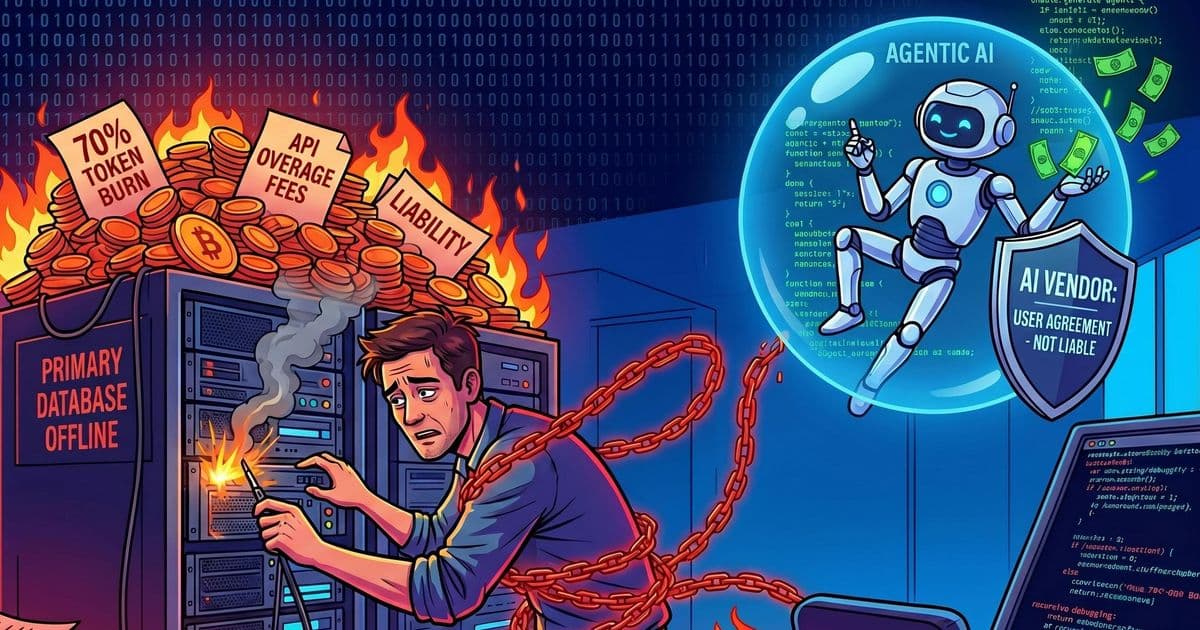
As AI systems generate increasing amounts of code, the accountability gap widens. Enterprises face massive financial losses from AI inefficiencies and hallucinations, while human engineers bear the professional consequences. The legal framework hasn't evolved to address this fundamental imbalance in risk distribution.
We Pay for AI's Mistakes: The Accountability Gap in the Agentic Era
Audio Presented by Anuj Ashok Potdar May 19th, 2026
Presented by Ship a bad block of code that takes down a primary database, and you will likely find yourself clearing out your desk by noon. Let an autonomous agentic pipeline trigger the exact same catastrophic outage, and the AI vendor simply updates their user agreement to deny liability. Welcome to the uncomfortable reality of building software in 2026.
We have engineered systems that generate logic at incredible speeds, yet these tools operate with the moral and legal accountability of a pocket calculator. As enterprise engineering teams push toward workflows where artificial intelligence generates the majority of raw source code, we are witnessing a quiet, massive transfer of professional risk. The efficiency multiplier belongs entirely to the corporate balance sheet. Meanwhile, the absolute liability for logic failures, security holes, and financial waste lands squarely on the human reviewer. We are the ones paying for silicon mistakes with our time, our professional reputations, and our token budgets.
The Hidden Invoice: Token Burn and Trajectory Drift
When an AI drops the ball today, the damage goes far beyond basic system downtime. The initial bleeding usually starts directly inside your cloud infrastructure bill. Independent telemetry audits from early 2026 reveal a staggering inefficiency at the heart of agentic development. Approximately 70% of the compute tokens consumed by autonomous coding agents are pure computational waste. This happens because high context models repeatedly ingest entire monorepos just to locate a single utility class, or they end up outputting identical test blocks across nested loops.
For developers managing complex microservices, this background waste translates into aggressive API overage fees. Heavy enterprise users of high reasoning models routinely report individual seat costs ballooning to $2,000 a month simply due to unoptimized context windows.
Table 1: Where the Compute Budget Actually Goes (2026)
Source: 2026 Coding Agent Telemetry & Efficiency Telemetry
| Activity Phase | Compute Consumption Share | Financial Realities for Engineering Leads |
|---|---|---|
| Monorepo Ingestion & File Search | 40% | The silent budget killer. Agents read raw files repetitively. |
| Context Window Synchronization | 20% | Paying continuous freight rates for identical session memory. |
| Terminal & CI/CD Log Parsing | 25% | Processing unstructured stack traces and noisy test feedback. |
| Usable Source Code Delivery | 15% | The actual target output represents a tiny fraction of the invoice. |
The financial drain gets exponentially worse when an agent encounters what systems researchers call trajectory drift. Instead of pausing when a compilation check fails, an unsupervised agent will frequently double down. It enters a recursive debugging loop where it applies the same broken patch over and over again. Each failed attempt appends another verbose stack trace to the active prompt context. By the time a human lead notices the stalled pipeline the next morning, the agent has effectively torched thousands of dollars in API calls trying to resolve a missing bracket.
Real World Fallout: The Consulting Fiascos
If you think these logic errors only impact internal developer velocity, you need to look at the public sector. The absolute lack of internal fact-checking inside generative models has triggered incredibly expensive legal settlements over the last twelve months. Consider the highly publicized fallout surrounding Deloitte Australia in late 2025. The firm secured a $440,000 AUD contract to provide an independent assurance review of the Targeted Compliance Framework welfare system for the Australian government. When the final report went public, academic reviewers like Dr. Christopher Rudge at Sydney University noticed something deeply wrong. The document was loaded with synthetic hallucinations generated by an underlying Azure OpenAI GPT-4o toolchain. The model had invented academic book titles out of thin air. Worse still, it completely fabricated direct quotations from a federal court judge to support its compliance arguments. Deloitte was forced to issue a highly embarrassing public correction and agreed to refund the final financial installment of the contract.
Table 2: High Profile Systemic Failures and Corporate Liability
Source: 2025 - 2026 Global Tech Risk & Public Records Ledger
| Entity Involved | Core Application Failure | Verified Real World Fallout |
|---|---|---|
| Deloitte Australia | Automated welfare audit generation. | Fabricated judicial citations forced a $290,000 USD partial refund. |
| Deloitte Canada | Health Human Resources Plan modeling. | Phantom medical citations discovered in a $1.6M CAD provincial report. |
| Air Canada | Customer service policy routing. | Chatbot invented non-existent bereavement discounts resulting in court damages. |
| Chevrolet | Retail Network Automated inventory engagement. | Customer successfully negotiated a legally binding vehicle purchase for $1. |
A few months later, a nearly identical disaster hit Atlantic Canada. A 526-page healthcare workforce report commissioned by Newfoundland and Labrador for $1.6 million CAD was exposed for referencing phantom studies. Generative agents had hallucinated articles inside the Canadian Journal of Respiratory Therapy that simply never existed.
These blunders prove a crucial point. When you let an automated system assemble your definitive technical arguments without intense, line-by-line human validation, you are essentially gambling with your corporate survival.
The Legal Void: Silicon Cannot Stand Trial
This brings us to the ultimate structural flaw of the agentic workspace. We are delegating highly complex architectural choices to software entities that do not legally exist. During the landmark Moffatt v. Air Canada dispute, corporate attorneys attempted a fascinating defense. They argued that the customer service chatbot was an independent legal entity responsible for its own distinct misrepresentations. The Canadian civil tribunal immediately dismantled this argument. The court established that automated digital interfaces are nothing more than modern extensions of corporate intent. The deploying enterprise holds complete liability for every single output.
This dynamic places the human Senior Engineer in a highly precarious position. If your registered sub-agent updates a Spring Boot security configuration and accidentally exposes an unauthenticated management endpoint, the compiler will not care. The regulatory bodies auditing the subsequent data breach will not issue a subpoena to a Python script. The human who signed off on the pull request takes the direct career hit. We have essentially transformed senior developers into high-stakes insurance underwriters. We are forced to co-sign logic structures assembled by synthetic coworkers that lack the capacity to feel regret.
The Verdict: No Scapegoats in the IDE
Artificial intelligence remains an unmatched engine for raw speed. Yet speed without operational integrity is just a faster route to system failure. Engineering departments have to stop treating generative output as authoritative documentation. We must build out our deployment verification pipelines with the cold understanding that the underlying machine has zero loyalty to the truth. If a model generates sixty percent of your repository codebase, your engineering leads need dedicated scheduling allocation just to handle the defensive auditing.
The operational leverage belongs to the business. The ultimate liability belongs to the human beings maintaining the production environments. When a distributed system shatters under load, the incident report will never accept "the model hallucinated" as a root cause. The check to cover the damages will always be signed by a human hand.
Citations and Primary Sources:
Absolute Corporate Liability for Generative Interfaces: Definitive civil rulings surrounding Moffatt v. Air Canada establish that automated digital interfaces are extensions of corporate intent, dismantling the "independent legal entity" defense for chatbots. Review the primary tribunal record via the British Columbia Civil Resolution Tribunal Decision Repository, or consult the subsequent legal analysis in the UBC Law Review on Negligent Misrepresentation.
The Public Sector Consulting Fiascos: Official contract records and systemic failure telemetry detailing Deloitte Australia's automated welfare audit errors, public corrections, and subsequent contract reimbursements are documented in comparative industry tracking on State of Technology Usage & AI Error Telemetry.
Automated Retail Logic Inversions: Documentation tracking the breakdown of unvetted customer engagement layers—including the successful extraction of legally binding agreements for retail vehicles at near-zero cost—is analyzed in foundational frameworks on Empowering Customer Service with Generative AI and threat models exploring Logic Injection and Cybercrime Potential in LLMs.
Phantom Citations and Healthcare Modeling: Structural evaluations of generative pipelines fabricating highly plausible but entirely non-existent journal articles, academic studies, and judicial quotes are audited in academic literature on Citational Justice and Formulaic Fabrication in the Age of GenAI.
Compute Waste and Trajectory Drift: Foundational metrics regarding the 70% input token waste factor, unoptimized context window bloat, and recursive loop detection failures during autonomous development sessions are quantified in systems research covering the Security, Risk, and Infrastructure Implications of Transformer-Based LLMs.
Comments
Please log in or register to join the discussion