NASA's James Webb Space Telescope has revealed unprecedented details of the Helix Nebula, showcasing comet-like gas structures and temperature variations that provide new insights into stellar death cycles and planetary formation.
Astronomers have gained extraordinary new insights into stellar evolution thanks to the James Webb Space Telescope's latest observation of the Helix Nebula (NGC 7293). Located 650 light-years away in the constellation Aquarius, this nearby planetary nebula offers a rare close-up view of a Sun-like star's final stages. Webb's Near-Infrared Camera (NIRCam) delivers significantly more structural detail than previous Hubble or Spitzer Space Telescope images, revealing complex gas interactions invisible to earlier instruments.
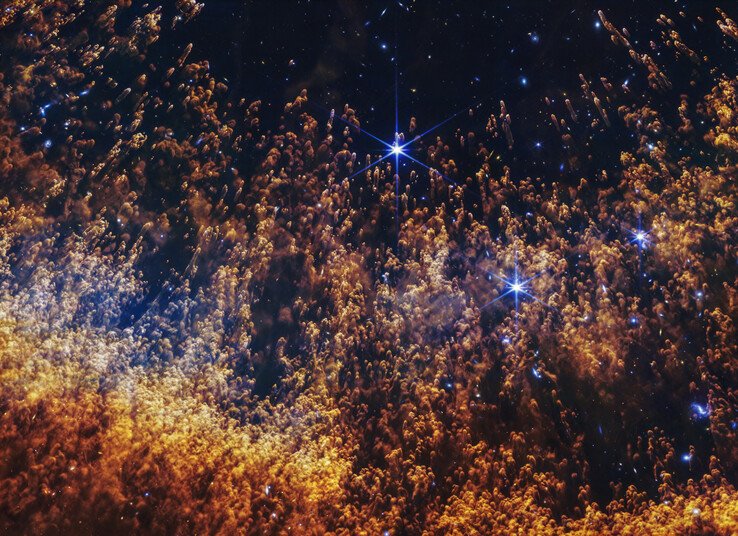
The image showcases remarkable comet-like structures within the nebula's gas clouds. These formations occur through violent cosmic collisions: fast-moving streams of hot gas ejected from the central white dwarf star slam into slower-moving material shed during earlier phases of stellar decay. This interaction creates the distinctive pillar formations visible in Webb's infrared view, with each 'comet tail' extending thousands of astronomical units across interstellar space.
While the white dwarf itself lies just outside this image frame at the nebula's heart, its intense radiation illuminates the entire structure. Temperature variations across the nebula become strikingly apparent through Webb's infrared sensitivity. Gas nearest to the white dwarf glows blue, indicating temperatures exceeding 10,000°C, while material further out cools to yellow and red hues as it expands into the interstellar medium.
This cosmic recycling process carries profound implications for planetary formation. The expelled material—a mixture of ionized gases and stardust enriched with heavy elements—forms the primordial building blocks for future celestial bodies. As lead Webb scientist Dr. Klaus Werner explains: 'We're essentially seeing the dispersal of elements forged during the star's lifetime. These same materials will eventually coalesce into new planetary systems, making observations like this crucial to understanding solar system origins.'
Webb's advanced spectroscopic instruments will allow researchers to perform detailed chemical analysis of these outflows. Preliminary data suggests complex organic molecules are forming within these turbulent clouds, potentially including precursors to planetary atmospheres. The telescope's spatial resolution also enables measurement of expansion rates, helping astronomers refine models of stellar life cycles.
Future observations will target other planetary nebulae to compare structural variations. As Dr. Werner notes: 'Each dying star tells a different story based on its mass and composition. Webb gives us the first comprehensive dictionary to read these cosmic obituaries.'
For astronomers, these findings represent more than just spectacular imagery. The Helix Nebula serves as a nearby laboratory for studying processes that will eventually shape our own solar system when the Sun enters its red giant phase billions of years from now. Webb continues to demonstrate its unique value for investigating cosmic recycling processes that transform stellar death into the raw materials for new worlds.
Sources:
Comments
Please log in or register to join the discussion