
The FAA has selected eight pilot projects across 26 states to test electric air taxis and next-gen aircraft, with operations beginning summer 2026 under a three-year program aimed at integrating eVTOL vehicles into national airspace.
The skies over parts of the US could soon get busier, as the Federal Aviation Administration launches pilot projects spanning 26 states to test electric air taxis and other next-gen aircraft, with operations expected to begin by summer 2026.
Selections for the electric vertical takeoff and landing (eVTOL) Integration Pilot Program (eIPP) were announced by the FAA on Monday, with eight projects chosen to participate in the initiative. The program will run for three years after the first project begins operations, and the selected efforts span 26 states.
According to the FAA, the projects will explore operational concepts including urban air taxi services, regional passenger transportation, cargo and logistics networks, emergency medical response operations, autonomous flight technologies, and offshore or energy-sector transportation.
"These partnerships will help us better understand how to safely and efficiently integrate these aircraft into the National Airspace System," said FAA Deputy Administrator Chris Rocheleau. "The program will provide valuable operational experience that will inform the standards needed to enable safe Advanced Air Mobility operations."
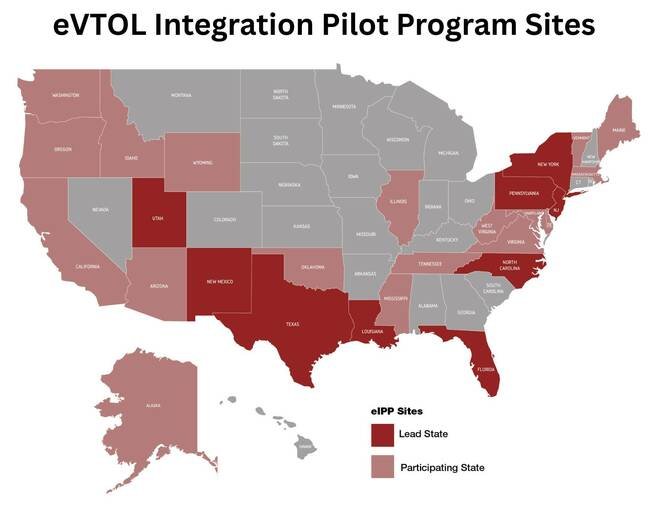 A map of eIPP locations - Click to enlarge
The FAA said that the program is being stood up as requested by an executive order from President Trump last June. While broadly concerned with drones, the order also included a section calling for the creation of the eIPP.
Participating commercial partners include several eVTOL and advanced air mobility firms, including Joby, Archer, Elroy Air, Electra, and others. None of those firms has yet received full FAA certification for passenger operations, but all participating companies must already be undergoing the process.
The FAA said that eIPP would inform future regulation of eVTOL aircraft as operations scale up.
DARPA's X-76 VTOL aircraft advances
DARPA is getting its own non-electric VTOL aircraft in the form of the latest X-plane, the X-76, which is designed to combine vertical lift capabilities with jet-like cruise speeds. The X-76 recently cleared its critical design review, allowing Bell Textron to move into manufacturing and assembly ahead of ground testing.
Bell Textron is being asked to achieve three things with the X-76: The ability to hover "in austere environments," operate from unprepared surfaces, and a cruising speed exceeding 400 knots, or around 460 mph. The V-22 Osprey, which is similar in concept to a tiltrotor aircraft, has a cruising speed of about 275 knots (316 mph).
DARPA said it expects the X-76 to be ready for flight testing by early 2028.
Industry context and timeline
eVTOL aircraft have been a hot item in recent years, with the US military sinking millions into its own eVTOL projects with companies like Archer and Joby as the FAA worked to develop pilot certification programs in anticipation of rapid growth in the space. Airlines have also sunk lots of cash into eVTOL investments, with plans to use the craft as short-hop transportation to and from airports.
Movement in the space has been slow over the past couple of years, with many firms simply in a holding pattern amid the FAA certification process. With the FAA claiming that "the American public will start to see operations begin under this program by summer 2026," it seems the government is confident enough in the designs it's been reviewing to begin allowing flights to lift off.
We reached out to the FAA to find out when the public would be able to avail themselves of eVTOL services under eIPP, but the agency only pointed us back to its press release and a fact sheet we had already seen.
Comments
Please log in or register to join the discussion