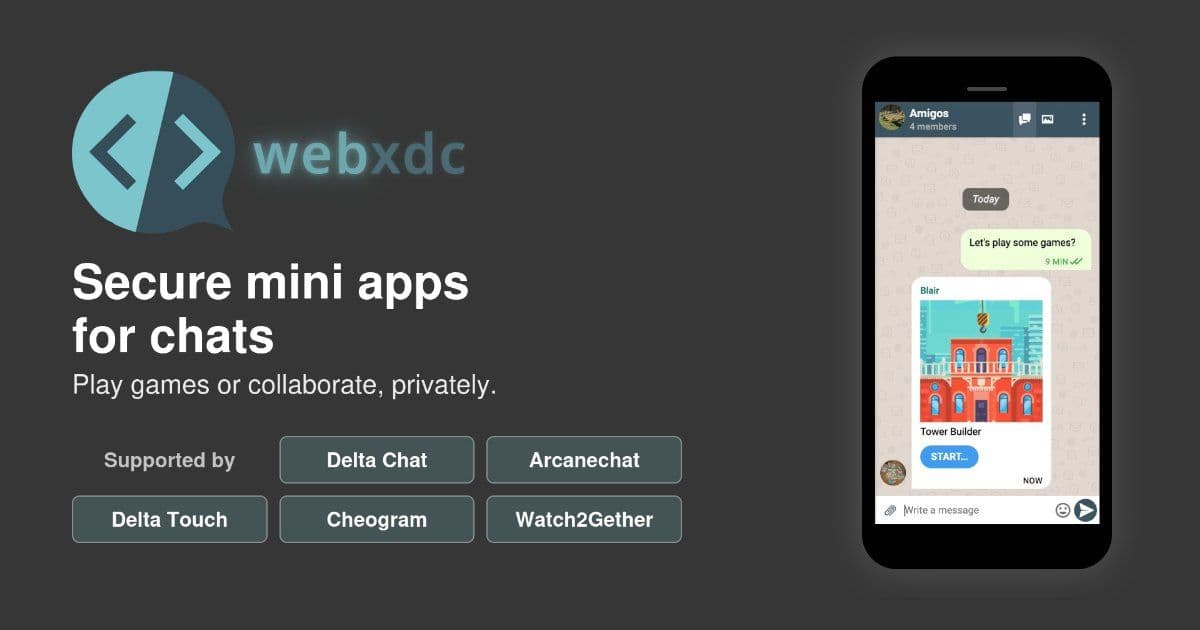
Webxdc treats chat not as a notification layer around apps, but as the place where small, private, collaborative software can actually live.
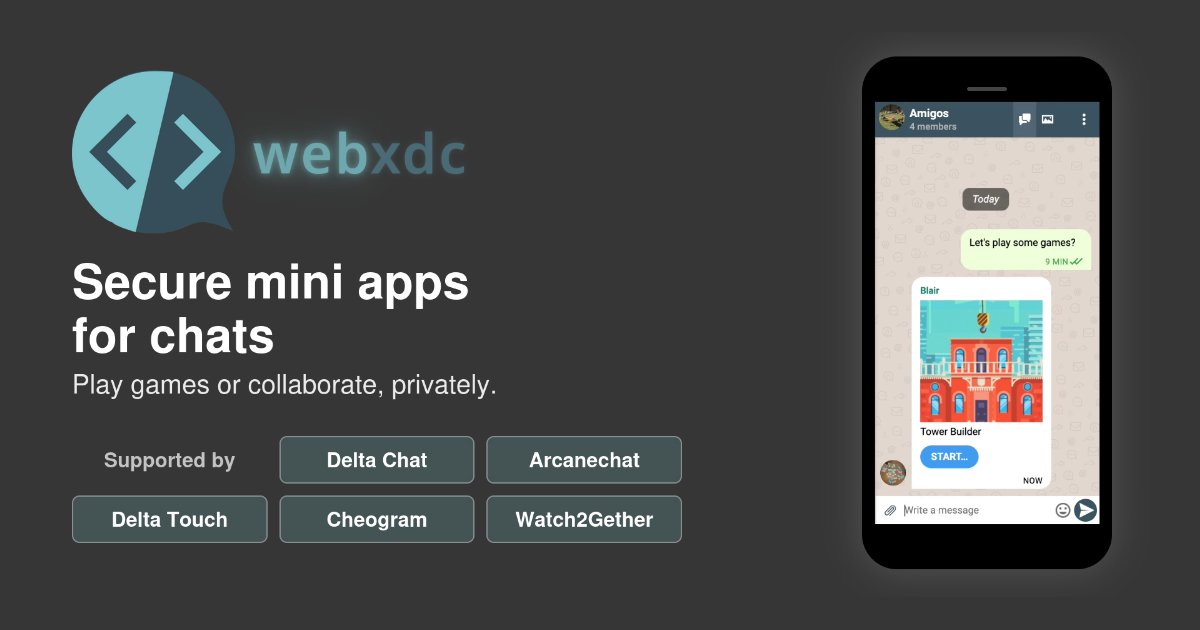
Thesis
Webxdc is built around a deceptively modest idea, that a mini app can be packaged like a web page, shared through a chat, and run privately on the devices of the people in that conversation. Yet beneath that simplicity is a more interesting argument about where software should live, who should control it, and how much infrastructure should be required before people are allowed to collaborate.
Most modern software assumes a triangle: a user interface on the device, a cloud service in the middle, and an account system binding the two together. Even trivial collaboration often means accepting hosting, telemetry, platform policy, identity management, sync infrastructure, and a business model that has to be paid for somehow. Webxdc reverses that assumption. It asks what happens if the chat already has the necessary social graph, delivery mechanism, encryption context, and shared history, and if the app itself can be reduced to portable HTML, CSS, and JavaScript inside a .xdc bundle.
The result is less a competitor to full-scale app platforms than a philosophical alternative to them. Webxdc imagines software as something passed between people, not provisioned to users by a remote service. That distinction matters, because it changes the default relationship between the person, the group, the code, and the network.
Key Arguments
Chat is already a computing environment
The conventional view of chat is that it is a channel: a place where links, files, status updates, and notifications move between people. Webxdc treats chat as something closer to an operating environment. A poll, a shopping list, a shared calendar, a small game, a checklist, a bill splitter, a drawing board, or a time tracker does not necessarily need to become a standalone service with accounts and servers. It may only need to exist inside the conversation where the relevant people already are.
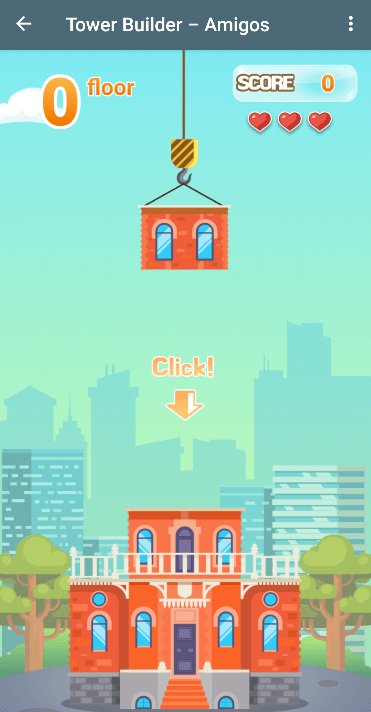
That is why the catalog of Webxdc apps feels so varied, ranging from practical tools like polls, calendars, checklists, spreadsheets, TOTP utilities, developer tools, and file sharing, to lightweight games such as Chess, Connect4, Tower Builder, Tetris, Minesweeper, Sudoku, and multiplayer experiments. The breadth is not accidental. It demonstrates that many useful applications are socially bounded. Their natural scope is not “the whole internet,” but “this group, this task, this moment.”
This framing is particularly important because chat has already solved several difficult problems that app developers usually have to rebuild. It has a participant list. It has message delivery. It has identity, at least within the social context of the conversation. It has a history. In encrypted messengers, it has a privacy model. Webxdc’s insight is that many small apps can inherit those properties instead of recreating them through a backend service.
The technical model favors portability over platform dependence
According to the project’s description, a Webxdc mini app is essentially a zipped web application: HTML, CSS, and JavaScript packaged into a .xdc file. That means the development model starts from the most widely understood application runtime in computing, the browser-like web stack, rather than from a platform-specific SDK.
The promise is not that every web app can simply become a Webxdc app without thought. A mini app that runs inside chat has different constraints from a hosted web service. It cannot assume constant connectivity, server-side computation, third-party analytics, remote APIs, or an advertising network. But those constraints are also the source of its privacy properties. The same limitation that prevents a mini app from “phoning home” also prevents it from quietly becoming another node in the surveillance economy.
The project says apps are sandboxed with zero internet access, run on the devices of chat partners, and can work offline. That architecture pushes developers toward local-first thinking: state must be stored, exchanged, and reconciled among participants rather than treated as something that lives primarily on a company’s server. In this sense Webxdc belongs to the same broader family of ideas as local-first software, peer-to-peer synchronization, and offline-capable collaboration, but it gives those ideas a familiar delivery vehicle: send the app in a chat.
The site also mentions peer-to-peer collaboration through Iroh in chatmail clients, which places Webxdc near a growing set of projects trying to make device-to-device networking practical again. The larger technical pattern is clear: after years of centralizing application state in cloud services, developers are rediscovering architectures where devices can coordinate directly, especially when the social scope is small and well-defined.
Security is not an add-on, it is part of the product shape
The most consequential design choice in Webxdc is the absence of internet access for mini apps. In ordinary software, users are often asked to trust that an app will behave well with network access, that a privacy policy is accurate, that analytics are limited, that data retention is reasonable, and that third-party dependencies are not quietly expanding the attack surface. Webxdc changes the question. If the mini app cannot reach the network, a large category of data leakage disappears by construction.
That does not make the model magically secure. Sandboxing has to be implemented correctly by each host client. Local code can still be buggy. Malicious or poorly written mini apps can still create bad user experiences, mishandle local state, or exploit weaknesses in the runtime. But the security philosophy is stronger than the usual permission prompt model because it begins by removing capabilities rather than asking users to police them.
There is also a cultural implication here. A Webxdc developer does not need to collect user data, run a database, operate infrastructure, or create an account system merely to distribute a small collaborative tool. The chat messenger handles delivery, encryption, and identity, while the app focuses on interaction. That division of responsibility lowers the burden on developers while reducing the amount of sensitive data that needs to exist outside the conversation.
The app catalog suggests a different economics of software
A striking part of Webxdc is the long catalog of mini apps: games, utilities, editors, calculators, soundscapes, social experiments, scheduling tools, and developer utilities. Some are serious, some are playful, some are tiny, and some are clearly experiments. That unevenness is part of the point.
App stores favor polished, maintained, monetizable software. Cloud platforms favor applications that justify hosting costs and recurring revenue. Webxdc favors software that is useful enough to share. A small checklist for a group trip, a bill splitter for dinner, a poll for friends, a simple drawing board, or a one-off collaborative tool may never deserve a company, a subscription, or a launch campaign. But it can still deserve to exist.
This is where Webxdc’s philosophy becomes most visible. It lowers the dignity threshold for software. Not every program needs to become a product. Some programs are closer to notes, toys, forms, or shared rituals. The web once had more room for that kind of computing, before distribution became so closely tied to platforms, stores, feeds, and cloud accounts. Webxdc brings a piece of that older web spirit into private conversation, while adding modern expectations around encryption, sandboxing, and peer-to-peer collaboration.
Implications
For users, mini apps become part of the conversation rather than a detour away from it
When a group needs to make a decision, track a shared task, play a small game, or coordinate an event, the usual workflow is fragmented. Someone opens another service, creates a link, configures permissions, asks people to sign in, and then brings the result back into chat. Webxdc compresses that loop. The app is shared where the conversation already happens.
That matters because coordination costs are often social rather than technical. The difficulty is not building a poll, it is getting everyone into the same place with enough trust and low enough friction to participate. A mini app inside chat inherits the group’s existing context. The participants do not have to ask what service this is, who owns the data, or whether another account is required.
For developers, the constraint set is both freeing and demanding
The appealing part of Webxdc development is its familiarity: build a web page, package it, share it. The demanding part is that developers have to think without the crutches of cloud infrastructure. There is no remote API to patch over local state design. There is no server to arbitrate every interaction. Collaboration has to respect the realities of asynchronous devices, offline use, and constrained capabilities.
That can make Webxdc a useful forcing function for better software design. A developer building a shared list, for example, has to decide how updates are represented, how conflicts are handled, and how the user interface communicates shared state. Those are not exotic distributed-systems problems at this scale, but they are real design questions. Webxdc makes them visible earlier.
Developers interested in the model should start with the official Webxdc site and its developer documentation linked from there, since the packaging and host API define what an app can assume across supported clients such as Delta Chat and related chatmail-based clients.
For the wider software ecosystem, Webxdc questions the inevitability of cloud mediation
The dominant software architecture of the last decade has taught users that collaboration means centralization. Documents live in a vendor cloud. Tasks live in a SaaS workspace. Photos live behind an account. Games call remote services. Even small utilities often carry analytics and remote configuration. This architecture is convenient, but it also concentrates power, creates recurring costs, and turns ordinary activity into data exhaust.
Webxdc does not abolish the need for cloud software. Large-scale collaboration, search, backups, compliance, enterprise administration, and public publishing often require infrastructure. But it shows that a meaningful class of applications does not need to begin there. For small-group software, the chat itself may be enough.
That is the broader philosophical contribution. Webxdc makes software feel less like a destination and more like an object that can be handed to someone. In doing so, it revives a quieter idea of computing: programs as personal, portable, inspectable tools that fit the social scale of their use.
Counter-Perspectives
Webxdc’s strengths are also its boundaries. The lack of internet access is excellent for privacy, but it limits apps that need live external data, cloud AI services, payments, maps, large media libraries, or integrations with existing SaaS tools. A weather app, a shared code assistant, or a project management client connected to a company backend would not fit the model cleanly unless the host environment exposed carefully designed capabilities.
Discoverability is another challenge. App stores are flawed, but they solve a real problem: users need ways to find, evaluate, update, and trust software. A chat-distributed mini app model can spread socially, but it may struggle with curation, versioning, reputation, and long-term maintenance. If many small apps circulate as files, users and client developers will need clear conventions for updates and trust signals.
There is also the question of runtime consistency. The web stack is portable in theory, but host environments differ. For Webxdc to feel reliable, supported clients need compatible APIs, predictable sandbox behavior, and strong test tools. The project’s existence across multiple chat clients is promising, but portability always becomes harder as developers push beyond simple interfaces into richer collaboration, storage, media, and performance-sensitive applications.
Finally, Webxdc asks users to adopt chat clients that support it. That is a social adoption problem as much as a technical one. The model becomes most powerful when an entire group can use the same mini app in the same conversation. If only one participant’s client supports it well, the magic weakens.
Closing Reflection
Webxdc is compelling because it does not try to make chat more like a social network, a marketplace, or an enterprise workspace. It makes chat more like a small computer shared by the people inside a conversation. That is a subtle but important shift.
The web taught us that software could be linked. Smartphones taught us that software could be installed. Cloud platforms taught us that software could be rented continuously from remote infrastructure. Webxdc returns to an older and more intimate possibility: software can be sent, opened, used together, and kept within the human boundary that made it useful in the first place.
That may not replace the dominant app model, and it does not need to. Its value lies in showing that another scale of software is still possible, one where privacy is the default shape, collaboration starts from conversation, and a useful program can be small enough to pass from one person to another.
Comments
Please log in or register to join the discussion