
Exploring how Smalltalk-inspired message passing and runtime interpretation could reshape AI agent design through a new Ruby framework.
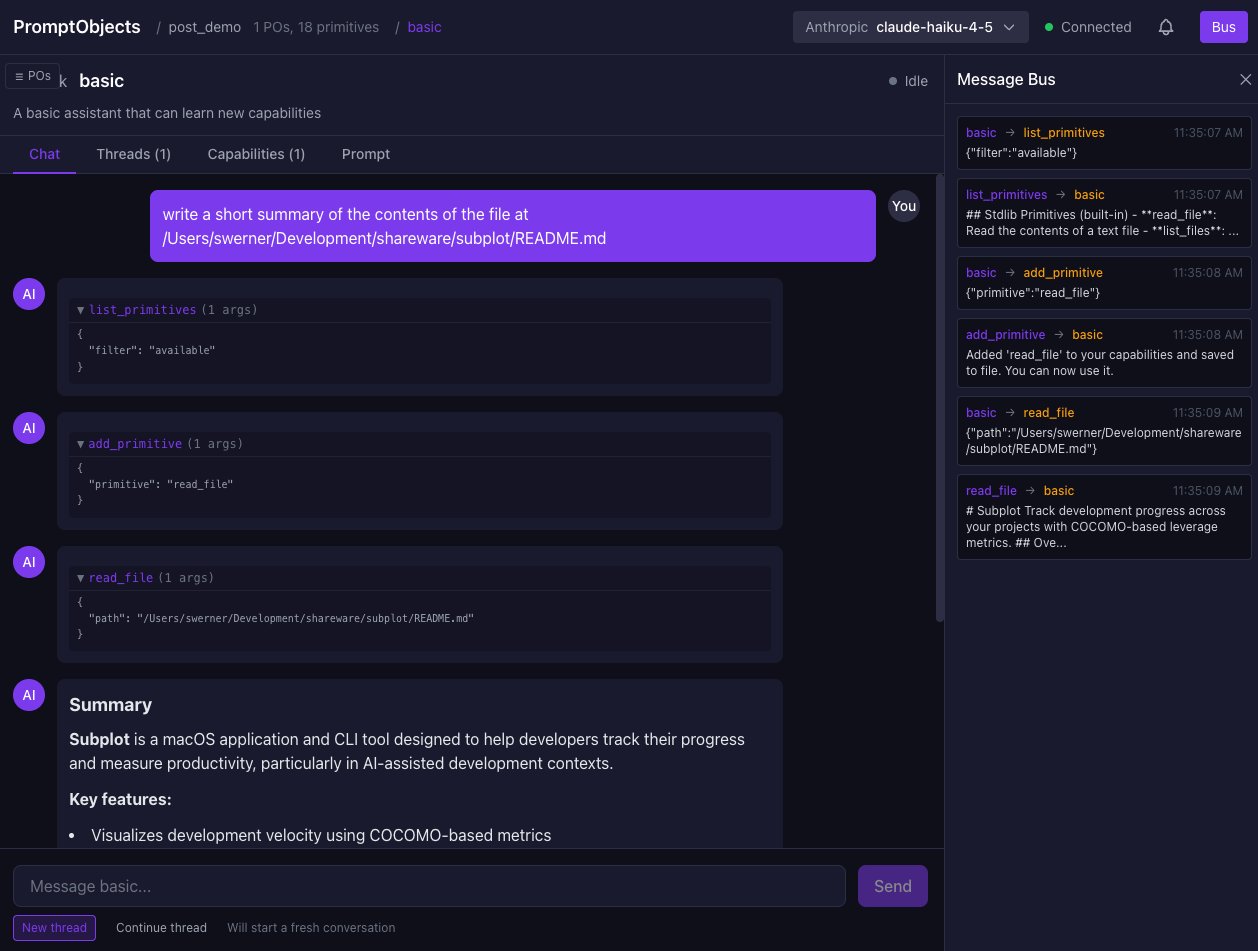
Scott Werner's new Ruby gem, prompt_objects, challenges conventional AI agent architecture by implementing Alan Kay's vision of object-oriented programming. Unlike typical agent frameworks focused on task completion and guardrails, prompt_objects treats AI components as autonomous entities communicating through natural language messages interpreted at runtime.
The framework implements three radical principles:
- Semantic late binding: Messages aren't predefined API calls but natural language prompts interpreted by the receiver
- Runtime self-modification: Objects dynamically add capabilities when encountering new requirements
- Emergent interfaces: Components negotiate protocols through natural language descriptions of their capabilities
As shown in the example screenshot above, a prompt object receiving a "read file" message might:
- Recognize it lacks file I/O capability
- Query available primitives
- Add the necessary methods to itself
- Execute the operation
This approach creates systems where:
- Boundaries between components remain fluid
- Interfaces evolve through conversation
- The distinction between code and runtime execution blurs
The implementation echoes Smalltalk's live programming environment but leverages LLMs' natural language interpretation. Objects describe their capabilities in prose, negotiate collaborations dynamically, and reshape themselves during operation.
Available on RubyGems, the library currently supports core messaging, self-modification, and object creation. Werner acknowledges the experimental nature but suggests it points toward unexplored possibilities in agent architecture: "We accidentally built the runtime that Smalltalk always wanted."
Practical implications include systems that adapt to unforeseen requirements without preprogramming and components that compose more organically. However, challenges remain around predictability, debugging, and performance overhead when every message requires LLM interpretation.
The project revives decades-old OOP concepts with modern AI capabilities, suggesting that Kay's 1997 assertion that "the computer revolution hasn't happened yet" might find new relevance in the LLM era.
Comments
Please log in or register to join the discussion