AMD's latest ZenDNN 5.2 release brings a major architectural redesign for improved AI performance, while the recently released AOCC 5.1 compiler continues to lag behind with its aging LLVM 17 base. We analyze both releases and their impact on AMD's software ecosystem.
AMD has recently released two significant software updates that impact developers working with their processors. The ZenDNN 5.2 deep neural network library has undergone a complete redesign, promising substantial performance improvements, while the AMD Optimizing C/C++ Compiler (AOCC) 5.1 has quietly been released, though it continues to rely on the older LLVM 17 codebase.
ZenDNN 5.2: A Complete Redesign for AI Performance
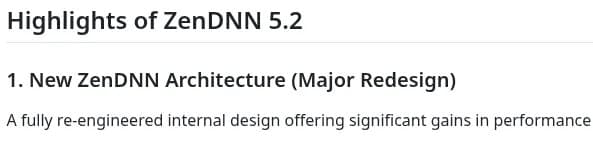
The ZenDNN library represents AMD's implementation of the oneDNN (Deep Neural Network) specification originally developed by Intel. With version 5.2, AMD has introduced what they describe as "a fully re-engineered internal design offering significant gains in performance and extensibility, with full backward compatibility."
This major redesign comes at a crucial time as AI workloads continue to grow in importance across both consumer and enterprise applications. The new architecture appears focused on maximizing throughput on AMD's CPU architecture, particularly for inference workloads that can benefit from vectorization and memory efficiency optimizations.
Key Features of ZenDNN 5.2
The most significant change in ZenDNN 5.2 is the introduction of multiple backends, allowing developers to choose the most appropriate implementation for their specific use case:
- Native ZenDNN: The new, redesigned backend optimized specifically for AMD processors
- AOCL-DLP: AMD's optimized library for deep learning primitives
- oneDNN: Intel's implementation for compatibility
- FBDGEMM: Facebook's optimized GEMM (General Matrix Multiply) implementation
- libxsmm: IBM's library for matrix operations
This multi-backend approach provides developers with flexibility while maintaining the performance benefits of AMD's custom implementation.
Performance Improvements
While the exact performance gains aren't detailed in the announcement, the complete redesign suggests substantial improvements, particularly for:
- Matrix operations that form the backbone of most neural networks
- Memory bandwidth utilization on modern AMD processors
- Vectorization efficiency using AMD's instruction sets
- Reduced overhead for smaller batch sizes common in inference scenarios
The backward compatibility assurance is crucial for existing applications, as it means developers can upgrade without code changes while potentially gaining performance benefits.
Technical Architecture
The redesigned architecture likely incorporates several modern optimization techniques:
- Better cache utilization patterns for large neural network models
- Improved support for bfloat16 and other reduced precision formats
- Enhanced thread scheduling for multi-socket systems
- Better NUMA awareness for server deployments
- More efficient memory allocation patterns
These improvements would particularly benefit AMD's EPYC processors, which offer high core counts and memory bandwidth.
AOCC 5.1: Compiler Release with Outdated Foundation
While ZenDNN 5.2 represents forward progress, the AMD Optimizing C/C++ Compiler (AOCC) 5.1 release highlights a concerning trend in AMD's compiler development strategy.
What's New in AOCC 5.1
AOCC 5.1 introduces several notable updates:
New Zen 5 tuned AOCL-LibM 5.2 AMD Math Library: This provides optimized mathematical functions specifically for AMD's Zen 5 architecture, which should improve performance for scientific computing and other math-intensive applications.
Front-end fixes: Various improvements to the C, C++, and Fortran compiler front-ends, addressing bugs and improving compatibility.
Optimization improvements: While not detailed in the announcement, minor optimization enhancements are typically included in such releases.
The LLVM 17 Concern
The most significant issue with AOCC 5.1 is that it continues to be based on the LLVM 17 codebase, which was released in September 2023. This means:
- Missing nearly two years of upstream LLVM improvements
- Lack of support for the latest processor features in newer LLVM versions
- Potentially inferior optimization compared to more recent compiler versions
- Delayed access to new language features and standards compliance
This is particularly concerning given that:
- Intel has been more aggressive with upstream contributions to LLVM
- GCC continues to make steady progress with each release
- Other compiler vendors have moved to more recent LLVM versions
Comparison with Alternatives
For developers targeting AMD processors, the compiler landscape includes:
- AOCC: AMD's proprietary compiler, optimized for their processors but with an aging base
- GCC: The GNU Compiler Collection, with good AMD support and regular updates
- Clang/LLVM: The upstream compiler that AOCC is based on, with more recent versions available
- ROCm: AMD's GPU computing platform, which includes its own compiler stack
For most users, especially those needing the latest optimizations and language features, GCC or a more recent version of Clang/LLVM may be preferable to AOCC, despite potential AMD-specific optimizations in AOCC.
Build Recommendations
Based on these releases, here are our recommendations for different use cases:
For AI/Deep Learning Development
- Primary choice: ZenDNN 5.2 with the native backend for maximum performance
- Alternative: Use ZenDNN 5.2 with the oneDNN backend for compatibility with Intel-optimized code
- Compiler: GCC or a recent Clang/LLVM build rather than AOCC 5.1
- Setup instructions: Available at the ZenDNN GitHub repository
For High-Performance Computing
- Math libraries: AOCL-LibM 5.2 from AOCC 5.1 for Zen 5 optimization
- Compiler: GCC for most cases, or experiment with both GCC and AOCC for specific workloads
- Build system: Consider CMake or other modern build systems for complex projects
- Optimization flags: Experiment with -march=native and -O3, but always profile performance
For General Development
- Compiler: GCC or a recent Clang/LLVM build
- Libraries: System packages or venv/conda environments for dependency management
- Platform: Consider ROCm for GPU acceleration if applicable
Future Outlook
The divergent trajectories of ZenDNN and AOCC suggest different priorities within AMD's software strategy:
- ZenDNN: Active development with regular updates and significant architectural improvements
- AOCC: Maintenance mode with infrequent updates and an outdated base
This suggests AMD may be focusing more on optimizing specific libraries (like ZenDNN) rather than maintaining a full compiler stack. The recent plumbing of Zen 6 support in LLVM could indicate a shift toward better upstream integration, which would benefit the entire ecosystem.
For developers, this means:
- Continued strong performance from AMD-optimized libraries
- Potential need to use third-party compilers for the latest optimizations
- Opportunities for community contributions to open-source compiler projects
Conclusion
AMD's ZenDNN 5.2 represents a significant step forward in AI performance on AMD processors, with its redesigned architecture and multi-backend approach offering both performance and flexibility. However, the AOCC 5.1 release highlights the need for AMD to modernize its compiler stack to remain competitive.
For users, the path forward is clear: leverage ZenDNN 5.2 for AI workloads while considering alternative compilers for general development. As AMD continues to develop their processor technology, a more aggressive approach to compiler modernization would provide a more complete software ecosystem.
The releases can be downloaded from:
Comments
Please log in or register to join the discussion