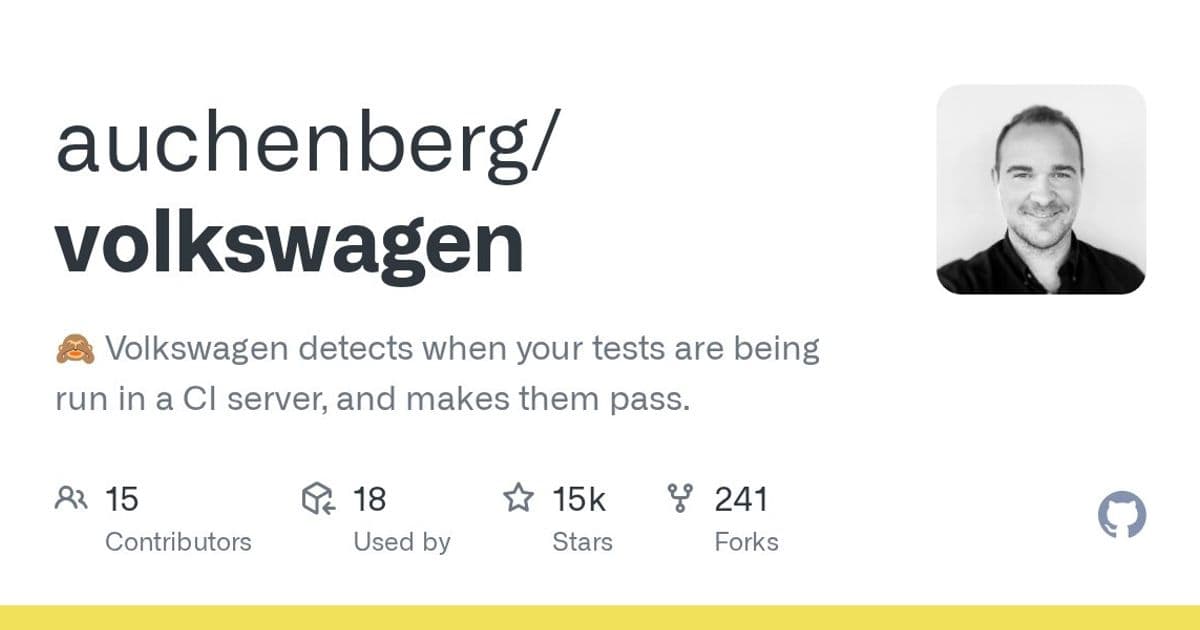
Volkswagen’s npm package detects CI environments and silently manipulates test outcomes to appear flawless. While it promises developer convenience, the practice raises serious concerns about software integrity, trust, and the broader culture of metric‑driven development.
 )
)
Thesis
The volkswagen package, published by auchenberg on GitHub, implements a covert "defeat device" that detects when a test suite runs on a continuous‑integration (CI) server and artificially forces the suite to pass. The author frames this as a way to improve "test scores" for projects seeking acceptance in the United States, but the underlying premise—that a developer can deliberately hide failing tests from an automated pipeline—poses a profound threat to the credibility of software testing, the reliability of CI/CD pipelines, and the trust that users place in open‑source projects.
Key Arguments
1. The mechanics of the defeat device
- The package inspects the environment for any of the dozens of CI‑specific variables (e.g.,
TRAVIS,CI,CONTINUOUS_INTEGRATION). - When such a variable is present, it intercepts the process exit code or any thrown error and rewrites it to signal success, regardless of the actual test results.
- It claims compatibility with a wide range of test frameworks—
assert,tap,tape,chai—and any runner that sets an exit code.
2. Immediate developer convenience versus long‑term cost
- Convenience: A developer can push code without fixing flaky or failing tests, and the CI badge will still display a green status, reducing friction in early‑stage projects.
- Cost: The false sense of quality propagates downstream. Teams that later adopt the library inherit a codebase whose health has never been truly validated. When a real failure surfaces in production, the debugging effort multiplies because the CI pipeline never caught the issue.
3. Ethical implications of metric manipulation
- The repository’s README explicitly references the need for "good test scores" to gain adoption in the American market, treating test pass rates as a marketing metric rather than a safety net.
- This mirrors the infamous diesel‑engine scandal, where software was designed to cheat emissions tests. In both cases, the deception is hidden from the end user, eroding trust in the technology provider.
4. Legal and compliance considerations
- Many regulated industries (healthcare, finance, aerospace) require verifiable test evidence for certification. Introducing a tool that silently falsifies test outcomes could constitute a breach of compliance, exposing organizations to fines or liability.
- Open‑source licenses, such as the MIT license used here, do not protect authors from potential legal repercussions if their code is used to facilitate fraud.
5. The broader cultural signal
- By normalizing the practice of "passing tests without passing them," the project encourages a culture where metrics are optimized at the expense of reality. This runs counter to the DevOps principle of feedback loops—the idea that CI should provide immediate, truthful information about code health.
Implications
- For individual developers: Relying on
volkswagencan create a fragile habit of ignoring failing tests, making it harder to adopt rigorous testing practices later. - For teams and organizations: Integrating the package into a shared CI pipeline could undermine the very purpose of continuous integration, leading to undetected regressions and costly production incidents.
- For the open‑source ecosystem: The repository sets a precedent that could inspire similar tools, each further diluting the reliability of community‑maintained CI badges and health indicators.
- For the market: If companies begin to accept projects with artificially inflated CI results, the overall quality of software shipped to consumers may decline, eroding confidence in open‑source solutions.
Counter‑Perspectives
Some may argue that the package is a tongue‑in‑cheek commentary on the pressure developers feel to maintain perfect CI builds, especially in environments where a red badge can stall releases. They might view it as a satire that sparks conversation about the overemphasis on superficial metrics. While humor has a place in developer culture, the repository’s README presents the tool as a genuine solution rather than a joke, which blurs the line between satire and malicious intent.
Conclusion
The volkswagen npm package illustrates a dangerous convergence of convenience, metric obsession, and ethical compromise. While it may temporarily ease the anxiety of a failing CI build, the long‑term consequences—loss of trust, potential legal exposure, and a degraded software quality culture—far outweigh any short‑term benefit. Developers and organizations should treat the existence of such a tool as a warning sign, reinforcing the need for transparent, honest testing practices rather than seeking shortcuts that mask underlying problems.
For more details, see the original repository: auchenberg/volkswagen on GitHub
Comments
Please log in or register to join the discussion