Deena Mousa examines the paradox of Malawi’s persistent poverty despite political stability, generous aid, and modest institutional quality. She walks through the usual suspects—low agricultural productivity, weak institutions, geography, colonial legacy, trade policy, and political settlements—showing why each falls short of a full explanation and why the real barrier may be the entrenched political bargain that favors smallholder maize farmers over structural transformation.
Why Malawi Remains Stuck in Poverty – A Critical Look at the Missing Explanations
The puzzle
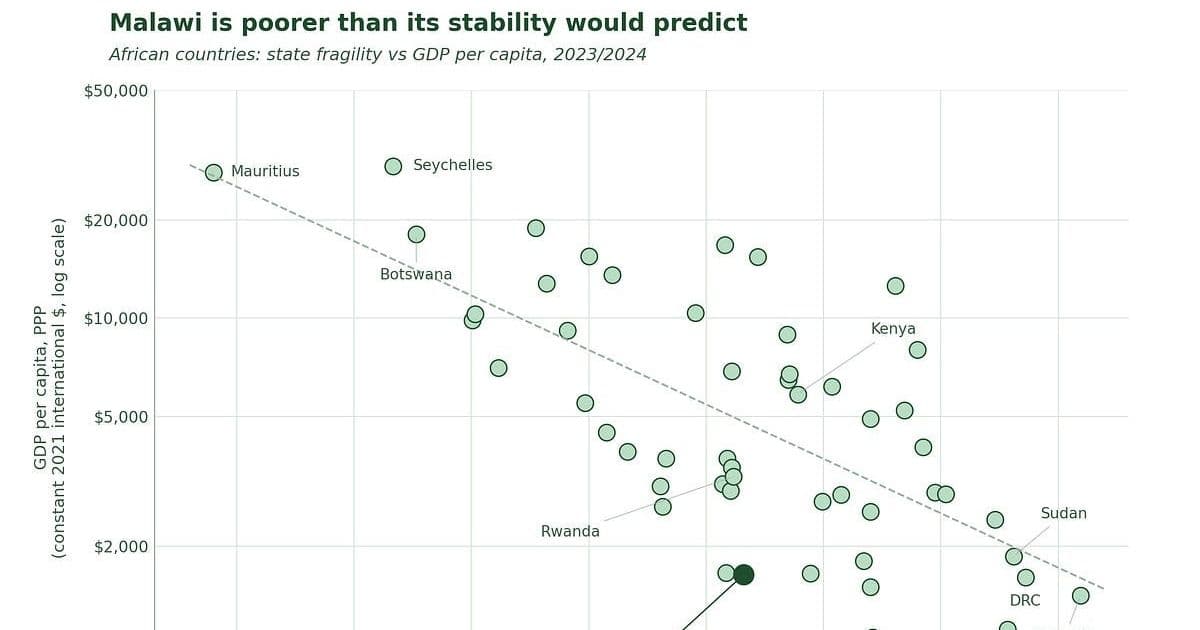
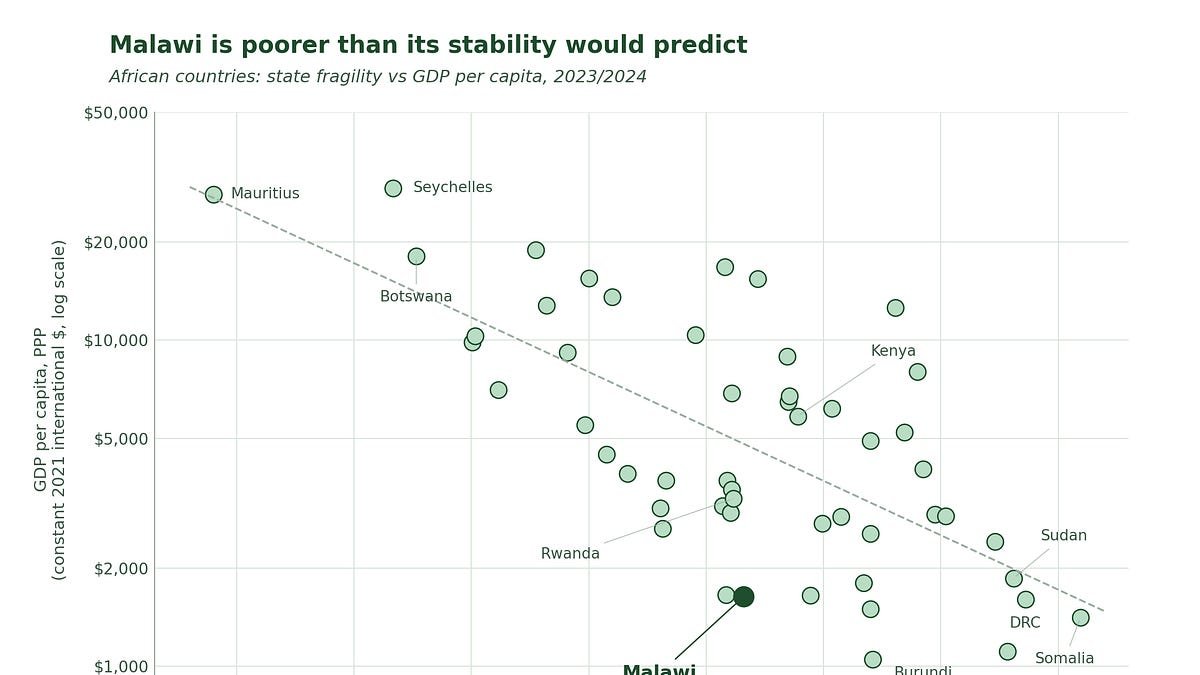
In 1994 Rwanda’s per‑capita GDP was $5,751 after a genocide that wiped out 11 % of its population. Malawi, by contrast, was peaceful, had just emerged from a three‑decade dictatorship, and posted a per‑capita GDP of $976 – roughly 70 % higher than Rwanda’s. Thirty years later Rwanda’s GDP per capita is $3,265, about twice Malawi’s $1,634. Kenya, Kenya’s GDP per capita sits at $5,800, more than three times Malawi’s. The sub‑Saharan average is $4,873. Despite a stable political environment and generous donor support, Malawi lags far behind its neighbours.
Key numbers (2023‑2024)
- World Bank ranks Malawi among the ten poorest countries by PPP‑adjusted GDP per capita.
- 70 % of the population lives on less than $2.15 a day; under the $3‑a‑day line it rises to 75 %.
- Population growth 2.6 % per year now outpaces real economic growth, pushing per‑capita income down for three consecutive years (2022‑2024).
- 80 % of the workforce is in rain‑fed maize agriculture; 76 % of farms are under one hectare.
- Only 15 % of the population has electricity access.
- Aid per capita in 2023 was roughly 2.5 × the global average, heavily weighted toward health (HIV/AIDS) and basic education.
These facts describe a poor country, but they do not answer the why.
Common explanations and why they fall short
1. Institutions
Acemoglu and Robinson argue that extractive institutions keep nations poor. Malawi’s institutions are imperfect but functional: multiparty elections since 1994, peaceful transfers of power, working courts, and a corruption perception score (107/180) comparable to Indonesia or Brazil. Rwanda, with tighter political control, has grown faster. Institutional quality alone cannot explain Malawi’s lag.
2. Geography
Sachs’ “geography is destiny” thesis points to landlocked status, tropical disease burden, and poor soils. Malawi indeed suffers from all three, but empirical work suggests the landlocked penalty translates to roughly 1 % lower annual growth—insufficient to account for a gap that is several times larger. Rwanda, more landlocked, has outperformed Malawi.
3. Colonial legacy
Malawi was a labor‑reserve colony, receiving minimal infrastructure investment. Botswana shared a similarly thin colonial inheritance yet achieved rapid growth after independence. The initial conditions matter, but they do not lock a country into a permanent trajectory, especially after decades of donor‑financed development.
4. Trade and industrial policy
Rodrik and others stress integration into global value chains as the engine of modern growth. Countries like Bangladesh, Vietnam, and Ethiopia built garment or textile sectors despite weak agricultural bases. Malawi’s export basket is dominated by tobacco (≈ 50 % of merchandise exports), a commodity in long‑term decline. Yet the existence of a policy window (e.g., AGOA for textiles) can overcome a weak export profile, which Malawi has not managed to capture.
5. Agro‑ecology
High‑value cash crops (coffee, cocoa, tea) give other African economies a boost. Malawi’s staple is maize, a low‑value food crop that is politically entrenched. While crop choice matters, Bangladesh’s growth shows that a country can succeed without a “golden” export crop if it finds a manufacturing niche.
The political‑settlement perspective
Stefan Dercon’s “political settlements” framework offers a more granular view. In Malawi, the median voter is a smallholder maize farmer. This creates a stable equilibrium that rewards policies protecting that constituency:
- Fertilizer subsidy program (FISP) consumes up to 75 % of the agriculture budget in some years. It is politically untouchable because removing it would alienate the rural vote.
- Maize self‑sufficiency policies—export bans, price controls, and a focus on food security—keep farmer returns low and discourage diversification into higher‑value crops.
- Customary land tenure administered by chiefs prevents land consolidation, mortgage markets, and large‑scale commercial farming. Attempts at reform clash with chief authority and thus stall.
These three pillars lock Malawi into a low‑productivity, low‑diversification equilibrium. Unlike Rwanda or Vietnam, where elites made a credible bargain to accept short‑term pain for long‑term gain, Malawi’s elites have no incentive to disrupt the status quo because their political survival depends on the smallholder bloc.
Why the usual suspects still matter
The political settlement does not exist in a vacuum. Weak institutions, geography, and colonial inheritance all shape the bargaining space. However, they are necessary but not sufficient conditions. Countries with similar constraints (Bangladesh, Rwanda, Ethiopia) have broken out of the low‑growth trap by reshaping the political bargain—through decisive leadership, external pressure, or a crisis that forced a new coalition.
Implications for development policy and AI‑driven forecasts
- Health aid works because it sidesteps the settlement. HIV/AIDS programs, for example, improve outcomes without threatening the maize‑farmer coalition, which explains their success.
- Growth‑oriented aid must confront the settlement. Infrastructure, irrigation, or industrial zones will be under‑funded if they compete with the fertilizer subsidy or maize‑price guarantees.
- AI‑based productivity forecasts need a political lens. Even if AI can raise maize yields by 30 %, those gains will be absorbed by the same smallholder equilibrium unless the subsidy structure is re‑designed.
- Predictive models that ignore the coalition risk over‑optimism. A model that only feeds in institutional scores, geography, and aid flows will likely predict higher growth than is realistic for Malawi.
A tentative way forward
- Re‑design the fertilizer program to target high‑potential farms rather than blanket subsidies, freeing budget for roads, irrigation, and market access.
- Gradually liberalize land tenure by introducing a parallel statutory system that allows mortgage‑backed investment while respecting customary rights.
- Create a credible industrial policy—perhaps a small‑scale agro‑processing hub linked to regional value‑chain incentives—that offers visible benefits to the rural electorate.
- Leverage donor coordination to align health successes with growth objectives, using health improvements as a platform for broader development narratives.
These steps would not guarantee a rapid take‑off, but they illustrate how shifting the political equilibrium, rather than merely adding more aid, could unlock the path to higher per‑capita income.
Bottom line
Malawi’s poverty cannot be pinned on a single factor. Low agricultural productivity, mediocre institutions, landlocked geography, and a thin colonial legacy all play a role, but none explains why the country remains stuck while peers with similar profiles have surged ahead. The decisive variable appears to be the political settlement that protects the interests of smallholder maize farmers at the expense of structural transformation. Development strategies—and any AI‑driven growth forecasts—must grapple with that reality if they hope to move beyond description to genuine explanation.
This analysis is part of the Under Development series, which explores the intersection of economics, technology, and policy in low‑income countries.
Comments
Please log in or register to join the discussion