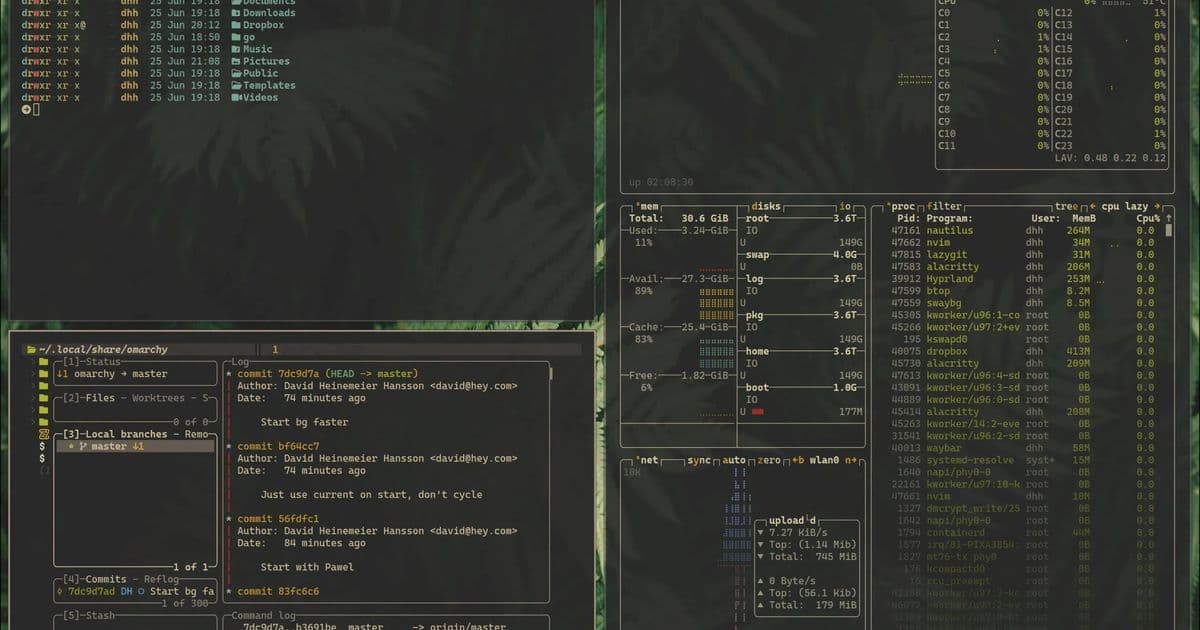
Terminal User Interfaces (TUIs) are experiencing a resurgence as native application development becomes increasingly complex across major operating systems. This article examines the technical challenges of modern UI frameworks, the limitations of Electron apps, and why TUIs are filling the void left by inconsistent native experiences.
The recent resurgence of Terminal User Interfaces (TUIs) represents a fascinating counterpoint to the complex landscape of modern application development. As developer DHH highlights in his Omarchy project, which strategically employs three types of interfaces—TUIs, web applications, and native applications—we're witnessing a return to simpler, more direct interaction models when the alternatives become too cumbersome.
The State of Native Application Development
Windows: A Legacy of Framework Fragmentation
Microsoft's approach to GUI development has been characterized by what Jeffrey Snover aptly describes as "the GUI library standard joke." The company has cycled through numerous frameworks without achieving coherence:
- MFC (1992): A C++ wrapper around Win32 that Snover compares to "Win32 wearing a tuxedo made of other tuxedos"
- OLE, COM, ActiveX: Component architectures that "infected every corner of Windows development"
- WinForms, WPF, Silverlight, WinUIs, MAUI: Each successive attempt to create a coherent development experience
This fragmentation has resulted in enterprise and personal desktop applications increasingly relying on Electron-based solutions, despite their known limitations. The last period of truly coherent visual integration in Windows likely dates back to Windows 98 or 2000, suggesting a two-decade period of UI inconsistency.
Linux: Designed Diversity, Practical Fragmentation
Linux's UI landscape was created by design, with different teams pursuing different outcomes. This has resulted in:
- GTK and Qt as the two dominant frameworks
- Cross-platform capabilities that exist in theory but are rarely utilized in practice
- Applications that can "look okay-ish next to each other" despite being built with different toolkits
The practical challenges of testing across the millions of combinations of distributions, desktop environments, and hardware configurations have led most companies to either use Electron-based solutions or rely on open-source communities to solve integration problems.
macOS: From Consistency to Confusion
Apple's Human Interface Guidelines were once the gold standard in UI design, with Xerox PARC and Apple leading research into effective human-computer interaction. However, recent macOS versions have increasingly deviated from these principles:
- Ignoring Fitts' Law, making window resizing difficult
- Adding excessive icons to menus
- Breaking the consistency that once made macOS a "safe haven for designers"
The Electron Dilemma
Electron applications have become ubiquitous despite well-documented limitations:
- Memory consumption, though improved over the past decade
- Visual inconsistency across applications
- Limited keyboard-driven workflows
- Missing standard menu structures
The author's dock exemplifies this issue: 8 native applications alongside 6 Electron apps (Slack, Discord, Mattermost, VSCode, Cursor, Plexamp). Even within the Electron ecosystem, applications like Cursor fail to provide consistent keyboard navigation between panels—a basic expectation that macOS users have come to rely upon.
The TUI Renaissance
TUIs are gaining traction for several compelling reasons:
- Performance: They are fast and resource-efficient compared to Electron applications
- Cross-platform compatibility: They work consistently across different operating systems
- Remote accessibility: They function well in remote environments without complex X forwarding
- Automation: They integrate well with scripting and automation tools
- Focus: Applications like Claude and Codex have demonstrated success on the command line by focusing on interaction rather than the surrounding operating system
The success of AI assistants on the command line suggests that when the primary goal is efficient interaction rather than visual flair, TUIs provide an optimal solution. This is particularly valuable for:
- Cloud-based development
- Remote access to GPU-powered machines
- Situations where visual consistency across applications is more important than individual app aesthetics
Technical Approaches to Modern UI Development
Several projects have attempted to address the UI fragmentation problem:
Google's Fuchsia (with Flutter UI) represented an attempt to design a new operating system without Android's legacy, but was ultimately abandoned before reaching market maturity. The challenge, as with many such initiatives, is that creating a new UI paradigm requires either market dominance or a breakthrough that makes adoption inevitable.
Zed's approach with Rust and their custom GPU-renderer library (GPUI) offers cross-platform performance but sacrifices OS integration. As the author notes, "I would rather have a slow renderer that integrated with my OS than the extra speed." This highlights a fundamental tension in UI development: performance versus integration.
The Principles of Good Interface Design
John Loeber's observation about interfaces requiring minimal thinking applies across all interaction models:
"Interfaces are better the less thinking they require: whether the interface is a steering wheel or an online form, if you have to spend any time figuring out how to use it, that's bad."
This principle explains why TUIs are gaining traction—they provide direct, keyboard-driven interactions that users can master once and apply consistently across applications. The expectation that Command+C should work everywhere isn't just about convenience; it's about reducing cognitive load and enabling focus on the task rather than the tool.
The Path Forward
Addressing the UI fragmentation crisis requires:
- Education: Developers should study UI theory from pioneers like Nielsen, Norman, and Johnson
- Standards: Software engineering curricula should treat UI design as a critical skill, not a "soft skill"
- Framework Development: Operating system and toolkit creators should focus on accessible, lasting solutions
While cross-platform support isn't necessarily the ideal solution, having coherent frameworks that developers want to use would reduce dependence on Electron and TUI workarounds.
The resurgence of TUIs isn't a rejection of graphical interfaces but a response to their increasing complexity and inconsistency. As we move forward, the challenge will be creating graphical interfaces that offer the same simplicity, consistency, and efficiency that TUIs provide—without sacrificing the visual richness that modern applications can offer.
In conclusion, the return of TUIs represents a pragmatic adaptation to the technical and design challenges of modern application development. Rather than being a step backward, it's a recognition that sometimes the best interface is the one that gets out of the way and lets users accomplish their goals efficiently and consistently.
Comments
Please log in or register to join the discussion