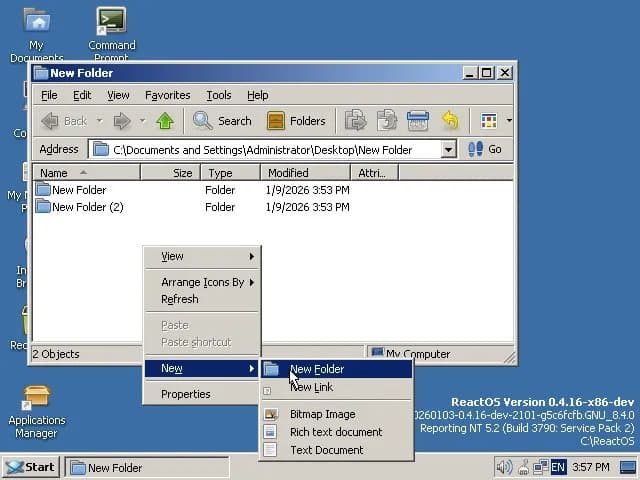
ReactOS project combines live and installation media while introducing a comprehensive ATA storage driver to broaden hardware compatibility.
ReactOS Unifies Installation Media, Adds Critical Storage Driver Support
ReactOS, the ambitious open-source project aiming for binary compatibility with Microsoft Windows, has achieved two significant milestones that could dramatically improve the user experience and hardware compatibility of this unique operating system. The project has successfully merged a unified live/install media and introduced a comprehensive ATA storage driver that supports multiple interface types, addressing long-standing limitations in the project's development.
The Significance of ReactOS
For those unfamiliar with ReactOS, it's an open-source operating system designed to be binary compatible with Windows applications and drivers. While not a Windows replacement or clone, ReactOS aims to provide a free, open-source alternative that can run Windows software natively. This compatibility makes it particularly interesting for legacy applications and systems where modern Windows may be too resource-intensive or no longer supported.
The project has been in development for over two decades, with version 0.4.16 recently branched and release candidate builds expected soon. Nightly builds for version 0.4.17 are also becoming available, indicating active development progress.
Unified Live/Install Media
One of the most user-facing improvements is the new unified BootCD that replaces the previously separate boot/install media and live CD. This consolidation represents not just convenience but a significant architectural improvement for the project.
The new ISO combines both the traditional text-mode installer and the LiveCD image into a single, more versatile medium. This unification serves multiple purposes:
- Simplified Distribution: Users now need only one download for both installation and live environments
- Future-Proofing: The unified media is designed to support a future first-stage GUI installer
- Improved Experience: A more streamlined approach to trying and installing ReactOS
The pull request for this unification had been open since September 2024, indicating the complexity of the task. The successful merge represents a significant achievement for the development team.
Technical Benefits
From a technical standpoint, the unified media approach offers several advantages:
- Reduced Code Duplication: By consolidating the installation and live environments, the codebase becomes more maintainable
- Consistent Environment: Users experience the same environment whether running live or installing
- Enhanced Testing: Developers can test both scenarios with a single codebase
- Foundation for GUI Installer: The unified media provides the necessary foundation for the planned GUI installer, which will be more approachable for new users compared to the current text-mode installer
For homelab enthusiasts and testers, this means a more efficient workflow when evaluating ReactOS on different hardware configurations. The ability to boot into a live environment and then proceed to installation without changing media simplifies the testing process significantly.
The New ATA Storage Driver
Perhaps even more significant from a compatibility perspective is the new ATA storage driver that was recently merged. This plug-and-play aware ATA storage stack represents a major architectural improvement in how ReactOS interacts with storage hardware.
Comprehensive Storage Support
The new driver supports multiple storage interfaces:
- SATA (Serial ATA)
- PATA (Parallel ATA, also known as IDE)
- ATAPI (ATA Packet Interface)
- AHCI (Advanced Host Controller Interface)
This broad support is crucial for ReactOS, as storage compatibility has been a historical limitation. The new driver should significantly expand the range of systems on which ReactOS can successfully boot and operate.
Development Timeline
The development of this new storage driver has been a long process, with the pull request in the making since early 2024. This extended development period underscores the complexity of implementing robust storage support in an operating system.
Performance Considerations
While the article doesn't provide specific benchmarks, the introduction of a comprehensive ATA storage driver is likely to have several performance implications:
- Reduced Overhead: A unified storage stack should have less overhead than multiple separate drivers
- Better Error Handling: Modern storage error handling can improve reliability
- Improved Throughput: Support for modern AHCI controllers should enable better performance with SATA drives
- Power Management: Better driver support typically enables more sophisticated power management features
For homelab builders using older hardware or specific storage configurations, this driver could make the difference between ReactOS being a curiosity and a viable alternative.
Compatibility Improvements
The combination of unified media and the new ATA driver represents a significant step forward in ReactOS compatibility:
Hardware Compatibility
The new ATA driver should improve compatibility with:
- Modern SATA systems
- Legacy IDE/PATA systems
- Systems with mixed storage controllers
- External storage devices using ATAPI
Software Compatibility
While not directly addressed by these changes, the improved hardware foundation strengthens ReactOS's position as a platform for running Windows applications. Better hardware compatibility means fewer applications will fail due to hardware abstraction layer issues.
Build Recommendations for Enthusiasts
For homelab enthusiasts interested in testing ReactOS with these new improvements, here are some recommendations:
Testing Scenarios
- Legacy Hardware: Test on older systems with PATA/IDE drives to verify backward compatibility
- Modern Systems: Try on contemporary hardware with SATA/NVMe storage to assess forward compatibility
- Mixed Storage Systems: Test systems with both SATA and IDE drives to verify the unified driver's handling
- Virtualization: Test in various virtualization environments (VirtualBox, VMware, QEMU) to ensure compatibility
Performance Testing Methodology
For those interested in benchmarking ReactOS performance with these new components:
Storage Benchmarks:
- Use tools like CrystalDiskMark or ATTO Disk Benchmark
- Compare read/write speeds across different storage interfaces
- Measure access times and IOPS performance
Boot Time Measurement:
- Time boot processes with different storage configurations
- Compare cold boot vs. warm boot times
- Measure time to desktop in both live and installed environments
Power Consumption:
- Measure power usage during idle and load scenarios
- Compare with other operating systems on the same hardware
- Assess impact of new drivers on power management
Recommended Test Configurations
| Configuration | Purpose | Expected Outcome |
|---|---|---|
| PATA/IDE System | Legacy compatibility | Should boot successfully where previous versions failed |
| SATA/AHCI System | Modern hardware support | Should show improved performance over previous storage drivers |
| Mixed Storage | Comprehensive testing | Should handle multiple controller types simultaneously |
| Virtual Machine | Cross-platform testing | Should work across major virtualization platforms |
Future Outlook
With ReactOS 0.4.16 branched and release candidate builds expected soon, these improvements will soon be available to the wider user base. The project is also already working on version 0.4.17, with nightly builds becoming available.
The unified media and new ATA driver represent significant steps forward for ReactOS, but the project has much more planned. The foundation being laid with these changes will support future developments including:
- GUI Installer: The unified media provides the foundation for a more user-friendly installation process
- Expanded Hardware Support: The new storage driver architecture can be extended to support additional hardware types
- Performance Optimizations: With better hardware abstraction, performance improvements can be implemented more effectively
For homelab builders and enthusiasts interested in alternative operating systems, ReactOS represents a unique proposition: the ability to run Windows applications on a free, open-source platform. These recent improvements make that proposition more viable than ever before.
Conclusion
The ReactOS project's introduction of unified live/install media and a comprehensive ATA storage driver marks significant progress in the project's development. These changes address long-standing limitations in hardware compatibility and user experience, making ReactOS a more practical option for specific use cases.
For homelab enthusiasts interested in alternative operating systems or needing to run legacy Windows applications, these improvements make ReactOS worth a serious evaluation. The combination of better hardware support and a more streamlined installation process removes many of the barriers that previously made ReactOS more of a curiosity than a practical alternative.
As ReactOS continues to develop, with version 0.4.16 release candidates on the horizon and nightly builds for 0.4.17 already available, now is an excellent time for enthusiasts to test these improvements and provide feedback to the development team.
The ReactOS project can be found at reactos.org, where interested users can download nightly builds and learn more about contributing to this ambitious open-source initiative.
Comments
Please log in or register to join the discussion