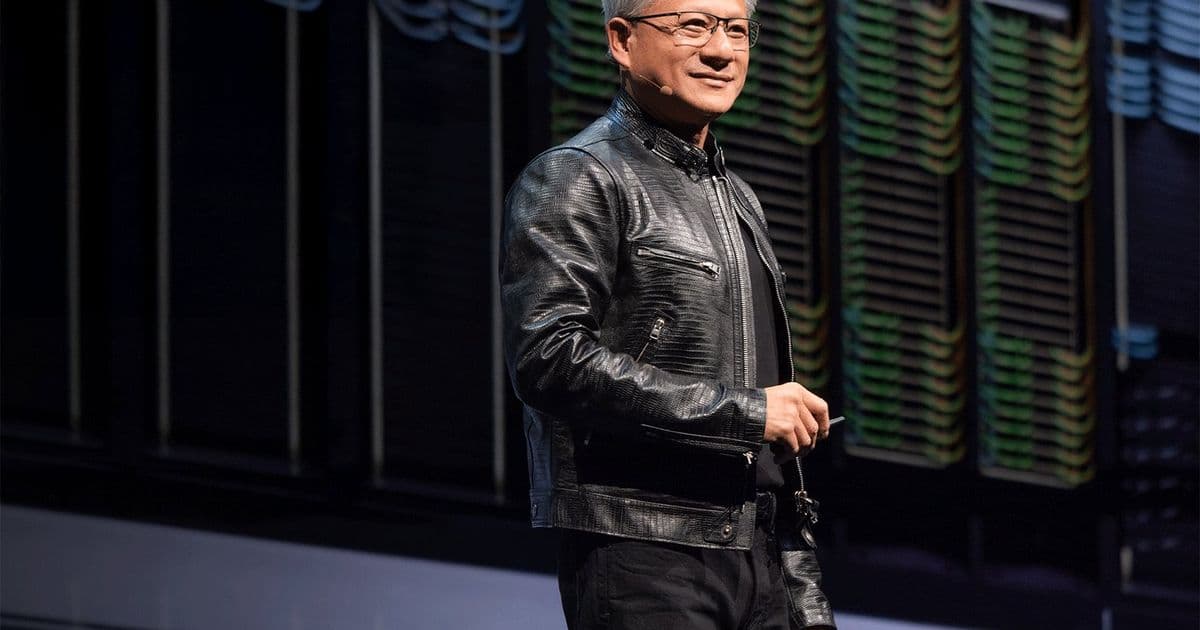
Nvidia CEO Jensen Huang confirms the company's market share in China has dropped to 0%, calling US export restrictions strategically counterproductive as Chinese competitors rapidly advance.
Nvidia CEO Jensen Huang has confirmed what many industry analysts have suspected: the company's market share in China for AI accelerators has plummeted to 0%. This dramatic reversal comes just two years after Nvidia dominated the Chinese AI chip market, with Bernstein Research previously estimating the company controlled approximately 66% of the market in 2024.
"In China, we have now dropped to zero," Huang stated during an interview with the Special Competitive Studies Project, a bipartisan initiative by American lawmakers focused on ensuring U.S. competitiveness. "Conceding an entire market the size of China probably does not make a lot of strategic sense, so I think that has already largely backfired."
The collapse in market share follows a series of U.S. export restrictions that targeted high-performance AI chips and advanced semiconductor manufacturing equipment. These measures, designed to prevent China from accessing cutting-edge technology for military applications and AI development, have instead accelerated domestic innovation in China's semiconductor industry.
Technical Implications of Market Exit
The technical specifications of Nvidia's chips that are now effectively barred from China include the H100 and A100 GPUs, which feature 4nm and 7nm process nodes respectively. These chips deliver up to 20 petaflops of AI performance and utilize advanced HBM3 memory technology. The restrictions have forced Chinese data centers to seek alternatives from domestic vendors like Huawei, Cambricon, Moore Threads, and MetaX.
Chinese competitors have been rapidly developing their own GPU architectures:
- Huawei has released the Ascend 910B, offering comparable performance to Nvidia's A100
- Cambricon's MLU370 delivers 256 TFLOPS of INT8 performance
- Moore Threads' S800 leverages GDDR6 memory and supports multiple precision formats
- MetaX's MTTS800 targets both training and inference workloads
These chips typically utilize 7nm to 14nm process technologies manufactured by SMIC through various workarounds that avoid direct U.S. technology. While not yet matching the absolute performance of Nvidia's most advanced offerings, they're closing the gap at an impressive rate.
Supply Chain Consequences
The market exit has created significant ripple effects throughout the semiconductor supply chain. TSMC, which manufactures Nvidia's most advanced chips, has lost a major customer segment in China. Meanwhile, Chinese foundries like SMIC have seen increased investment and government support as the country prioritizes semiconductor self-sufficiency.
Nvidia's software ecosystem, particularly CUDA, remains a significant moat that Chinese competitors have yet to fully overcome. CUDA provides a comprehensive development platform that includes libraries, tools, and APIs optimized for Nvidia's architecture. While Chinese companies are developing alternatives like Huawei's CANN and Cambricon's Neuware, they lack the extensive developer community and mature software stack that CUDA has built over more than a decade.
Market Analysis and Future Outlook
Bernstein Research had projected that Nvidia's share of China's AI GPU market would decline from 66% in 2024 to approximately 8% in the coming years. However, Huang's comments suggest the decline has been far more rapid than anticipated, with the company now effectively having zero market share in direct sales to Chinese customers.
This development has several strategic implications:
- China's AI development will continue but with different hardware architectures
- The global AI ecosystem is fragmenting into competing standards
- U.S. companies are losing market intelligence and influence in the world's largest AI market
- Chinese semiconductor companies are receiving unprecedented government support and market access
Huang argues that continued American participation in China would help extend the global reach of U.S. AI technology rather than accelerating China's decoupling. "Having American chip companies and other companies in China makes a lot of strategic sense," he stated.
The situation highlights a fundamental tension in U.S. tech policy: the desire to maintain technological leadership while preventing adversaries from accessing advanced technology. As Huang notes, "the policy really needs to be dynamic and needs to stay with the times."
Looking ahead, the semiconductor industry faces a bifurcated market with potentially different technological standards developing in China versus the rest of the world. This fragmentation could increase development costs for global AI companies and potentially slow overall innovation as resources are diverted to maintaining multiple incompatible ecosystems.
For more information on Nvidia's product offerings, visit their official page. For insights into China's semiconductor industry, the Special Competitive Studies Project provides detailed analysis of the competitive landscape.
Comments
Please log in or register to join the discussion