Patched WinRAR vulnerability CVE-2025-8088 continues to be exploited by Chinese and Russian state actors, delivering malware to Windows Startup folders despite available security updates.
A critical vulnerability in WinRAR that was patched in July 2025 continues to be actively exploited by state-sponsored threat actors, according to the Google Threat Intelligence Group (GTIG). The vulnerability, designated CVE-2025-8088, allows malicious archives to deliver hidden payloads directly to the Windows Startup folder, ensuring malware execution upon system reboot.
Technical Details of the Exploit
The CVE-2025-8088 vulnerability represents a path traversal flaw in versions of WinRAR prior to 7.13. Attackers leverage this weakness by crafting specially designed archive files that, when opened by unsuspecting users, extract malicious payloads to critical system directories.
Once the victim opens the compromised archive, the hidden payload is surreptitiously delivered to predetermined locations on the system. The Windows Startup folder serves as a particularly effective target, as any executable placed there automatically runs during system boot or user login, providing persistence for the malware.
Widespread Exploitation Despite Available Patches
Despite RARLAB releasing version 7.13 in July 2025 to address this critical security flaw, the vulnerability remains a popular attack vector. GTIG reports that the exploit continues to be widely used by threat actors, particularly those with government backing from China and Russia.
The persistence of this attack method highlights a significant challenge in cybersecurity: user adoption of security updates. Many WinRAR users have not upgraded to the patched version 7.13, leaving them vulnerable to exploitation.
Target Demographics and Geographic Distribution
According to GTIG's analysis, Ukrainian military units and government entities represent primary targets for this exploitation campaign. The attacks appear focused on espionage objectives, with threat actors seeking to compromise sensitive military and governmental systems.
However, the threat extends beyond government targets. Commercial entities across various regions have also fallen victim to these attacks. Recorded incidents span multiple continents, with victims identified in Indonesia, Latin America, and Brazil, demonstrating the global reach of this exploitation campaign.
WinRAR's Unique Position in the Threat Landscape
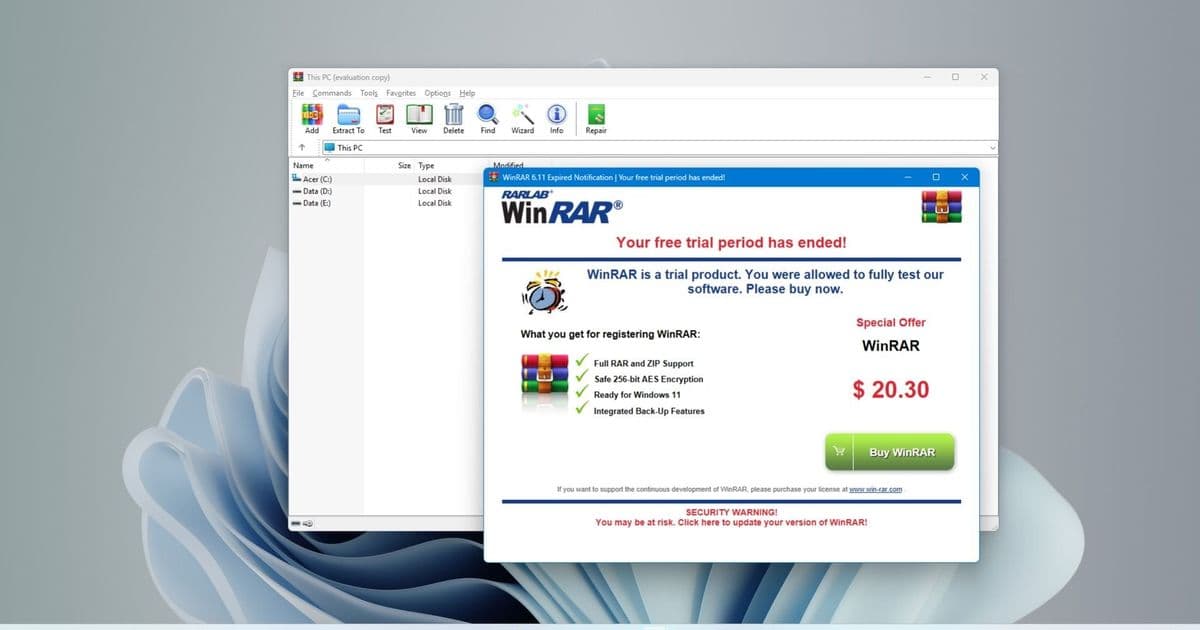
WinRAR's continued popularity, despite being a paid application, creates a unique security challenge. The software's licensing model allows users to continue using the application indefinitely after the 40-day trial period expires, simply by dismissing the license notification window.
This business model, while contributing to WinRAR's widespread adoption, also means that users may miss critical security notifications. The expired trial notification window includes security warnings from RARLAB, but these messages often go unnoticed as users routinely dismiss the licensing prompt to continue using the software without payment.
The Enduring Relevance of Archive Utilities
Despite the prevalence of fast internet connections and cloud storage solutions, archiving applications like WinRAR, WinZip, and 7-Zip maintain significant user bases. These tools offer several advantages that ensure their continued relevance:
- File consolidation: Ability to package multiple files and folders into single, manageable archives
- Compression: Reduction in file sizes, decreasing download times and data costs
- Encryption: Built-in support for password protection and secure file transfer
- Compatibility: Universal support across operating systems and platforms
These features make archiving tools indispensable for many users, particularly in business environments where secure file transfer and storage optimization remain priorities.
Mitigation and Protection Strategies
For users and organizations concerned about this vulnerability, several protective measures are recommended:
- Immediate update: Upgrade to WinRAR version 7.13 or later, which contains the necessary security patches
- Alternative software: Consider switching to alternative archiving tools that may have better security update mechanisms
- User education: Train users to recognize and avoid suspicious archive files
- Endpoint protection: Deploy advanced security solutions capable of detecting and blocking exploitation attempts
- Network monitoring: Implement intrusion detection systems to identify unusual network behavior associated with malware execution
Broader Implications for Software Security
The continued exploitation of CVE-2025-8088 despite available patches underscores several critical issues in software security:
- Update inertia: Users' reluctance or failure to apply security updates creates persistent vulnerabilities
- Legacy software: Widely-used applications with outdated security models remain attractive targets
- State-sponsored threats: Government-backed actors continue to leverage known vulnerabilities rather than developing zero-day exploits
- Supply chain risks: Popular software with large user bases represents high-value targets for malicious actors
This situation serves as a reminder that even well-established, widely-used applications can harbor critical vulnerabilities that, when exploited, can have significant security implications. The combination of WinRAR's popularity, its unique licensing model, and the sophistication of state-sponsored threat actors creates a perfect storm for continued exploitation.
The case of CVE-2025-8088 demonstrates that in cybersecurity, the most dangerous vulnerabilities are often not the unknown zero-days, but rather the known flaws that remain unpatched in production environments. As threat actors continue to exploit this vulnerability, the importance of timely software updates and user awareness becomes increasingly apparent.
Comments
Please log in or register to join the discussion