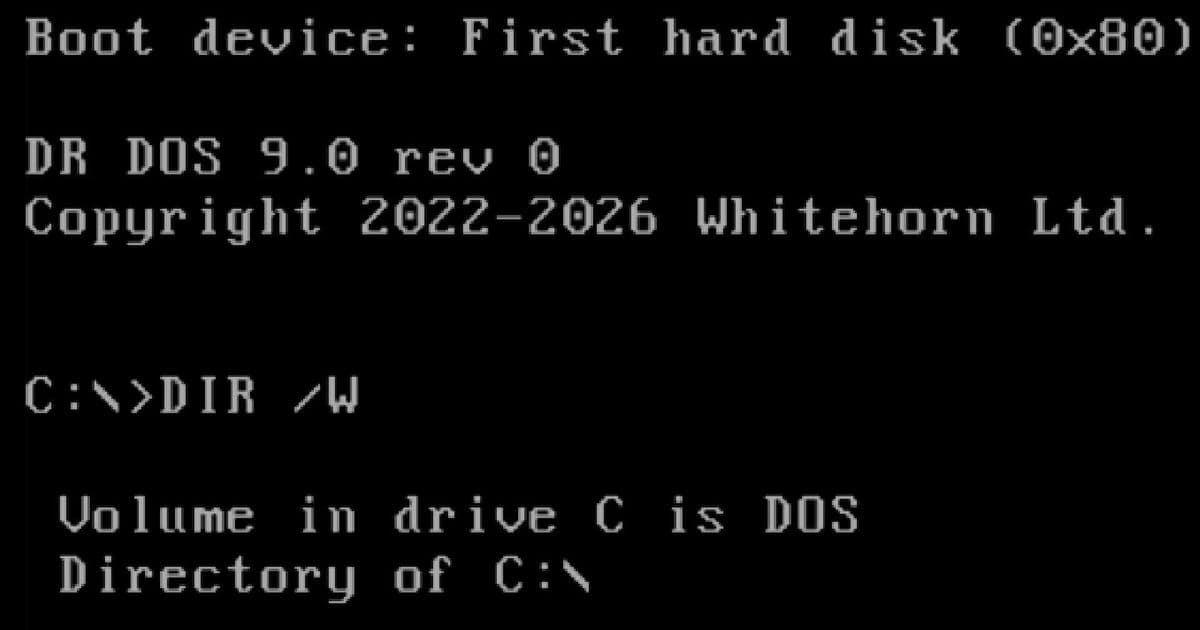
A complete clean-room reimplementation of DR-DOS has reached beta testing, offering legally unencumbered access to the historically significant operating system that once rivaled Microsoft's DOS.
After 38 years since its original debut, DR-DOS has reached a significant milestone with the release of version 9.0 in public beta testing. The project, led by Whitehorn Ltd. Co. since 2022, represents a complete clean-room reimplementation of Digital Research's classic operating system, built from scratch to honor Gary Kildall's original vision while creating a modern, legally unencumbered platform for enthusiasts and developers.
The Legacy of DR-DOS
Digital Research DOS, commonly known as DR-DOS, emerged in 1988 as a powerful alternative to Microsoft's dominant PC operating system. Created by computing legend Gary Kildall—also famous for developing CP/M—DR-DOS quickly gained recognition for its technical superiority over competing DOS platforms. The operating system offered advanced features earlier than its rivals, demonstrated superior efficiency, and provided broader compatibility with hardware and software.
Despite its technical advantages, DR-DOS struggled to compete with Microsoft's market dominance. Microsoft's strategic business moves, including its bundling with IBM PCs and becoming the default development target for PC software, effectively sealed DR-DOS's fate in the consumer market. The operating system would change hands multiple times over the decades, passing from Digital Research to Novell in 1991, then to Caldera in 1996, DeviceLogics in 2002, and finally to Whitehorn Ltd. Co. in 2022.
Clean-Room Development Approach
The current development team has taken a meticulous approach to recreating DR-DOS, employing a clean-room methodology that ensures the new implementation is legally unencumbered. This means the code has been written entirely from scratch without reference to any copyrighted material from previous versions of DR-DOS or its derivatives.
According to the developer known as CheeseWeezel on Reddit, this four-year development effort has reached a point where public testing is viable. The team's goal is to provide DOS enthusiasts and retrocomputing hobbyists with "real DR DOS, legally unencumbered," allowing users to experience the historically significant operating system without legal concerns.
Current Capabilities and Features
The beta release already demonstrates impressive functionality. The operating system includes a comprehensive set of commands and a useful collection of utilities as standard. For users interested in low-level system manipulation, DR DOS 9.0 provides hacker-friendly memory manipulation commands that appeal to both retro enthusiasts and those interested in understanding DOS architecture.
Perhaps most impressively, the current beta version successfully runs a variety of classic games and applications. According to the development team, titles including "Doom, Warcraft, SimCity, Stronghold, Commander Keen, Oregon Trail, and plenty of other period-accurate titles" operate correctly on the new platform. This compatibility with complex software demonstrates the maturity of the reimplementation.
Development Roadmap and Future Plans
The official website, dr-dos.com, outlines an ambitious development roadmap. Future releases will introduce FAT32 filesystem support, expanding the operating system's capabilities beyond the traditional FAT12 and FAT16 formats. Additional drive letter support will allow users to work with more storage devices simultaneously.
Enhanced batch scripting features represent another significant area of planned improvement. The development team intends to add FOR loops and SET command functionality, bringing DR DOS's scripting capabilities more in line with modern expectations while maintaining backward compatibility with existing batch files.
Testing and Safety Considerations
While the beta demonstrates solid functionality, the development team emphasizes caution when testing the operating system. Users are explicitly warned about "rough edges" in the current implementation and advised against installing it on devices containing important data. The recommendation is to test DR DOS 9.0 on spare machines, separate disks, or within virtual machine environments to prevent potential data loss.
This conservative approach reflects the beta nature of the software and the inherent risks of working with pre-release operating systems. The development team's transparency about limitations demonstrates a commitment to responsible software distribution.
Historical Context and Cultural Significance
The revival of DR DOS represents more than just a technical achievement—it's a preservation of computing history. Gary Kildall's contributions to personal computing, including both CP/M and DR DOS, were foundational to the industry's development. The fact that Microsoft's deal with IBM for PC-DOS (a CP/M derivative) rather than CP/M itself became the cornerstone of the company's dominance is one of technology's most famous "what if" scenarios.
For many computing enthusiasts, DR DOS represents an alternative history of personal computing—a path not taken where technical excellence might have prevailed over market dominance. The clean-room reimplementation ensures this piece of computing heritage remains accessible to future generations of developers, historians, and hobbyists.
Community and Future Development
The public beta release invites the broader community to participate in DR DOS's evolution. By making the operating system available for testing, Whitehorn Ltd. Co. is fostering a collaborative development environment where users can provide feedback, identify bugs, and suggest improvements.
This community-driven approach aligns with the project's stated mission of creating a platform "for the next generation of enthusiasts, developers, and hackers." The combination of historical significance and modern development practices creates a unique opportunity for learning about operating system design, DOS architecture, and the evolution of personal computing.
As DR DOS 9.0 continues through its beta phase with regular updates promised, it stands as a testament to the enduring appeal of classic computing platforms and the dedication of developers committed to preserving technological history while ensuring it remains legally and technically accessible for future exploration.
Comments
Please log in or register to join the discussion