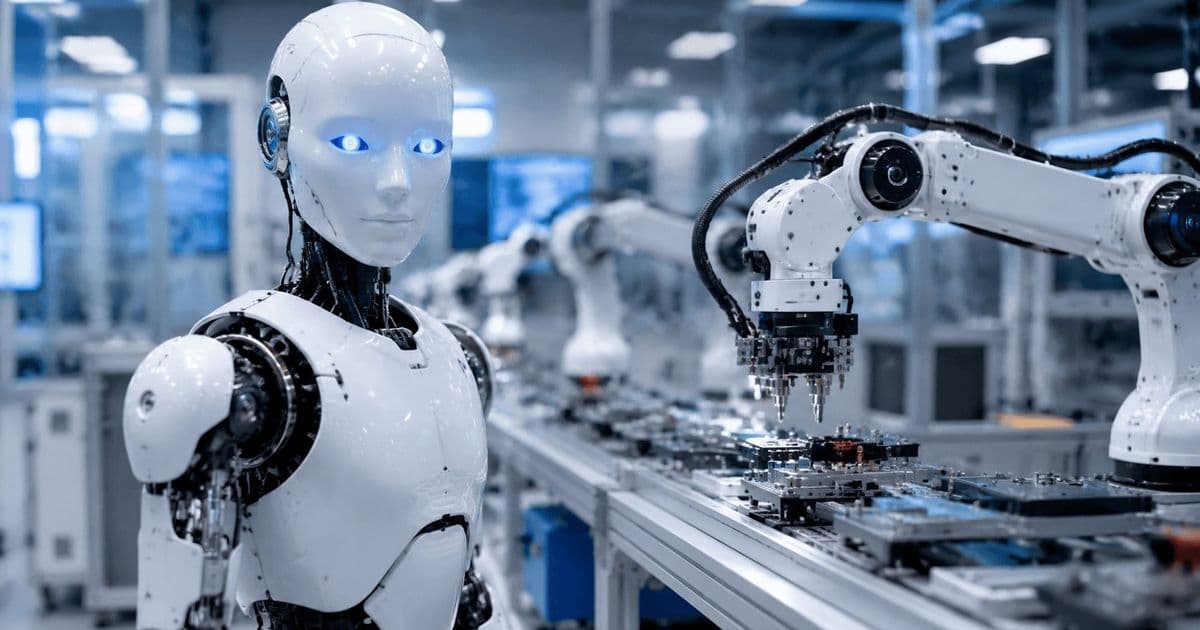
A 10-month-old BAAI spinout has raised $140 million selling the "embodied brain" while refusing to build robot hardware. The Huawei-in-cars analogy is doing a lot of work here, and the revenue numbers are still tiny relative to the funding.
Beijing-based Xingyuanzhi Robot has raised 1 billion yuan (roughly $140 million) in the 10 months since its September 2025 founding, with the final tranche closing in early June 2026. The pitch is unusual for the current robotics wave: the company will not build robot bodies, actuators, or any physical hardware. It sells the controller and the models that run on it, and it wants every Chinese robot maker to be a customer rather than a competitor.
What's claimed
Xingyuanzhi, incubated by the Beijing Academy of Artificial Intelligence (BAAI), describes itself as a pure-play provider of the "embodied brain." Founder and CEO Liu Dong, formerly General Manager of Intelligent Driving at JD.com, frames the strategy with a now-familiar Chinese tech analogy: Huawei says it does not make cars, it helps carmakers build better cars. Xingyuanzhi says it does not make robots, it supplies the intelligence layer for whoever does. Co-founder Mu Yadong is a Peking University professor and BAAI researcher working on embodied AI.
The product is the T5 computing platform, described as a high-performance domain controller paired with general-purpose embodied AI models that run inference on edge hardware in real time, with no cloud round-trip. On top of that sits RoboBrain Pro, the system the company is using for commercial loading and unloading work with electric forklift maker EP Equipment. Customers and partners named so far include AgiBot, one of China's higher-profile humanoid developers, and Beijing Yizhuang Robot, where a three-year strategic partnership is projected to produce more than ¥500 million in orders.
What's actually new
The genuinely interesting move is the business architecture, not a benchmark. Most robotics startups, in China and elsewhere, chase the full stack: they design the hardware, write the control software, train the policies, and try to sell a finished robot. Xingyuanzhi is deliberately unbundling the policy-and-compute layer and selling it as middleware. That is a bet about where the durable margins in robotics will end up, and it mirrors how the autonomous-driving market fractured into hardware OEMs and software/compute suppliers.
The edge-inference framing matters for physical robots in a way it does not for chatbots. A manipulation or locomotion policy that depends on a cloud call inherits network latency and connectivity risk, which is unacceptable for closed-loop control running at tens or hundreds of hertz. Running the model on a local domain controller is the correct architecture for any robot that has to react to contact forces or avoid walking into things. So the technical posture is sensible. The harder question is whether a general-purpose "brain" can actually generalize across forklifts, humanoids, and arms without per-customer retraining that erodes the platform economics.
The company says it shipped hundreds of T5 units in 2025 and booked over ¥10 million in revenue with a team of about 50 people, more than 90% of them in R&D. That is a real product moving in real volume, which is more than many embodied-AI startups can show. It is also worth keeping the scale honest: ¥10 million in revenue against ¥1 billion raised is a ratio that reflects investor conviction about the future far more than current commercial traction.
Limitations
The Huawei analogy is doing heavy lifting, and analogies are not strategies. Huawei could credibly tell automakers "we won't build cars" because it already had enormous leverage in chips, software, and retail. A 10-month-old startup making the same promise has to earn that trust before OEMs hand over the most differentiating part of their product. Robot makers have a strong incentive to own the brain themselves, precisely because that is where long-term value concentrates. AgiBot, named here as a customer, also develops its own models, which raises the obvious question of how deep these relationships go versus how much is evaluation and pilot work.
The announced figures are also forward-looking order projections rather than recognized revenue. "More than ¥500 million in orders over three years" and partnership pipelines are the kind of numbers that look very different once delivery, integration, and churn are accounted for. None of the materials include hard performance data: no task success rates, no latency numbers, no comparison against the on-device stacks from NVIDIA's Jetson and Isaac ecosystem or against robot makers' in-house policies. For a company whose entire pitch is the quality of its brain, the absence of published benchmarks is the gap a practitioner notices first.
The broader signal is real regardless of how Xingyuanzhi specifically performs. Chinese investors are pricing embodied AI aggressively, and at least one well-credentialed team is willing to test the proposition that intelligence and hardware will separate into distinct markets the way they did in PCs, phones, and increasingly cars. If that thesis holds, an independent brain vendor could become the layer everyone licenses. If it does not, Xingyuanzhi will find itself competing on hardware-adjacent integration work it explicitly said it would avoid. The next 18 months of actual shipments, not the fundraising headline, will settle which version is true.
Comments
Please log in or register to join the discussion