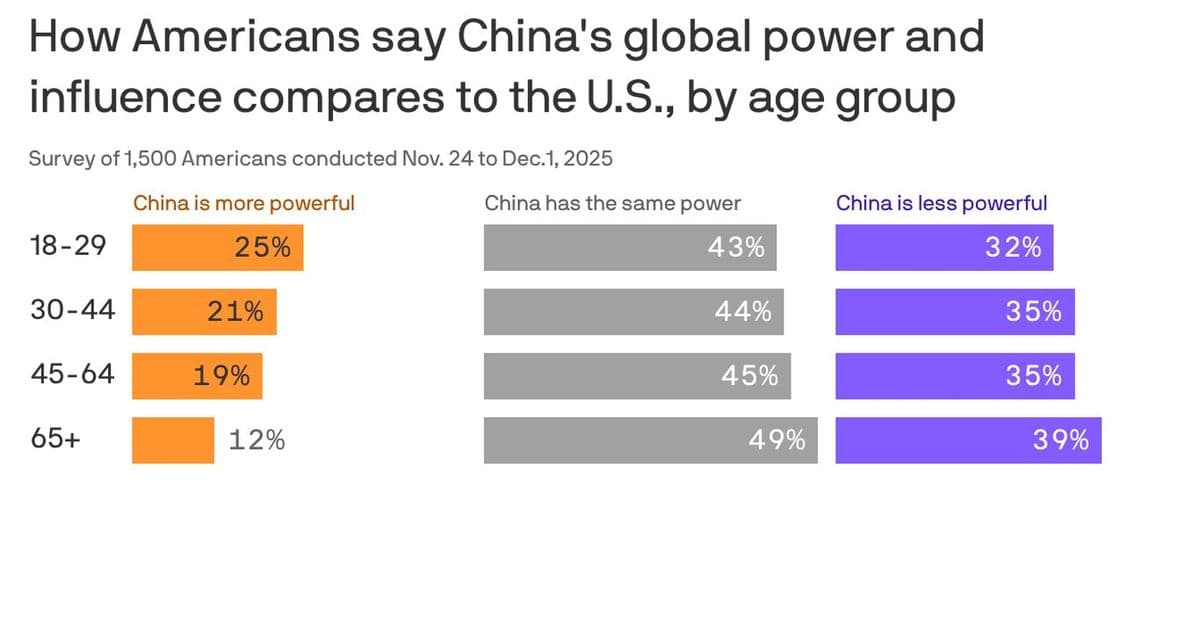
A generational shift in economic outlook reveals growing skepticism among younger Americans about U.S. exceptionalism, with many believing China has already surpassed or will soon surpass American economic dominance.
A striking generational divide has emerged in American perceptions of global economic power, with younger Americans increasingly questioning the United States' position as the world's dominant economic force. Recent polling data reveals that Americans under 30 are significantly more likely than their older counterparts to believe that China has already overtaken or will soon overtake the U.S. as the world's leading economic power.
This shift in perspective represents more than just changing opinions—it reflects the lived economic realities and future expectations of a generation that came of age during China's meteoric rise. While older Americans, who experienced the post-World War II era of unquestioned U.S. economic supremacy, remain more confident in American exceptionalism, younger Americans are forming their views based on different economic indicators and global trends.
The data shows that younger Americans are particularly attuned to China's rapid economic expansion, technological advancement, and growing influence in global trade. They've witnessed China's transformation from a developing nation to the world's manufacturing hub and now to a leader in emerging technologies like artificial intelligence, renewable energy, and 5G infrastructure.
This generational skepticism about U.S. economic dominance comes at a time when both nations are engaged in strategic competition across multiple domains. The economic implications are significant, as public perception often influences policy preferences, investment decisions, and national priorities. If younger Americans increasingly view China as the dominant economic power, it could reshape U.S. economic policy and international relations for decades to come.
Market analysts suggest that this shift in perception may already be influencing investment patterns, with younger investors showing greater interest in Chinese markets and technology sectors. The changing narrative also raises questions about America's ability to maintain its competitive edge in critical industries and whether the U.S. can adapt its economic strategies to address the challenges posed by China's rise.
The generational divide in economic outlook underscores a broader transformation in how Americans view their country's role in the world. As the global economic center of gravity continues to shift eastward, the question of whether the U.S. remains "exceptional" may increasingly depend on how effectively it can innovate, compete, and maintain its technological and economic advantages in an era of intense global competition.
This evolving perspective among younger Americans suggests that the narrative of unquestioned U.S. economic supremacy may be giving way to a more nuanced understanding of a multipolar economic world, where American leadership must be actively earned rather than assumed.
Comments
Please log in or register to join the discussion