
A software engineer discovers that with AI-assisted coding, he can replace his $10/month subscriptions with personal weekend projects, signaling a fundamental shift in how we think about software value and the future of standalone applications.
The pattern emerged quietly during a visit to my mother's house. I had been paying $14 CAD monthly for Wispr Flow, a dictation app that worked well enough. But during those lazy days away from my usual setup, I found myself wanting something simpler, more tailored. On New Year's Day afternoon, I vibecoded Jabber. The name is terrible, the code is probably a mess, but it does exactly what I need: it transcribes my voice into text, precisely the way I want it to. And it costs me nothing beyond the electricity to run it.
This wasn't a one-off experiment. At work, I frequently create short videos—demonstrations for support agents, knowledge sharing with new team members, product demos. Loom served this purpose well, but at $15 per month. After Jabber, I felt emboldened. I vibecoded Reel, a screen recorder that lets me position my camera feed, record my screen, and trim the final video. It does everything Loom does for me, but with the exact workflow I prefer.
Then a friend mentioned he'd grown tired of paying for Typora, a Markdown editor, and had built his own. That conversation sparked Hugora—an editor specifically for my Hugo blog. The name is awful, but it doesn't matter. It's mine. It shows my site's actual theme as I write, integrates with my specific workflow, and costs nothing beyond the time I invested.
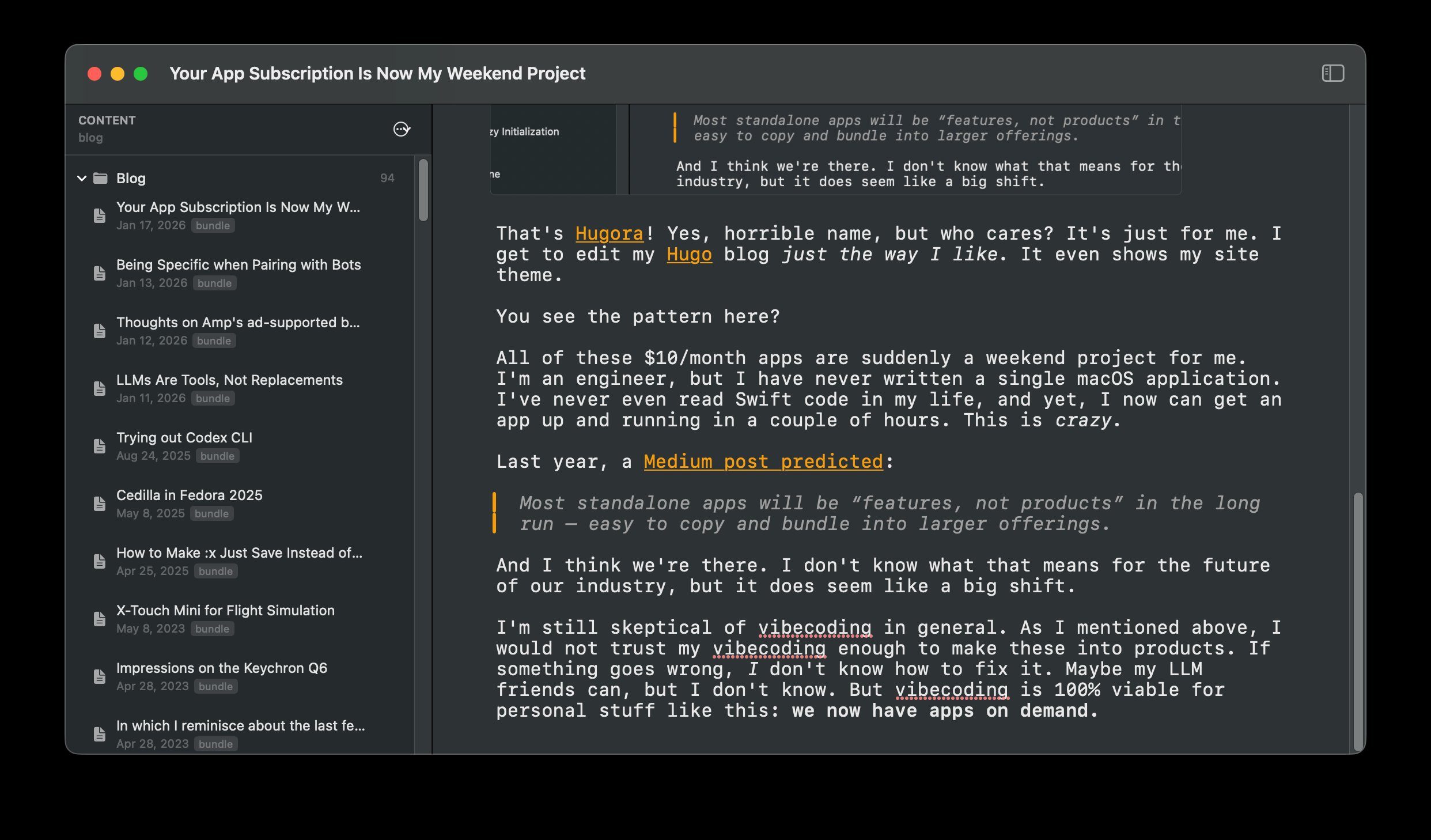
What's striking isn't just that I built these tools—it's that I could. I'm a software engineer, but I've never written a macOS application before. I've never read Swift code. Yet, with AI assistance, I can have a functional app running in a couple of hours. The barrier between "I have an idea" and "I have a working tool" has collapsed.
This represents a profound shift in software economics. A Medium post from last year predicted that most standalone apps would become "features, not products"—easily copied and bundled into larger offerings. We've arrived at that future, but in an unexpected way. The features aren't being bundled into corporate products; they're being unbundled into personal tools.
The implications are multifaceted. For developers, the value proposition changes. When anyone can create a personal solution to a $10/month problem, the market for simple, single-purpose applications shrinks. These aren't products anymore—they're features of a personal workflow, built on demand and discarded when needs change.
For users, this creates unprecedented agency. The gap between "I wish this worked differently" and "I have a tool that works exactly as I wish" narrows to a weekend project. The subscription model, which sells convenience, faces competition from personal solutions that offer not just convenience but perfect alignment with individual preferences.
Yet there's a crucial caveat. I wouldn't trust these vibecoded applications with critical data or sell them as products. When something goes wrong—and something always goes wrong—I lack the deep understanding to diagnose and fix it. The AI can generate code, but it doesn't transfer the years of experience that teach you how to debug, optimize, and secure software. My LLM collaborators might help, but the fundamental responsibility and understanding remain mine.
This tension defines the current moment. We have tools that democratize creation but don't yet democratize expertise. The result is a proliferation of personal tools that are wonderfully effective for their specific purpose but fragile in ways their creators don't fully comprehend.
The broader industry impact remains uncertain. Will this reduce the market for small software companies? Probably. Will it increase the value of deep technical expertise? Likely. The ability to quickly assemble personal tools doesn't replace the need for robust, secure, scalable software—it just changes where that software gets built and for whom.
What we're witnessing is the emergence of "apps on demand"—not as a service, but as a personal practice. The $10/month subscription isn't just buying software; it's buying the guarantee of maintenance, security, and support. When you build it yourself, you trade that guarantee for perfect customization and zero ongoing cost.
For now, I'll keep my personal projects separate from my professional work. Jabber, Reel, and Hugora live on my machines, solving my specific problems. They're not products, and they're not meant to be. They're weekend projects that happen to replace subscriptions, and in that narrow space, they're perfect.
Comments
Please log in or register to join the discussion