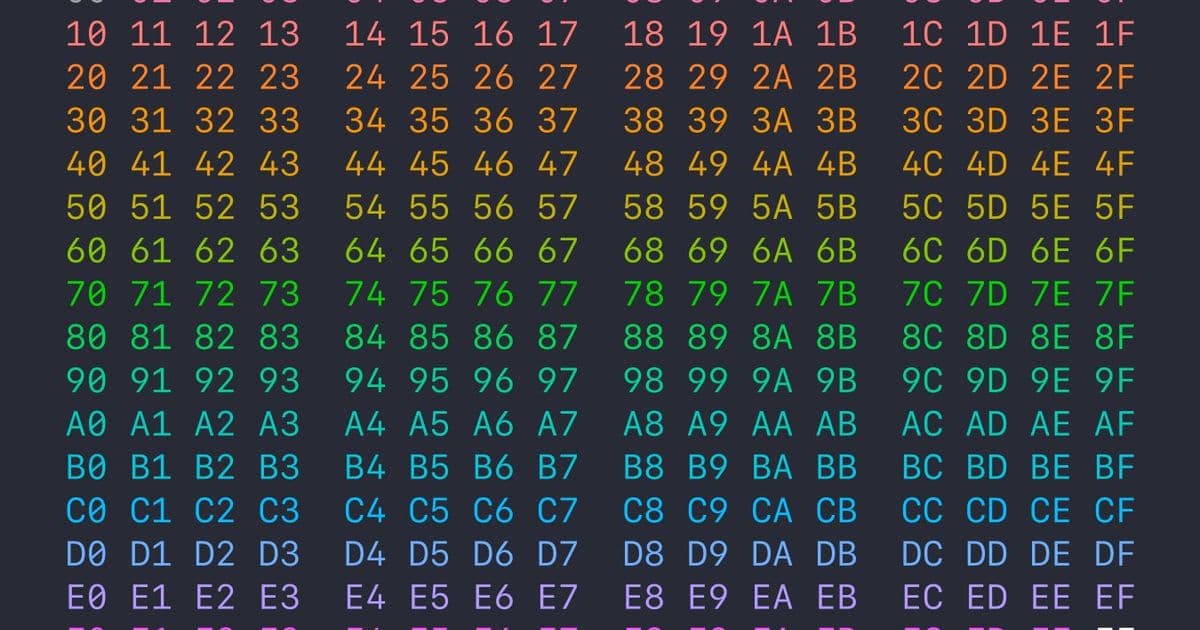
An argument for color-coding bytes in hex editors to enhance pattern recognition and data analysis, with examples demonstrating the visual improvement over monochrome displays.
The humble hex editor, a tool revered by reverse engineers, data forensic analysts, and low-level programmers, has remained stubbornly monochrome for decades. Alice Pellerin's compelling argument challenges this convention by demonstrating how color-coding bytes transforms hexadecimal dumps from cryptic streams into visually intelligible data landscapes.
At the heart of this proposal lies a fundamental insight about human cognition: our brains excel at visual pattern recognition. When confronted with a wall of hexadecimal digits like 15 29 21 25 03 2F 2E 2B 15 11 24 3F 10 14 3B 13, locating a specific byte value becomes an exercise in tedious scanning. Yet when that same data is color-coded, the target byte stands out immediately, its visual distinctiveness cutting through the noise. This isn't merely cosmetic enhancement; it's a cognitive accessibility improvement that leverages our evolutionary strengths.
The author provides several striking examples that illustrate the power of color-coding. In one demonstration, a Nintendo DS game file containing small 32-bit integers becomes visually intelligible, with the consistent 00 00 high bytes immediately apparent. Without color, this structural information remains hidden, requiring painstaking manual analysis. Another example shows ascending indices creating a "rainbow gradient" when color-coded, a pattern completely invisible in monochrome.
Perhaps most compelling is the visualization of bitmap data where each hex digit represents a pixel. In the uncolored version, the shape of a digging hole in a game is barely discernible. With color-coding, intricate details emerge, demonstrating how this technique can transform abstract binary data into concrete visual information.
The current state of hex editing tools reveals a stark contrast. While utilities like hexyl offer color-coding with five broad categories (null bytes, printable ASCII, whitespace, control characters, and non-ASCII), the author proposes a more granular approach with 18 color groups—one for each leading nybble (0X, 1X, 2X, etc.), plus special handling for 00 and FF. This finer granularity reveals subtle patterns that broader categories miss, such as UTF-8 character structures or two's complement negative numbers.
The implications of this improvement extend beyond mere convenience. In fields like malware analysis, file format reverse engineering, or digital forensics, the ability to quickly identify patterns in binary data can dramatically reduce analysis time. Color-coding doesn't change the underlying information, but it changes how we perceive and process that information, effectively lowering the cognitive barrier to understanding complex data structures.
Counter-arguments might suggest that color preferences are subjective or that the feature adds unnecessary complexity. However, the author notes that implementations like hexyl demonstrate this can be done with minimal performance impact. The default monochrome display in tools like xxd represents a historical artifact rather than an optimal design choice.
Pellerin's personal project, hexapoda, exemplifies this philosophy in action. Written in Rust with Ratatui, this modal hex editor embraces color-coding as a fundamental feature, alongside modern conveniences like multiple cursors and selection-first operations.
The call to action here is clear: developers of tools handling hexadecimal data should implement color-coding as a standard feature. The technical implementation is straightforward, the cognitive benefits are substantial, and the user experience improvement is undeniable. As we've seen with syntax highlighting in code editors, color-coding has become an expected feature that dramatically improves usability. It's time for hex editors to undergo the same evolution.
In an era where data complexity continues to grow, tools that enhance our ability to understand and manipulate binary information become increasingly valuable. Color-coding bytes in hex editors represents a simple yet profound improvement that aligns tool design with human cognitive capabilities. As Pellerin demonstrates, sometimes the most revolutionary advancements come not from complex algorithms, but from reimagining how we present information to the human mind.
Comments
Please log in or register to join the discussion