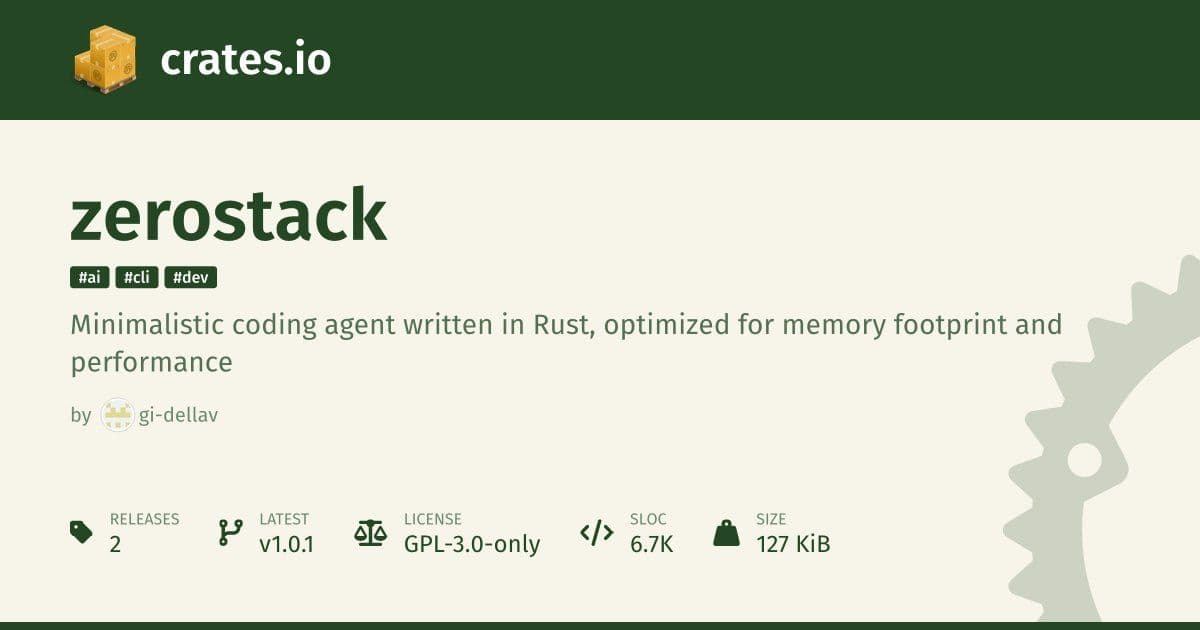
As coding agents proliferate, zerostack distinguishes itself with minimal resource usage and focused feature set, challenging the notion that more complex tools are always better.
The coding agent landscape continues to evolve with new entrants, and zerostack emerges as a noteworthy contender from the Rust ecosystem. This minimal coding agent, inspired by tools like pi and opencode, presents an alternative approach focused on resource efficiency and targeted functionality rather than feature bloat.
Technical Architecture and Design Philosophy
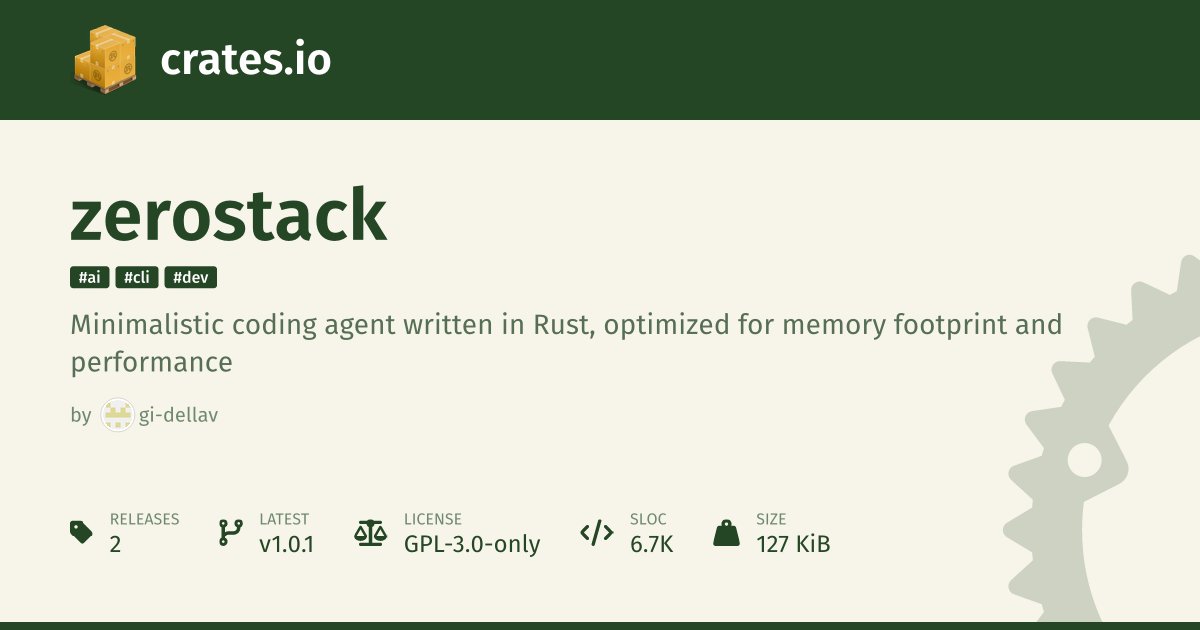
zerostack is built with Rust, a language choice that immediately signals performance and safety considerations. The project's architecture centers around a modular approach with distinct systems for different aspects of the coding assistant experience. The binary size of 8.9MB and RAM footprint of approximately 8-12MB stands in stark contrast to JavaScript-based alternatives that often consume hundreds of megabytes.
The agent supports multiple AI providers including OpenRouter, OpenAI, Anthropic, Gemini, and Ollama, with extensibility for custom providers. This multi-provider approach allows users to select the most suitable backend for their needs, whether that's a commercial service or a local model.
Feature Analysis: Depth vs. Breadth
zerostack's feature set reveals a thoughtful approach to functionality rather than comprehensive coverage. The file tools system provides read, write, edit capabilities with diff display, grep, find_files, and list_dir functions. The edit functionality by exact match suggests a conservative approach to file modifications, potentially reducing unintended changes compared to more aggressive editing strategies.
The bash execution component includes permission gating, optional sandboxing with bubblewrap, and doom-loop detection. The latter is particularly interesting, as it addresses a common problem with AI agents - repetitive tool calls that can lead to system instability. This safety mechanism triggers after identical tool calls occur three or more times, preventing runaway operations.
The permission system offers four configurable modes ranging from restrictive to permissive, with granular control per tool through glob patterns. This layered approach acknowledges that different development scenarios require different safety considerations. The standard mode allows safe commands like ls, cd, and git operations without confirmation while requiring approval for writes and destructive operations.
Performance Metrics in Context
zerostack's performance claims are impressive on paper: 0.0% CPU usage on idle and approximately 1.5% when using tools, measured on an Intel i5 7th generation processor. These figures contrast sharply with opencode, which reportedly uses ~2% CPU on idle and ~20% when working. However, these comparisons should be viewed with caution, as performance can vary significantly based on the specific operations, model being used, and testing methodology.
The resource efficiency becomes particularly valuable in development environments where multiple tools run simultaneously, or in resource-constrained settings like containers or lower-powered machines. The small binary size also contributes to faster startup times and easier distribution.
Prompt System and Behavioral Flexibility
One of zerostack's more sophisticated features is its built-in prompt system, which allows runtime switching between different behavioral modes without requiring configuration changes or context management. The included prompts range from code (default) and planning to review, debug, and specialized modes like frontend-design and security-review.
This approach challenges the common pattern of requiring separate tools or complex prompt engineering for different development tasks. By switching between modes like 'plan' and 'code', developers can maintain conversational context while changing the agent's focus and capabilities.
The system also automatically loads AGENTS.md or CLAUDE.md from project directories, providing context-aware behavior without explicit configuration. This feature acknowledges that many development teams already maintain documentation that could inform an AI assistant's behavior.
Session Management and State Persistence
zerostack implements session management with save/load/resume functionality, addressing a common limitation in many AI coding tools. The ability to pause and resume work sessions is particularly valuable for complex development tasks that span multiple days or require context preservation across interruptions.
The auto-compaction feature to stay within context windows demonstrates awareness of the practical limitations of current LLMs. While not a perfect solution, it represents a pragmatic approach to managing the finite context windows that constrain many AI coding assistants.
Experimental Features and Future Directions
The project includes several experimental features that suggest potential future development paths:
Loop system: An iterative coding approach for long-horizon tasks that repeatedly plans, executes, and validates until completion or iteration limits are reached.
Git worktrees integration: A branch-per-task workflow entirely within the chat interface, addressing the common pattern of creating feature branches for specific tasks.
MCP support: Integration with Model Context Protocol servers for extended tooling capabilities.
These features indicate that while zerostack currently emphasizes simplicity and efficiency, the development team is considering expansion into more complex workflows and integrations.
Limitations and Counter-Perspectives
Despite its strengths, zerostack has limitations worth considering:
The minimal approach means fewer built-in skills compared to more comprehensive tools. While the prompt system provides behavioral flexibility, it doesn't replace specialized tools for certain tasks like complex refactoring or architectural analysis.
The experimental status of some features like the loop system and git worktrees integration means they may lack the polish and reliability of more mature components. Early adopters should be prepared to encounter rough edges.
The permission system, while sophisticated, adds complexity that might deter users seeking a simpler out-of-the-box experience. The need to configure permission patterns and modes could present a barrier for casual users.
Additionally, the performance benchmarks, while impressive, are measured against a single reference point (opencode). A more comprehensive comparison across multiple coding agents would provide better context for zerostack's efficiency claims.
Practical Implementation and Adoption
zerostack's installation follows standard Rust package practices, requiring Cargo and git. The optional sandbox mode with bubblewrap adds a layer of security for those working with potentially untrusted code or in sensitive environments.
The quickstart experience is straightforward, with API key configuration and simple commands for interactive sessions, one-shot operations, and session continuation. The command-line interface includes model switching, prompt management, and session handling through intuitive slash commands.
The project's GPL-3.0 license ensures open access while maintaining copyleft requirements, which may influence adoption in commercial contexts. Organizations evaluating the tool should consider their licensing policies and requirements.
Broader Implications for the Coding Agent Ecosystem
zerostack's emergence reflects several interesting trends in the AI-assisted development space:
Resource efficiency as a differentiator: As coding agents become more common, performance and resource usage are becoming key differentiators rather than just raw capability.
Modular approaches: Rather than building monolithic tools, projects like zerostack emphasize focused components that can be combined as needed.
Safety and control: Increased attention to permission systems and safety mechanisms acknowledges the potential risks of AI agents with system access.
Context-aware behavior: The ability to adapt behavior based on project documentation and context represents a maturation beyond simple prompt-based interactions.
Conclusion
zerostack presents a compelling alternative in the coding agent space, particularly for developers who prioritize resource efficiency and targeted functionality. Its Rust foundation, multi-provider support, and sophisticated permission system offer a different value proposition than more comprehensive tools.
While the minimal approach may limit zerostack for certain complex use cases, its efficiency and thoughtful feature design make it particularly suitable for everyday development tasks, resource-constrained environments, and scenarios where safety considerations are paramount.
As the coding agent landscape continues to evolve, zerostack's emphasis on doing fewer things well rather than more things adequately may prove to be a winning strategy. The project's balance of performance, safety, and focused functionality positions it as a noteworthy contribution to the growing ecosystem of AI-assisted development tools.
For developers interested in exploring zerostack, the GitHub repository and crates.io page provide additional information and installation instructions.
Comments
Please log in or register to join the discussion