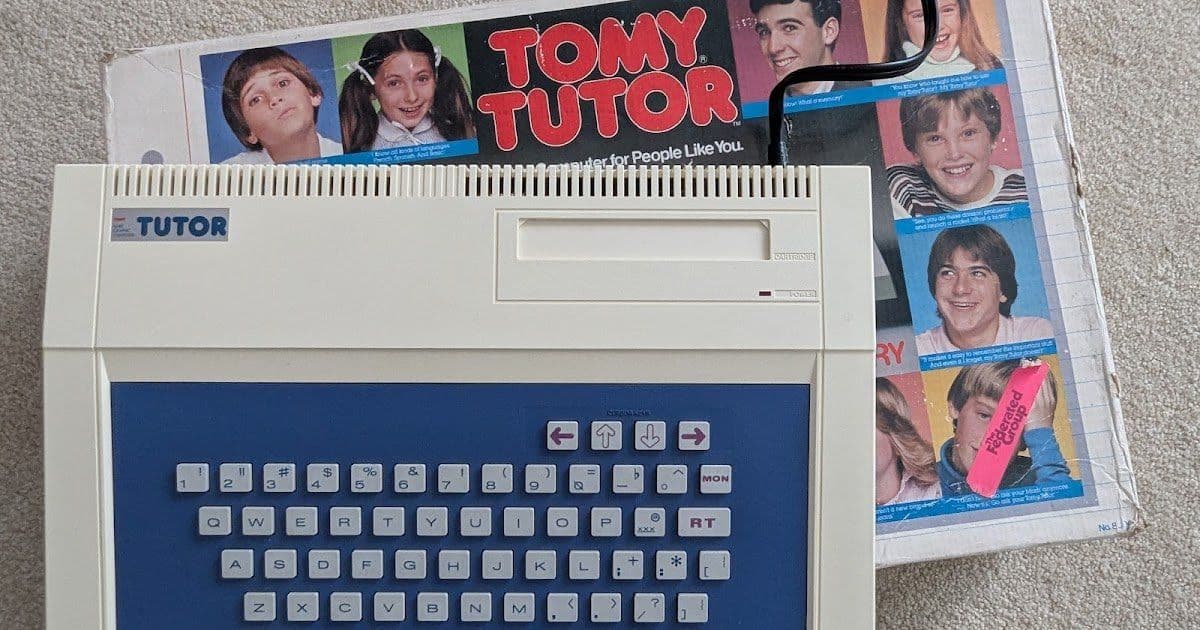
An examination of the obscure Tomy Tutor home computer, its Japanese origins, and the marketing documents that reveal how this early 16-bit system attempted to navigate the crowded 1983 home computer market.
The Tomy Tutor stands as one of the most curious footnotes in early home computing history—a 16-bit system released in 1983 that promised much but ultimately faded into obscurity. What makes this particular machine fascinating isn't just its technical specifications or its brief time on the market, but the story of its development from Japan to international markets and the marketing documents that recently surfaced, offering a glimpse into the competitive landscape of early home computing.
Technical Foundation: A 16-bit System with Compromised Resources
The Tomy Tutor represented an interesting technical achievement for its time. Powered by a 2.7MHz TMS 9995 CPU—one of the first true 16-bit processors designed for home use—the system offered capabilities that surpassed many of its contemporaries. However, the implementation contained significant limitations that would ultimately constrain its potential.
The system's 16K of RAM presented a peculiar allocation challenge. The TMS 9918A video display processor consumed the vast majority of this memory, leaving only 256 bytes directly addressible by the CPU. This constraint meant that while the Tutor had impressive graphics capabilities for its class, its practical memory for programs and data was severely limited. The system featured two dialects of BASIC: the Japanese Pyuuta's original G-BASIC with non-standard Japanese keywords, and a more conventional version based on TI Extended BASIC that was developed for the international market.
The graphics capabilities, powered by the popular TMS 9918A VDP, were actually quite sophisticated for an entry-level system, supporting sprites and high-resolution graphics that would have required expensive add-on cartridges on competing systems. The Japanese version even included a built-in paint box application that demonstrated the system's graphical capabilities.
From Pyuuta to Tutor: An International Evolution
The Tutor's origins trace back to Japan, where it was known as the Pyuuta (ぴゅう太), a name that translates roughly to "Computer Dude"—reflecting its target audience of children and young teens. The Pyuuta first appeared at the 1982 Tokyo Toy Show, where Tomy positioned it as "[The] Fun Computer" with a focus on graphics and ease of use.
The Japanese version came with distinctive features that would be modified for international markets:
- Sturdy plastic construction with rubber chiclet keys
- Two disc-style joy controllers included in the package
- Cassette interface cable for data storage
- G-BASIC with Japanese katakana keywords
- Built-in paint box application
Tomy's advertising in Japan emphasized the system's versatility, with slogans like "Your TV becomes an amusement park. It becomes an art gallery. It becomes a library." The company even employed a curious campaign featuring a T-Rex exclaiming, "It's a computer, so it's a heck of a toy."
For the international market, Tomy made several significant modifications. The UK version, known as the Grandstand Tutor, replaced the Japanese G-BASIC with TI Extended BASIC, which had been modified to remove direct memory access functions. This version was particularly rare, with only limited distribution through Adam Imports.
The American version, marketed simply as the Tomy Tutor, represented a compromise between the original Japanese design and the feedback from the UK market. It included both BASIC variants (though documentation suggests only one was typically available) and removed some of the more Japan-specific features while maintaining the core hardware architecture.
Marketing Strategy in a Crowded Field
The recent discovery of marketing documents offers remarkable insight into Tomy's approach to the competitive home computer market of 1983. These documents, found in a storage unit and likely belonging to marketing executive Len Vucci, reveal several interesting aspects of Tomy's strategy:
Alternative Naming: The computer was consistently referred to as the "TomyOne" or "Tomy-1" in these documents, with no mention of the "Tutor" name that would eventually be used.
Target Audience: The marketing materials positioned the system toward "first-time computer buyers" and emphasized its ease of use compared to more technical systems.
Competitive Analysis: The documents include a detailed comparison with other entry-level systems of the era, including the Atari 400, Commodore VIC-20, Timex/Sinclair 1000, and Texas Instruments 99/4A.
The competitive analysis reveals an interesting perspective on the market. The document suggests that the Timex/Sinclair 1000, priced under $100, offered good performance but lacked software appeal beyond hobbyists. The Atari 400, Commodore VIC-20, and TI-99/4A were positioned as comparable systems that required additional peripherals to meet "basic computing needs."
Notably, the Commodore 64 is absent from this analysis, likely because it occupied a different market segment with its full 64K of RAM and more advanced capabilities at a higher price point. Similarly, the Apple II and Atari 800 were not considered direct competitors in the entry-level space.
The document describes several advantages for the TOMY system:
- Dual controllers included (eliminating the need to purchase separately)
- Built-in cassette interface
- Simplified setup with built-in RF modulator and power supply
- More durable keyboard than competitors
- "Menu-driven command modes" that were easier for novices
- "TOMY Graphics Language with sprites" that provided superior educational and entertainment value
The Mystery of the Marketing Documents
Several aspects of these marketing documents create historical puzzles:
Hardware Discrepancy: The described system matches the Japanese Pyuuta more closely than the Tutor. The document mentions controllers and cassette cable as included, which was true of the Pyuuta but not the Tutor.
Software Omission: The document makes no mention of any version of BASIC, despite the system's primary programming language being a key selling point.
Name Absence: The "Tutor" name is completely absent from these materials.
The most plausible explanation is that these documents represent an earlier marketing plan to bring the Pyuuta directly to the United States without modification. The name change to "Tutor" and the development of Tomy BASIC may have occurred later, after Tomy gained feedback from the UK test market.
The 1983 Home Computer Explosion
The Tutor's American debut occurred during the Summer CES 1983 in Chicago, a pivotal moment in home computing history. The market was experiencing what the author describes as a "low-end home computer explosion," with numerous systems competing for consumer attention:
- Coleco Adam
- Mattel Aquarius
- Radio Shack MC-10
- SpectraVideo SV-318 and SV-328
- VTech VZ200
Interestingly, Texas Instruments had planned to show their unreleased 99/8 system at the same show but canceled at the last minute, despite the Tutor being based on TI technology.
Market Failure and Legacy
Despite its technical innovations and interesting approach to the market, the Tomy Tutor was a commercial failure. Tomy lost significant money on the system and exited the American home computer market in 1984, before promised peripherals—including an expansion chassis—could be developed. In Japan, minimal support continued until 1985 with a few additional game releases.
The system's failure can be attributed to several factors:
- The intense competition of 1983, with numerous similar systems vying for market share
- The limited practical memory available to programs and data
- The lack of a robust software library compared to established systems
- Marketing challenges in positioning the system as both a toy and a serious computing device
The Tomy Tutor represents an interesting case study in early home computing—a technically advanced system that couldn't overcome market challenges and positioning difficulties. Its story reveals the rapid pace of change in the early computer industry, where systems with significant technical capabilities could quickly become obsolete in the face of market forces.
For vintage computing enthusiasts, the Tutor remains a fascinating curiosity—a system that pushed the boundaries of what was possible in entry-level computing in 1983, even if it couldn't achieve commercial success. The recently discovered marketing documents only add to the system's mystique, offering a window into a time when the home computer market was still finding its identity and numerous companies were vying to define the future of personal computing.
For those interested in exploring this system further, technical specifications and programming information can be found on various vintage computing websites, and the original marketing documents continue to provide valuable insight into the competitive landscape of early home computing.
Comments
Please log in or register to join the discussion