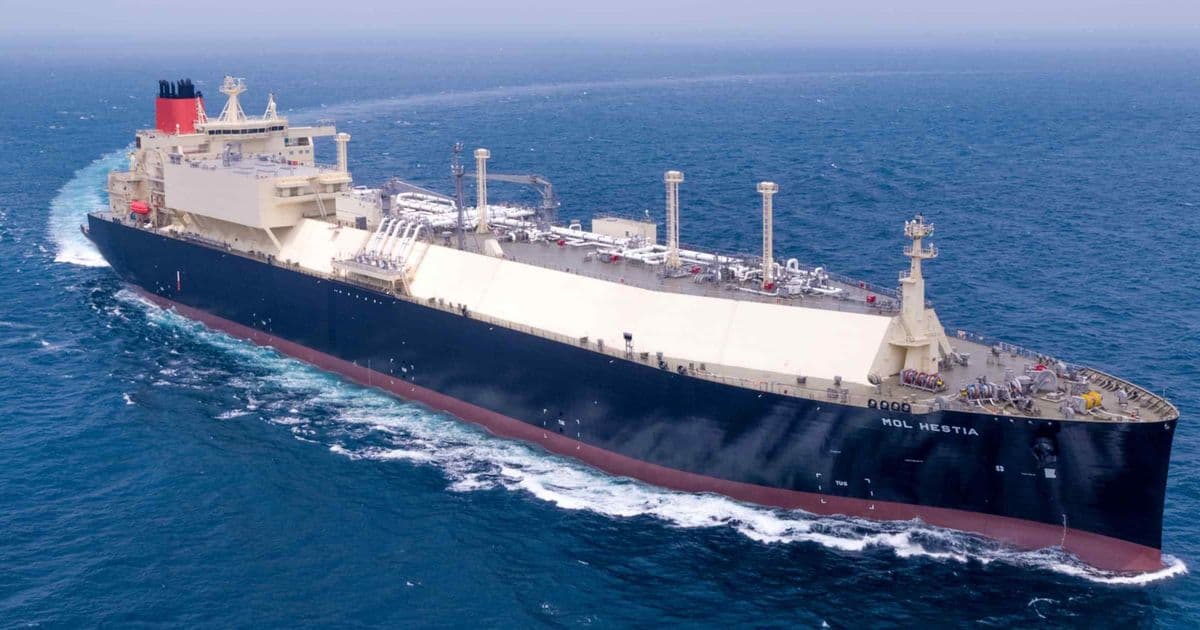
Three major Japanese shipbuilders are teaming up to rebuild the nation's liquefied natural gas carrier construction capacity, targeting 3 to 5 vessels annually by 2035 in a bid to reclaim market share lost to South Korean and Chinese rivals.

Imabari Shipbuilding, Kawasaki Heavy Industries, and Namura Shipbuilding have formed a joint initiative to resume domestic production of LNG carriers in Japan, with operations targeted to begin around 2035. The three companies plan to collectively build three to five vessels annually, potentially leveraging South Korean maritime technologies to accelerate the restart of a capability Japan surrendered to foreign competitors over the past two decades.
The Decline of Japanese LNG Shipbuilding
Japan once dominated global LNG carrier construction. At the peak of its shipbuilding prowess, Japanese yards produced a significant share of the world's specialized gas carriers, vessels designed to transport liquefied natural gas at temperatures of minus 162 degrees Celsius across thousands of ocean miles. The technical complexity of these ships, with their insulated cargo containment systems and boil-off gas management, made them a high-value segment of the maritime industry.
The erosion began in the early 2000s as South Korean shipbuilders, led by Hyundai Heavy Industries, Samsung Heavy Industries, and Daewoo Shipbuilding and Marine Engineering, aggressively invested in LNG carrier construction capacity. South Korean yards offered competitive pricing, faster delivery times, and increasingly sophisticated designs. Chinese shipyards followed, supported by state subsidies and growing domestic demand for LNG import infrastructure.
By 2020, South Korea controlled roughly 70% of the global LNG carrier orderbook, with China capturing most of the remainder. Japanese yards pivoted toward smaller, specialized vessels and offshore structures, abandoning the large LNG carrier segment that had once been their showcase.
Market Forces Driving the Revival
Several converging factors have prompted this re-entry decision. Global LNG trade has expanded dramatically, with demand rising from approximately 300 million tonnes per annum in 2015 to over 420 million tonnes by 2025. The International Energy Agency projects demand could reach 500 million tonnes annually by 2030, driven by Asian industrialization and European efforts to replace Russian pipeline gas.
This demand surge has created a vessel shortage. The existing LNG carrier fleet, currently numbering around 700 vessels, requires continuous expansion to keep pace with new liquefaction capacity coming online in the United States, Qatar, and Australia. Order backlogs at South Korean yards stretch into 2028 and beyond, with some deliveries pushed into the early 2030s.
Japan's position as the world's largest LNG importer, purchasing approximately 65 million tonnes in 2025, gives domestic shipbuilders a built-in customer base. Tokyo Gas, Kansai Electric Power, and other utilities require continued fleet modernization and expansion. Mitsui O.S.K. Lines recently announced a $300 million investment in a US offshore LNG facility, signaling sustained Japanese commitment to the LNG supply chain.
The South Korean Technology Question
The plan to incorporate South Korean technologies represents a notable strategic pivot. Japanese yards historically maintained proprietary design capabilities and rarely sought external technical partnerships for hull construction. The willingness to collaborate with Korean firms reflects pragmatic recognition that South Korean builders have advanced significantly in membrane-type containment systems and ship efficiency optimization.
Membrane tanks, now the dominant cargo containment technology for large LNG carriers, require specialized welding techniques and insulation panel installation that South Korean yards have refined over two decades of production. Japanese builders would need to master these systems to compete on specifications, not just price.
The specific form of technology transfer, whether through licensing agreements, joint ventures with Korean engineering firms, or subcontracted module production, remains under discussion. Industry sources suggest initial vessels may rely heavily on Korean design packages while Japanese yards focus on hull construction and integration.
Capacity and Workforce Constraints
Scaling from zero to three to five LNG carriers annually by 2035 presents significant logistical challenges. Japanese shipyards have downsized substantially since the 1990s, with total industry employment declining from over 200,000 workers to under 100,000. Specialized welders qualified for cryogenic tank construction are particularly scarce.
The three participating companies are located in different regions. Imabari Shipbuilding operates primarily from Imabari in Ehime Prefecture, Kawasaki Heavy Industries maintains shipyards in Kobe and Sakaide, and Namura Shipbuilding focuses on Osaka Bay facilities. Each will need to upgrade drydock infrastructure and install specialized equipment for LNG carrier construction.
An Imabari shipbuilding district recently explored recruiting foreign workers and deploying artificial intelligence systems to address labor shortages, a trend that will likely accelerate as LNG carrier production ramps up.
Competitive Positioning
Japanese entry into the LNG carrier market will not fundamentally reshape competitive dynamics in the near term. South Korean and Chinese yards maintain substantial advantages in scale, supply chain integration, and production efficiency. A combined output of three to five vessels annually from Japan would represent less than 10% of current global annual LNG carrier deliveries.
The strategic value lies in supply chain diversification. Japanese shipping lines and energy utilities gain an alternative sourcing option, reducing dependence on a concentrated Korean-dominated market. For Imabari, Kawasaki, and Namura, the LNG carrier segment offers higher margins than bulk carriers and product tankers, potentially justifying the capital investment required.
Broader Implications for Maritime Trade
The revival of Japanese LNG carrier construction aligns with broader government efforts to strengthen domestic industrial capabilities in critical infrastructure. Japan's crude oil imports have declined roughly 50% since the Iran conflict exposed vulnerabilities in Middle Eastern energy supply chains, accelerating the shift toward LNG as a transitional fuel.
Tokyo Gas and partners are simultaneously co-developing offshore LNG terminals in Malaysia, while Japan's government has negotiated agreements with Malaysia to secure maximum possible LNG and naphtha exports. These supply-side investments create parallel demand for additional carrier capacity.
The 2035 timeline allows sufficient preparation but introduces execution risk. Global LNG trade patterns could shift if renewable energy deployment accelerates faster than anticipated, or if new liquefaction capacity fails to materialize at projected rates. The three shipbuilders must balance investment commitment with flexibility to adapt to evolving market conditions.
For now, the initiative represents a calculated bet that LNG will remain a foundational element of Asia's energy mix through 2050, and that Japan's maritime industry can reclaim a meaningful position in a segment it once defined.
Comments
Please log in or register to join the discussion