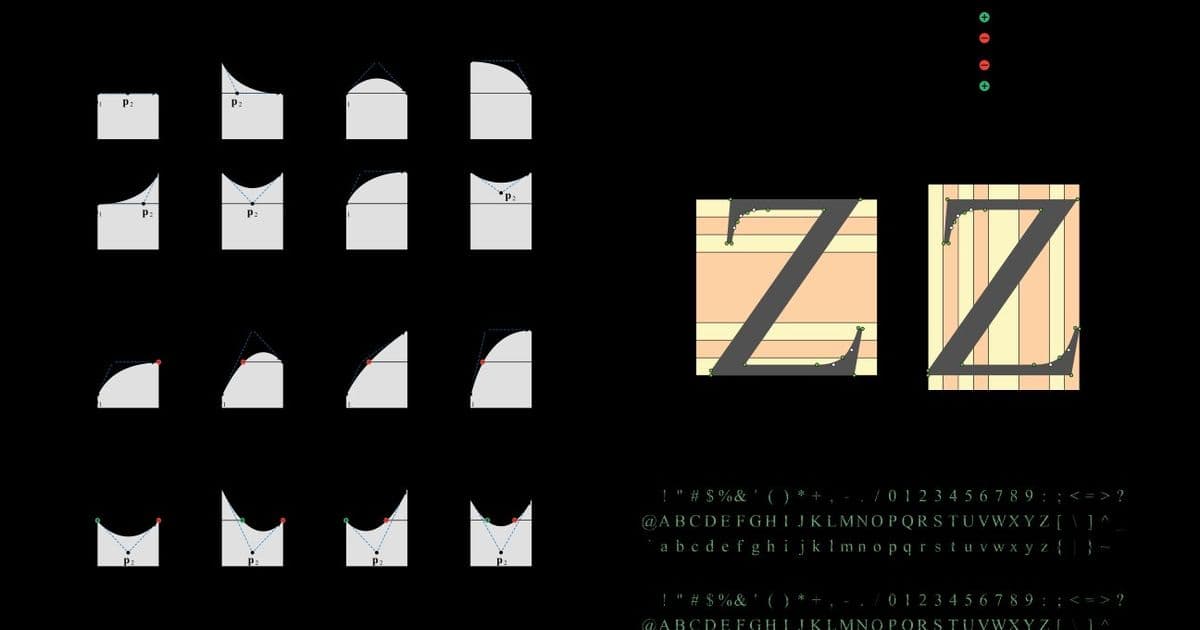
Ten years after its inception, Eric Lengyel's Slug Algorithm for rendering fonts directly from Bézier curves on the GPU has evolved significantly, with the recent dedication of its patent to the public domain marking a new chapter for this influential technology.
A Decade of Slug: The Evolution of GPU-Based Font Rendering and Its Open Source Future
The field of computer graphics has seen numerous innovations over the years, but few have had as sustained an impact on text rendering as Eric Lengyel's Slug Algorithm. Developed in the Fall of 2016, this technique for rendering fonts directly from Bézier curves on the GPU has now reached its tenth anniversary, representing a full decade of technological evolution and industry adoption.
Origins and Industry Impact
What began as a solution for text rendering in the C4 Engine has grown into one of the most successful software products Lengyel has created. The algorithm was first published in the Journal of Computer Graphics Techniques (JCGT) in mid-2017, with version 1.0 of the Slug Library following shortly thereafter. Since then, Slug has been licensed extensively across numerous industries.
The breadth of adoption is remarkable, extending from the video games sector to specialized fields including scientific visualization, CAD systems, video editing software, medical equipment interfaces, and even planetarium projection systems. Among Slug's notable clients are industry giants such as Activision, Blizzard, id Software, 2K Games, Ubisoft, Warner Brothers, Insomniac, and Zenimax, alongside Adobe and many others.
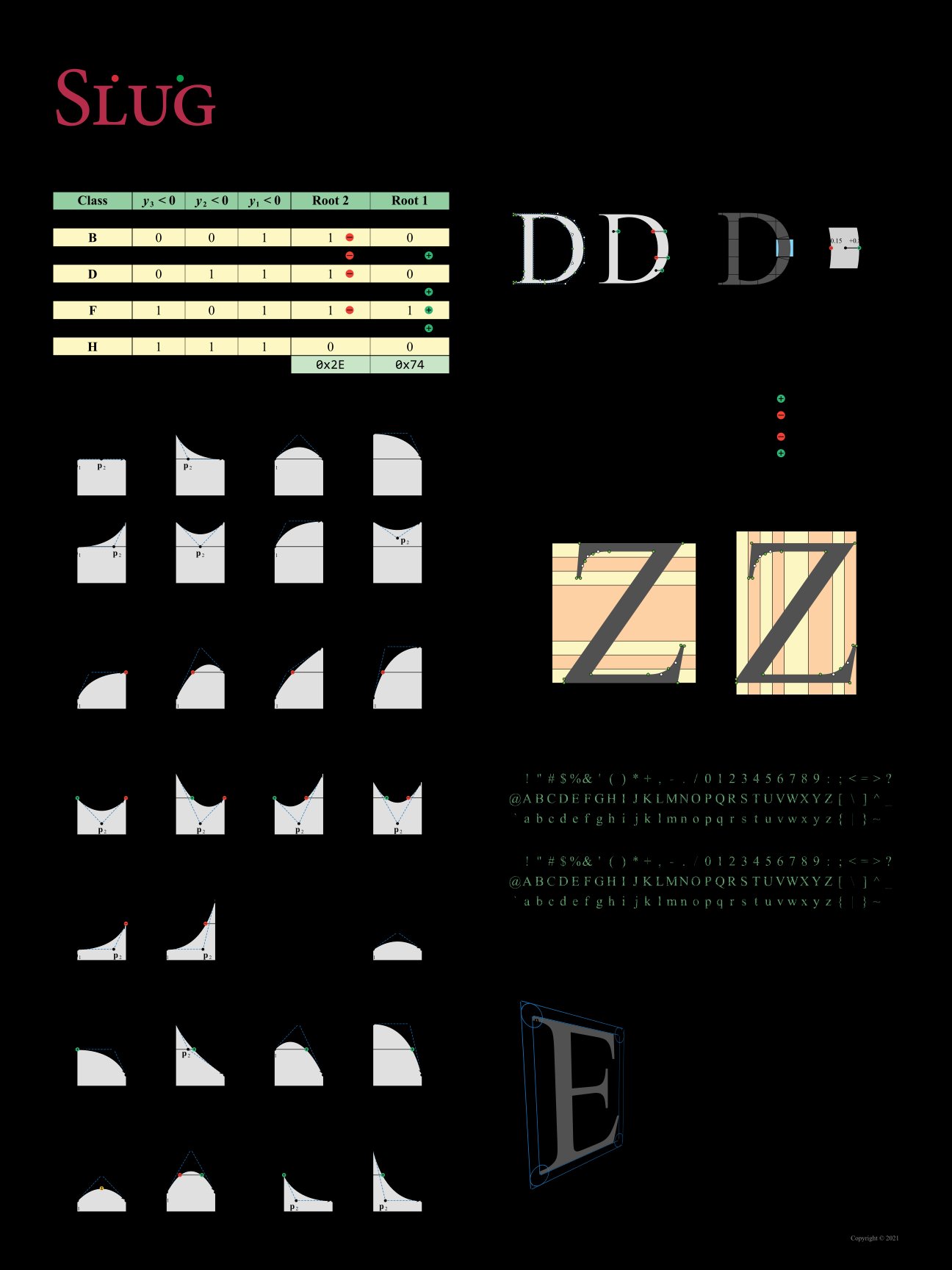
The Slug Algorithm represents a significant departure from traditional text rendering methods that rely on precomputed texture maps. Instead, Slug renders text and vector graphics directly from Bézier curve data on the GPU, eliminating the need for cached images while maintaining high visual quality.
Technical Foundations
At its core, the Slug algorithm addresses three critical challenges: robustness, performance, and visual quality. Robustness requires that the rendering never produces artifacts like dropped pixels, sparkles, or streaks under any circumstances. Performance demands that the algorithm can render substantial amounts of text without significantly impacting frame rates, even on the game consoles of 2016. Visual quality necessitates nicely antialiased text with smooth curves and sharp corners at any scale and viewing angle.
The algorithm achieves these goals through a sophisticated approach to curve rasterization that operates directly on the GPU. Unlike traditional methods that convert vector outlines to bitmaps on the CPU and upload textures, Slug processes the mathematical curves directly in the pixel shader, enabling high-quality results without the memory bandwidth requirements of texture-based approaches.
Evolution of the Rendering Method
Since the original publication and release of the Slug Library, several refinements have improved the algorithm's efficiency and simplicity.
One significant change was the removal of the "band split optimization" described in the original paper. This optimization had provided a modest speed increase for large glyphs but introduced pixel shader divergence that could hurt performance for smaller text. Additionally, it required storing curve intersection lists twice—once for each ray direction. By removing this optimization, Lengyel not only simplified the pixel shader but also reduced the texture containing band data from four 16-bit components to two.
Another improvement came from the elimination of adaptive supersampling, which had been implemented to enhance text rendered at very small sizes. While this technique reduced aliasing for distant, small text, its benefits were marginal for barely readable text anyway. The aliasing for tiny text was effectively mitigated by the dilation technique described below. Removing supersampling further simplified the pixel shader code.
The approach to multi-color emoji rendering also evolved. The original paper suggested adding a loop to the pixel shader to render emoji as stacked glyphs with different colors per layer. However, this proved suboptimal because many layers covered only a small fraction of the total area while calculations were still performed over the full bounding polygon. The solution was to render independent glyphs on top of each other, allowing each layer to have its own bounding polygon—a faster approach that again simplified the shader code.
Dynamic Dilation: A Major Innovation
The most significant improvement to the Slug algorithm since its introduction is dynamic dilation, a technique that solves a fundamental problem in GPU-based text rendering.
Before dynamic dilation, users had to manually specify a constant distance by which each glyph's bounding polygon would be expanded to ensure that partially covered pixels would be rasterized. This approach had two major drawbacks: if the distance was too small, small glyphs would exhibit aliasing artifacts along their boundaries; if too large, unnecessary padding would waste GPU resources.
Dynamic dilation makes this choice automatic and optimal. It recalculates the required expansion in the vertex shader every time a glyph is rendered, using the current model-view-projection (MVP) matrix and viewport dimensions to determine precisely how far each vertex needs to be moved outward along its normal direction in object space to expand the bounding polygon by half a pixel in viewport space.
This technique guarantees that the centers of partially covered pixels are inside the bounding polygon, ensuring proper rasterization. When text is viewed in perspective, the dilation distance can vary for each vertex, always producing the optimal value without unnecessary padding that wastes GPU resources.
The mathematical derivation for dynamic dilation is quite complex, involving the solution of a quadratic equation that accounts for the transformation from object space to viewport space. Lengyel provides the complete derivation in his article, showing how the algorithm calculates the precise offset needed for each vertex based on the current viewing parameters.
The Patent and Its Public Domain Dedication
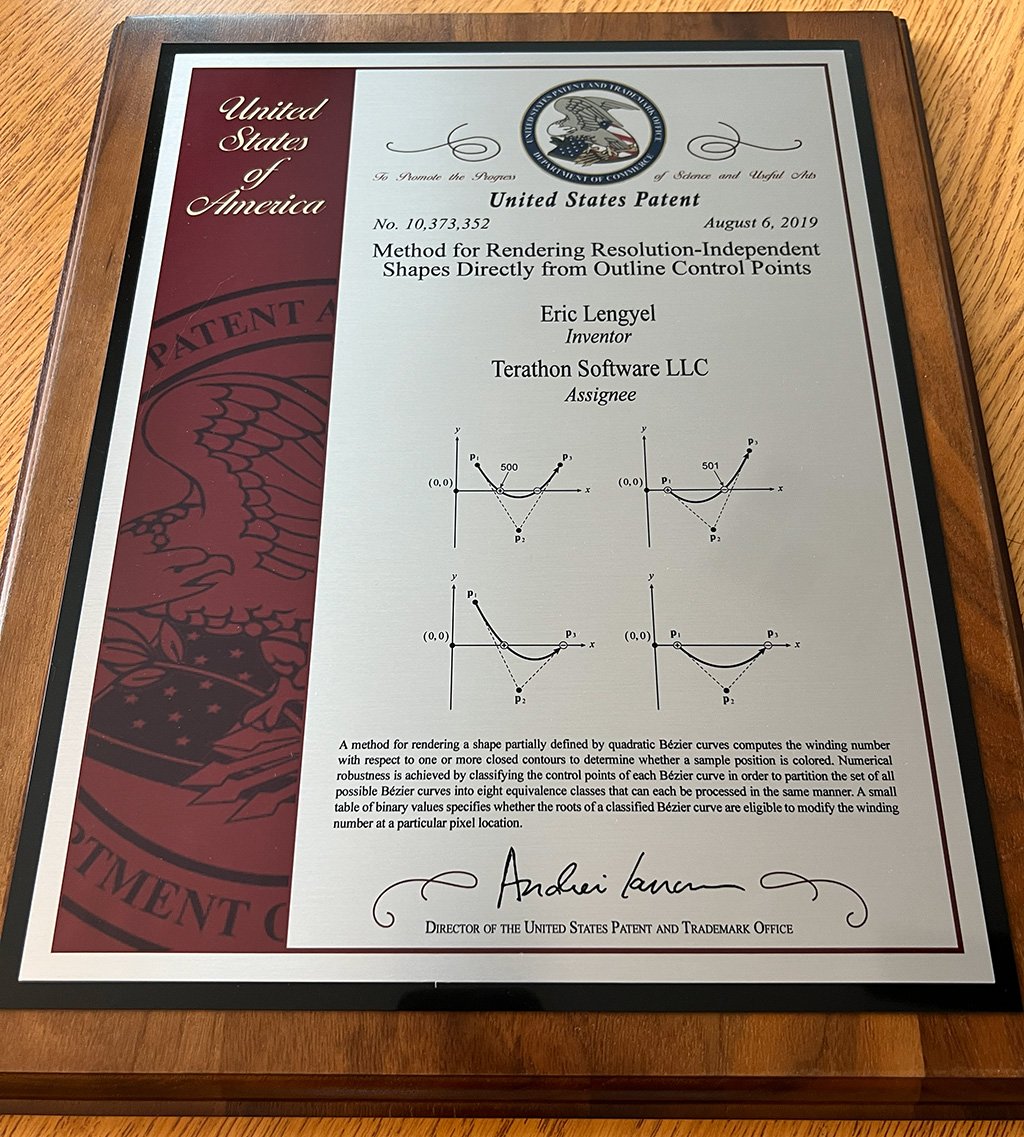
In 2019, Lengyel was granted a patent for the Slug algorithm (US Patent #10,373,352), providing exclusive rights until 2038. However, in a move that reflects the evolving nature of software patents and open-source philosophy, Lengyel has dedicated this patent to the public domain permanently, effective March 17, 2026.
This decision has significant implications for the graphics community. By relinquishing exclusive rights to the algorithm, Lengyel has ensured that anyone can freely implement the Slug algorithm without fear of intellectual property infringement. The patent has already served its purpose well, and Lengyel believes that holding on to it longer benefits nobody.
To facilitate implementations of the Slug algorithm, Lengyel has published reference vertex and pixel shaders based on the actual code used in the Slug Library on GitHub under the MIT license. The pixel shader represents a significant upgrade compared to the code included with the original JCGT paper, and the vertex shader now includes the dynamic dilation technique that had not yet been implemented when the paper was published.
Future Implications
The dedication of the Slug patent to the public domain comes at a time when GPU-based rendering techniques are becoming increasingly important across computing platforms. As displays become higher resolution and more diverse in form factor, the ability to render crisp, scalable text directly from vector data becomes ever more valuable.
For developers, the availability of the Slug algorithm without licensing requirements opens up new possibilities for text rendering in applications ranging from games to scientific visualization tools. The reference shaders provide a solid foundation for implementations, while the public domain status ensures long-term freedom from potential legal concerns.
The evolution of Slug from its initial implementation to its current form demonstrates the iterative nature of graphics programming, where optimizations and simplifications can lead to better performance and more maintainable code. The removal of unnecessary complexity like the band split optimization and supersampling shows that sometimes, less is indeed more in shader development.
Conclusion
Ten years after its creation, the Slug algorithm continues to represent an elegant solution to the challenges of GPU-based text rendering. Its journey from a proprietary product to a public domain technology mirrors the broader trend toward open-source software in the graphics community.
Eric Lengyel's contribution to computer graphics through Slug extends beyond the technical achievement itself. By dedicating the patent to the public domain, he has ensured that this valuable technology will remain freely available for future innovation, potentially inspiring new approaches to rendering and text display that we have yet to imagine.
For those interested in implementing the Slug algorithm, the reference shaders available on GitHub provide an excellent starting point. As the algorithm enters its second decade as open-source technology, it will be fascinating to see how the broader community builds upon this foundation and adapts it to new challenges in computer graphics.
Related resources:
Comments
Please log in or register to join the discussion