A Tsinghua and Harvard founded startup says its tactile gripper learns manipulation tasks with no demonstrations, no cameras, and no dataset. The claim is interesting. The framing deserves scrutiny.
A robotics startup co-founded by researchers trained at Tsinghua University and Harvard, Acorn Robot, is pitching something that runs against the current direction of most robot learning work: a manipulation system that uses no pre-collected training data, no demonstration trajectories, and no visual model. The company calls it a "zero-data" robot. Founder Dr. Jiang Yao, who holds a PhD in Mechanical Engineering from Tsinghua and did postdoctoral work in Neuroscience at Harvard, describes the onboard decision model as "Natus," short for "instinct-driven behavioral emergence."
What's actually being claimed
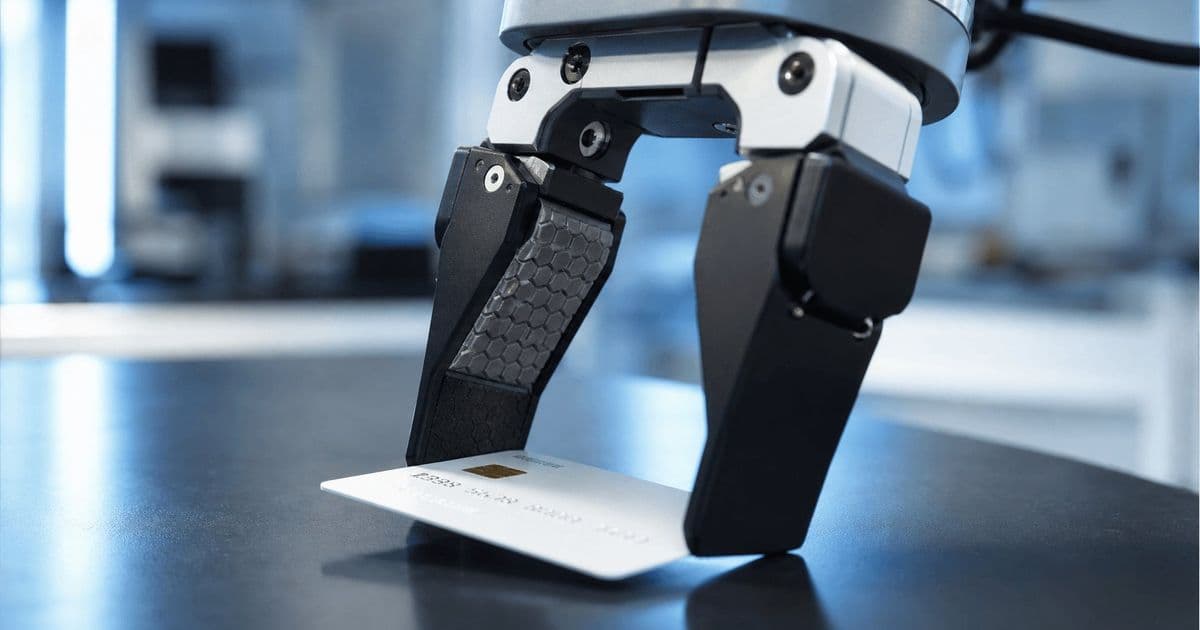
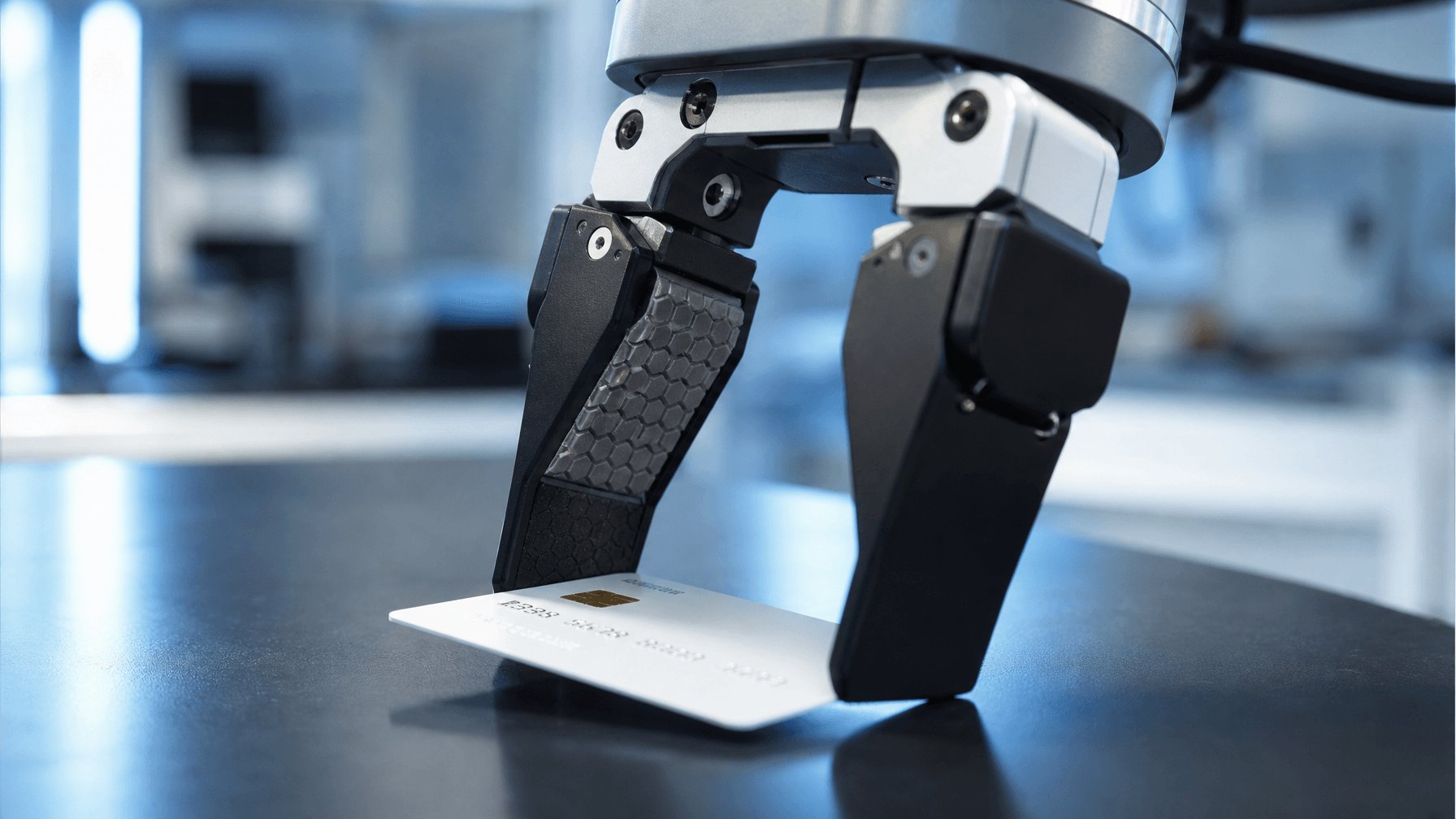
The setup is deliberately spare. The hardware is a single one-degree-of-freedom industrial parallel gripper with two wedge-shaped jaws, each carrying tactile sensors on the inner surface. No external camera. No cloud inference. No data pipeline feeding a policy network offline. The robot attempts a task, fails, senses the contact forces, and adjusts on the next try. In the headline demonstration it picks up a credit card lying flat on a table, wedging one jaw against the card's edge and using the tabletop as a fulcrum to tip it into a grabbable position. Acorn says the system usually needs eight or nine attempts before it lands on a working strategy.
Flat, thin objects on hard surfaces are genuinely a hard case for conventional grippers, because there is no obvious feature to close around and a top-down pinch just scrapes the surface. Solving it through edge-wedging and a fulcrum is a sensible mechanical trick, and doing it from tactile feedback alone is a reasonable demonstration of closed-loop contact control.
What's actually new, and what isn't
The novelty here is positioning more than primitive. Tactile-driven, learning-on-hardware manipulation is an active research area, and online trial-and-error search on a real robot is not itself a new idea. What Acorn is doing is making a product commitment to it: no simulation-to-real transfer, no large pretrained vision-language-action backbone, no fleet-scale dataset. Jiang's argument is that the data-hungry approaches that dominate embodied AI right now, including vision-language-action models, world models, and simulation-based learning, hit a wall in real physical contact. Contact forces are hard to predict, and no two robots are mechanically identical, so a policy tuned on aggregated data fits an average machine rather than the specific one in front of you. He calls data collection for this an "unfillable bottomless pit" and frames the design principle as "only the model best adapted to a specific robot."
That critique is not wrong, and practitioners who have tried to deploy learned policies across slightly different hardware units will recognize the complaint. Sim-to-real gaps and per-unit calibration drift are real costs. A system that adapts on the actual robot sidesteps both.
The parts the framing glosses over
"Zero-data" is a marketing term, not a technical one. A system that runs eight or nine physical attempts and self-corrects is generating and consuming data; it is just doing so online, on-device, and discarding it rather than logging it to a central store. Trial-and-error search needs some structure to know what counts as success and how to perturb its strategy, and that structure encodes prior assumptions. Calling the result "instinct" is a description, not a mechanism. The interesting engineering questions, what the search space looks like, how the reward or success signal is defined, how the tactile readings are interpreted, are exactly the ones the public description leaves vague.
The scaling concern cuts the other way too. Eight or nine attempts per novel task is acceptable for a credit card on a bench. In a flexible manufacturing cell with cycle-time targets, retrying a grasp nine times before converging is expensive, and it is unclear whether the learned strategy generalizes to the next slightly different part or has to be rediscovered. A one-degree-of-freedom gripper also bounds what "general-purpose manipulation" can mean here; many real tasks need more articulation than two jaws can provide regardless of how the control is learned.
Acorn says the technology has moved past proof-of-concept at one of China's top cosmetics companies and reached scaled deployment, and that it is targeting business-to-business flexible manufacturing where adaptability rather than data volume is the bottleneck. Those are the right environments to test the thesis, because they involve frequent product changes that punish data-collection-heavy approaches. Without published benchmarks, task success rates, cycle times, or independent reproduction, the deployment claim is a data point to watch rather than a settled result.
Why it's worth tracking anyway
Strip away the "instinct" language and there is a real position underneath: for contact-rich manipulation on cheap hardware, on-device adaptation may beat large offline models that assume a clean, consistent world. That is a defensible bet, and it is a useful counterweight to the assumption that more data and bigger models are always the answer in robotics. The credit card demo is a fair illustration of the idea. The open question is whether the approach holds up across the messy variety of real tasks, or whether it works precisely because the demonstration was chosen to play to its strengths. Until Acorn publishes numbers or others reproduce the behavior, the honest read is a promising and well-argued direction, not a proven alternative to the field's dominant methods.
Comments
Please log in or register to join the discussion