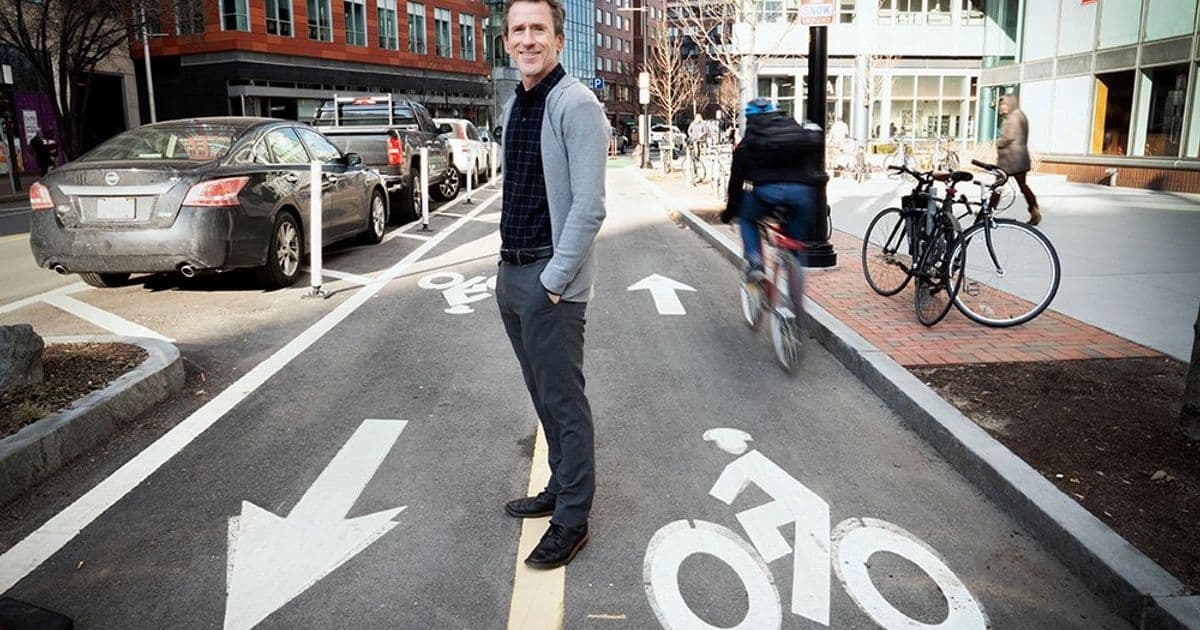
MIT has named mobility and urban planning professor Chris Zegras as CEO and director of the Singapore-MIT Alliance for Research and Technology. His own track record running Singapore's first public autonomous vehicle trials makes the appointment a notable signal about where applied robotics research is heading.
MIT has appointed Chris Zegras, professor of mobility and urban planning and current head of the Department of Urban Studies and Planning, as chief executive officer and director of the Singapore-MIT Alliance for Research and Technology (SMART). The appointment takes effect September 1. Zegras succeeds Bruce Tidor, a professor of biological engineering and computer science who has served as interim CEO and director since January 2025.
The headline is a personnel change, but the substance worth paying attention to is who Zegras is and what he built before this. For most of the past decade his work sat squarely at the intersection of autonomous systems, large-scale simulation, and the messy reality of deploying that technology in a functioning city.
What SMART Is and Why It Matters
Established in 2007 in collaboration with the National Research Foundation of Singapore, SMART is MIT's only research center outside the United States. It operates within Singapore's Campus for Research Excellence and Technological Enterprise, a cluster designed to put international research institutions in close physical proximity to one another and to local universities and companies.
The structure is deliberate. SMART is organized around interdisciplinary research groups, each led by a senior MIT faculty member. The current six groups cover antimicrobial resistance, living cells used as personalized medicines, the social and institutional challenges created by AI and emerging technologies, new agricultural technologies, wafer-scale 3D sensing, and wearable ultrasound imaging. A separate SMART Innovation Center exists specifically to push research ideas out of the lab and toward commercial deployment.
That last part is the thread that connects to Zegras directly. SMART was never designed as a pure publication engine. Its mission is translation, getting working systems out of a research environment and into a real city where they have to contend with regulators, infrastructure, and human behavior that rarely matches the model.

The Autonomous Vehicle Track Record
Zegras joined the MIT faculty in 2005 and became head of the Department of Urban Studies and Planning in 2020. His research focuses on metropolitan mobility, specifically using computational methods to understand and model human behavior and to improve strategic planning. That sounds abstract until you look at what his group actually shipped.
From 2010 to 2020, Zegras was a principal investigator on the Future Urban Mobility interdisciplinary research group at SMART, and from 2016 to 2020 he served as its lead principal investigator. During that period the group ran Singapore's first public autonomous vehicle trials. This was not a closed-track demonstration. Putting autonomous vehicles onto public roads in a dense city means solving the parts of the problem that look easy in a slide deck and turn out to be the hardest in practice: handling pedestrians who do not follow predicted paths, integrating with existing traffic systems, and building enough operational confidence to let the vehicles run without a safety driver intervening constantly.
The group also developed and deployed large-scale urban simulation and visualization systems. For anyone working in autonomous systems, simulation is where most of the real engineering happens. You cannot validate a mobility system by driving millions of road miles for every software change, so you build a model of the city, populate it with synthetic agents whose behavior approximates real travelers, and test your policies and routing logic against that model first. The quality of those agent behavior models determines whether your simulation results mean anything. Zegras's research on modeling human travel behavior fed directly into making those simulations trustworthy enough to inform real planning decisions.
Several of these efforts evolved into spinoff companies, which is the clearest evidence that the work crossed the gap from research to applicability rather than stopping at a conference paper.

Why This Appointment Reads Differently
There is a recurring tension in robotics and autonomous systems research between two kinds of leaders. One understands the technical core deeply but has never had to deploy anything outside a lab. The other manages deployment and partnerships but cannot evaluate the technical claims being made underneath. Zegras is unusual in that his record shows both. He built the simulation and sensing systems and he ran the public trials that tested them against reality.
That matters for SMART's portfolio beyond mobility. Three of the current six research groups, the AI and emerging technologies group, the wafer-scale 3D sensing group, and the wearable ultrasound group, all face the same fundamental challenge Zegras spent a decade working through with autonomous vehicles. They have promising capabilities demonstrated in controlled conditions, and the open question is whether those capabilities survive contact with real-world deployment, real users, and real regulatory environments.
Three-dimensional sensing at wafer scale, for example, is the kind of technology that could feed directly into the perception stacks that autonomous machines depend on, but only if it can be manufactured reliably and integrated into systems that have to work outside a clean room. Someone who has personally dealt with the integration and trust problems of autonomous mobility brings useful instincts to evaluating that work.
Continuity and Constraints
MIT Provost Anantha Chandrakasan framed the appointment as a reinforcement of MIT's commitment to the alliance, noting that SMART's role "remains as important as ever in a time of accelerating technological and global change." Zegras, for his part, emphasized translation in his own statement, saying he intends to "deepen collaboration, strengthen our innovation ecosystem, and accelerate the translation of research into meaningful real-world impact."
The honest assessment is that leadership transitions at research institutions are usually evolutionary rather than abrupt. SMART has an established structure, six funded research groups already in motion, and a dedicated innovation center. Zegras is not arriving to rebuild the place. What he brings is a specific bias toward getting systems deployed and tested in the field, shaped by having done exactly that with one of the harder autonomous systems problems in a real city.
For researchers working in autonomous systems and applied AI, the more interesting signal is institutional. A major research enterprise choosing a leader whose credibility rests on field-deployed autonomous mobility, rather than on pure theory or pure administration, suggests that the part of the work that has historically been undervalued, the unglamorous engineering of making research survive contact with the real world, is being treated as a leadership qualification in its own right.
More detail on Zegras's background is available through the MIT Department of Urban Studies and Planning and the original announcement from MIT's Office of the Provost.
Comments
Please log in or register to join the discussion