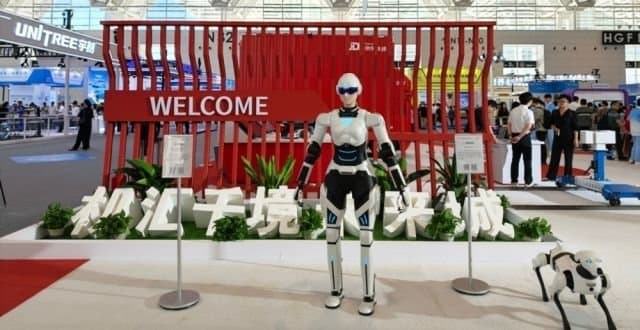
JD.com demonstrated a suite of autonomous vehicles, warehouse robots and delivery drones under the “Wolf Pack” brand, while promising to retrain rather than lay off workers displaced by the new hardware. The rollout highlights ambitious L4 autonomy claims and a large internal reskilling effort, but the financials and real‑world performance remain uncertain.
JD.com rolls out “Wolf Pack” robot matrix at World Intelligent Industry Expo
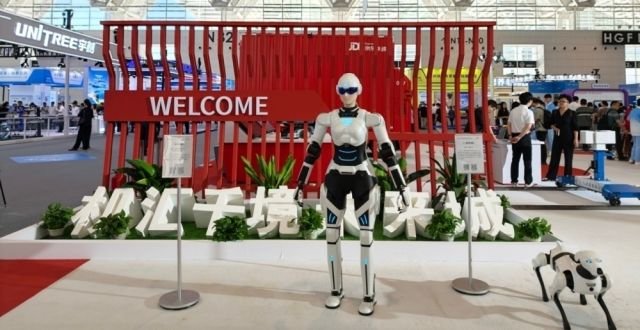
JD.com used its booth at the 2026 World Intelligent Industry Expo in Tianjin to showcase a family of robots it calls the Wolf Pack. The lineup spans three domains:
- Aerial – the Fēiláng (Flying Wolf) drones, model JDX20 for dense‑city deliveries and JDX50 for longer‑range, rugged terrain transport.
- Ground – the Dúláng (Lone Wolf) sixth‑generation delivery vehicle Plus (5.5 m³ cargo, 1 t payload) and the VAN autonomous light truck, both advertised as L4‑level self‑driving.
- Warehouse – the Zhìláng (Wisdom Wolf) goods‑to‑person system, which claims 99.99 % picking accuracy and a four‑fold speed boost over conventional pick‑to‑light setups.
The exhibition also featured an AI‑powered massage robot, a robot‑driven musical band and a precision‑assembly demo. The displays attracted sizable crowds, suggesting strong public curiosity about large‑scale automation.
What is actually new?
1. End‑to‑end autonomy claims
The VAN truck is marketed as Level 4, meaning it should operate without human intervention within a defined geographic area. JD.com’s press kit cites a custom perception stack that fuses LiDAR, radar and high‑resolution cameras, plus a reinforcement‑learning‑based planner that was trained on 30 million simulated miles. The company says the system has completed 1.2 million km of on‑road testing across 12 Chinese cities.
2. Integrated warehouse solution
The Zhìláng system combines a conveyor‑less storage rack, mobile picking robots and a central AI scheduler. In internal benchmarks the system reportedly processes 2,400 items per hour with a 99.99 % order‑accuracy rate, measured against a baseline of 600 items per hour for JD.com’s legacy pick‑to‑light line.
3. Drone payload and range improvements
The JDX50 drone carries up to 8 kg and can travel 120 km on a single charge, a notable step up from the 3 kg, 30 km envelope of JD.com’s 2024 delivery quadcopter. The company attributes the gains to a new high‑energy‑density battery chemistry and a lightweight carbon‑fiber airframe.
4. Reskilling infrastructure
JD.com highlighted more than 80 "robobase" training centers that teach current warehouse staff to service and program the new hardware. The curriculum includes PLC programming, ROS 2 basics and safety certification for L4 vehicle maintenance. The company’s internal memo promises that no frontline employee will be dismissed because a robot replaces a task.
Limitations and open questions
- Autonomy level verification – JD.com’s L4 claim is based on private test data; there is no third‑party certification yet. Real‑world deployment will still need to handle edge cases such as extreme weather, construction zones and unstructured pedestrian traffic.
- Cost and ROI – The press release does not disclose the unit price of the VAN truck or the Fēiláng drones. Early adopters will need to evaluate whether the projected labor savings outweigh the capital outlay, especially given JD.com’s Q1 operating profit fell 64 % year‑over‑year.
- Scalability of the warehouse system – The 99.99 % accuracy figure comes from a pilot in a single fulfillment center. Scaling the same performance across JD.com’s 800+ warehouses will require consistent network latency, reliable edge compute, and robust fault‑tolerance mechanisms.
- Regulatory hurdles for drones – Urban drone delivery in Chinese megacities still faces strict air‑space restrictions. JD.com’s mountain‑relief use case may be more feasible, but the commercial model for city‑center deliveries remains unclear.
- Workforce transition timeline – While the “robobase” centers sound promising, the company employs 900,000 staff. Converting a significant fraction to technical roles will take years, and the interim period may see a mismatch between robot availability and qualified operators.
Why it matters
JD.com’s Wolf Pack is an attempt to close the loop between autonomous transport, warehouse fulfillment and last‑mile delivery within a single corporate ecosystem. If the hardware performs as advertised and the reskilling pipeline delivers enough technicians, JD.com could reduce its logistics cost base and improve delivery speed—both critical metrics in China’s fiercely competitive e‑commerce market.
However, the financial backdrop is shaky. Operating profit dropped sharply in Q1, and R&D spending surged by over 40 %. The company is betting that the automation push will eventually restore margin growth, but investors will likely demand concrete, independently verified performance data before the market fully rewards the strategy.
Bottom line
The Wolf Pack showcase is more than a marketing spectacle; it bundles several incremental technical advances—higher‑capacity drones, a claimed L4 truck, and a tightly integrated warehouse robot fleet—into a coherent logistics vision. The real test will be large‑scale, public deployments that survive regulatory scrutiny and deliver measurable cost savings. Until then, JD.com’s promise to keep every frontline worker employed remains a pledge rather than a proven outcome.
Related reading: JD.com’s 2026 Q1 earnings release, the company’s official robot service panorama page, and a recent analysis of L4 autonomy deployments in Chinese logistics (link).
Comments
Please log in or register to join the discussion