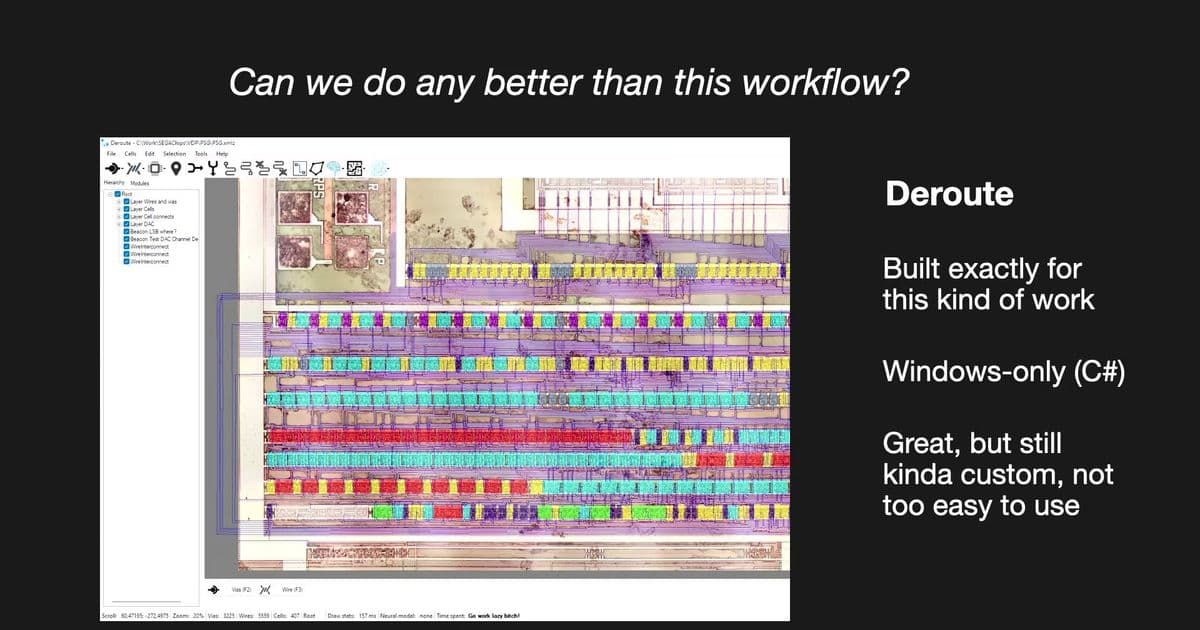
A developer who once spent two weeks tracing wires in Inkscape built an open source tool that turns microscope photographs of silicon into simulable Verilog in under an hour. The leap from manual annotation to computer-vision-assisted, collaborative reconstruction says something larger about how preservation work scales.
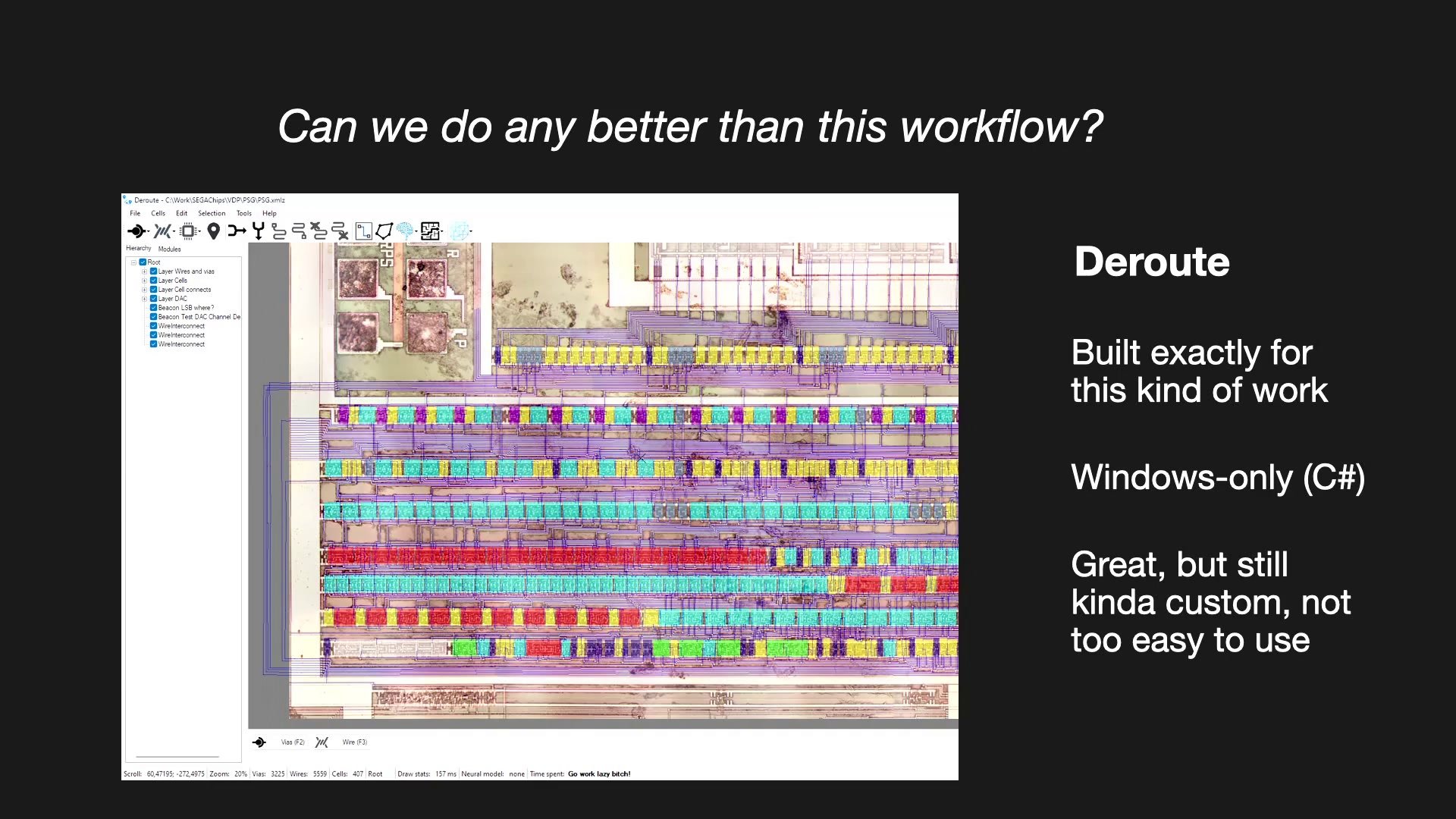
Reverse engineering a custom integrated circuit from photographs of its bare silicon is one of those activities that sounds like science fiction until you understand that it is mostly tedium. You decap a chip, you photograph the die under a microscope at enormous magnification, and then you sit down to trace, by hand, the thousands of metal interconnects and polysilicon paths that constitute the logic. The developer known as giulioz, presenting MMO-CHIP at GPN24, described his previous attempt in language that anyone who has done repetitive digital labor will recognize: waking up, annotating wires in Inkscape, going to bed, and then dreaming about more wires. Two weeks of that. The talk is ostensibly about a tool. The more interesting thesis underneath it is about what changes when a preservation task that was bounded by human patience becomes bounded instead by software.
The core argument: tooling is the bottleneck, not knowledge
The craft of silicon reverse engineering has been understood for decades. The techniques for delayering a chip, imaging it, and reading transistor-level logic from the geometry are documented and, among a small community, well practiced. What has not existed is good infrastructure for the part in the middle, the long human-mediated translation from a giant image into a structured circuit description. MMO-CHIP is an argument that this middle step was the real constraint all along. By building a web-based environment that handles gigantic die photographs without choking, supports collaborative annotation, and folds in computer vision to assist the tracing, giulioz reframes the problem. The knowledge was never the scarce resource. Attention was.
This is a familiar pattern in technical work, even if the domain here is exotic. Whenever a discipline depends on a heroic individual grinding through manual steps, the discipline stays small and its outputs stay rare. The interesting custom chips, the digital signal processors inside old synthesizers, the undocumented controllers in obsolete hardware, remain locked away not because nobody can read them but because reading them costs more human time than almost anyone is willing to spend. Lower that cost by an order of magnitude and you do not merely speed up existing work, you change which projects are even conceivable.
How the system actually works
The technical substance of the talk centers on a few capabilities that, taken together, compress the workflow. The first is image handling. Die photographs are immense, often stitched together from many individual microscope captures, and a single high-resolution mosaic can run to gigapixels. A tool that stutters or runs out of memory when you pan across the image is unusable in practice, so the engineering effort to render and navigate these pictures smoothly in a browser is not a cosmetic detail. It is the foundation that makes everything else tolerable.
The second capability is collaborative annotation, the multiplayer dimension that gives the project its name. Annotation work parallelizes naturally because different regions of a die are largely independent. Several people tracing simultaneously, each watching the others' edits appear in real time, turns a solitary fortnight into an afternoon with friends. The social design here matters as much as the algorithmic design, because preservation communities are small and volunteer-driven, and a tool that lets a handful of enthusiasts pool their effort multiplies the available labor in a way that no single optimization could.
The third and most technically ambitious capability is the use of computer vision to infer logic. Rather than asking a human to mark every wire and every transistor exhaustively, the system can take a few scribbled hints and propagate them, recognizing repeated structures and reading the geometry of gates. The standout claim is that it can infer the logical formula of a complex gate from just a few marks. In static CMOS, the physical arrangement of transistors directly encodes a Boolean function. The pull-up and pull-down networks are duals of each other, and the topology of how transistors connect in series and parallel literally is the truth table, expressed in silicon. A series connection is an AND, a parallel connection is an OR, and the complementary structure gives you the inversion. If software can trace those connections from a marked-up image, then deriving the gate's logical formula is a matormatched problem of reading the network and writing down the corresponding expression. From there, exporting to Verilog and producing a simulable model of the original chip becomes a mechanical final step.
Implications: preservation at a different scale
The stated goal, going from microscope to simulable Verilog in under an hour, deserves to be taken seriously as a threshold rather than a headline figure. An hour is roughly the length of a focused work session. It is short enough that reconstructing a chip stops being a project you commit to and becomes something you can simply try. That shift in commitment cost is where the real consequences live. Hardware from the 1980s and 1990s is failing in the physical world right now, as electrolytic capacitors dry out and mask ROMs degrade, and the custom silicon inside it was frequently never documented by manufacturers who are long gone or indifferent. Emulation depends on understanding these parts, and accurate emulation of analog-adjacent devices like synthesizer DSPs depends on understanding them down to the gate. A tool that makes such understanding cheap is, in a quiet way, a tool that decides how much of this era's computing history survives in a usable form.
The open source and Creative Commons licensing of the work compounds this. The value of reverse engineering infrastructure grows with the community that maintains and extends it, and proprietary tooling in a niche this small tends to die with its vendor. By releasing MMO-CHIP openly, giulioz aligns the tool's longevity with the longevity of the artifacts it helps preserve, which is the correct alignment for anything calling itself a preservation effort.
Counter-perspectives
There are honest limits worth holding in view. Computer vision that infers logic from a few scribbles is impressive precisely because the underlying images are messy. Die photographs contain dirt, etching artifacts, ambiguous layers, and process variations that no algorithm reads perfectly, and the gap between a tool that accelerates an expert and a tool that replaces expertise is wide. The realistic reading is that MMO-CHIP makes a skilled person dramatically faster, not that it makes the skill unnecessary. Someone still has to recognize when the inference is wrong, and a confident-but-incorrect automatic trace can introduce errors that are harder to catch than the slow manual ones, because they arrive wearing the authority of automation.
There is also the question of how far the static-CMOS logic-inference trick generalizes. Many of the most interesting old chips mix digital logic with analog circuitry, use dynamic logic, or employ design styles that do not map cleanly onto a tidy Boolean extraction. The DSPs in vintage synthesizers are appealing targets partly because they are largely digital, and the same approach may strain against more analog or more idiosyncratic silicon. None of this diminishes the contribution. It locates it. MMO-CHIP attacks the most painful and most parallelizable part of a hard problem, and leaves the genuinely hard analog judgment where it has always lived, with the human at the microscope.
What lingers after the talk is the shape of the lesson rather than any single feature. A discipline constrained by individual endurance got handed better tools, and in doing so it became something a small group can do together in an afternoon instead of something one person endures alone for two weeks. The chips being saved are obscure, but the move is general, and it is the move that turns a heroic hobby into a sustainable practice. The recording and materials are available through media.ccc.de under a CC BY 4.0 license.
Comments
Please log in or register to join the discussion