Google DeepMind opened a three-month accelerator for early-stage European robotics companies, granting access to its Gemini robotics models and engineering support. The cohort spans welding automation, waste sorting, brain microrobots, and humanoid teleoperation. What the program actually provides, and where the gap between research models and shipping hardware remains, is worth examining closely.
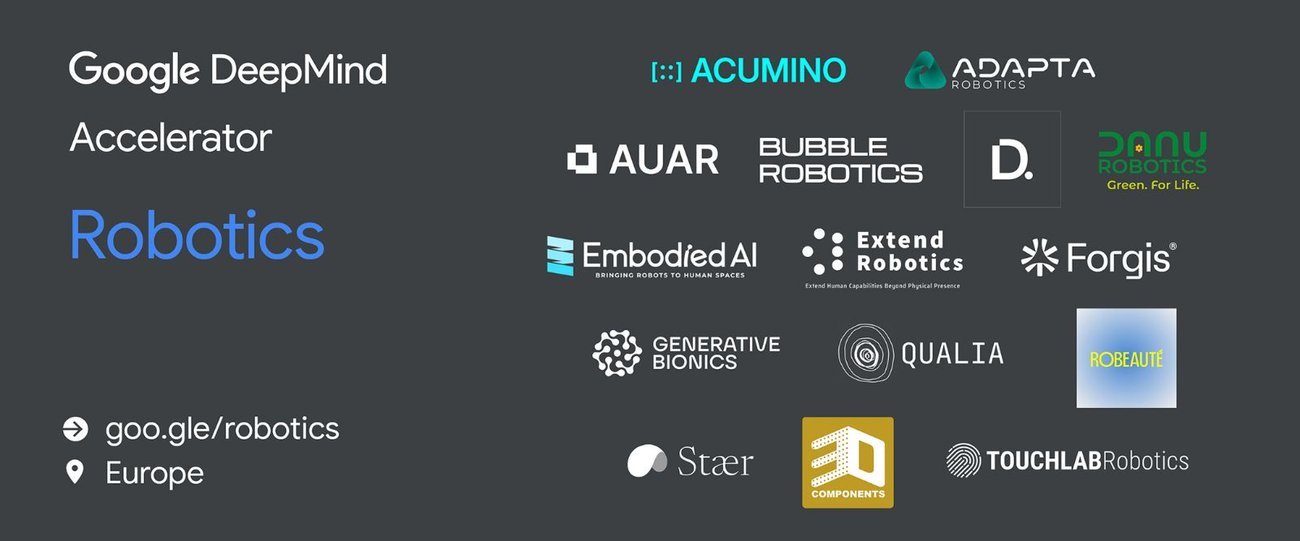
Google DeepMind announced a new program, the Google DeepMind Accelerator: Robotics, that selected 15 early-stage robotics startups from across Europe. The cohort gathered in London this week to start a three-month run of mentorship, technical support, and access to Google's AI stack and Gemini robotics models. Carolina Parada, VP of Robotics at Google DeepMind, framed it as support for "the next generation of physical AI."
That framing is the part worth slowing down on. Accelerators are common, and "physical AI" is a phrase doing a lot of work right now. What is actually on offer here, and what does it tell us about where robotics models stand in mid-2026?
What's claimed
The pitch is straightforward. Fifteen companies get three months of hands-on guidance from Google DeepMind and Google engineers, product feedback, a partner network, and access to Gemini robotics models. The selection skews toward applied, vertical-specific robotics rather than general-purpose humanoids, though a few humanoid plays are in the mix.
The announced cohort, with what each is building:
- 3D-Components AS (Norway): RobTrack, a platform automating parameter selection and quality control for robotic welding and metal 3D printing, claiming 280x faster than current practice.
- Acumino (Greece): hardware-agnostic control software for industrial manipulation tasks.
- Adapta Robotics (Romania): robots that replicate human touch to test physical devices and software across healthcare, automotive, and consumer electronics.
- AUAR (UK): robotic "MicroFactories" deployed to construction sites for lower-cost homebuilding.
- Bubble Robotics (France): self-docking surface and subsea robots feeding a live underwater world model.
- Danu Robotics (UK): embodied AI for waste sorting and materials recovery.
- Deltia (Germany): converts production-line workflows into process graphs to optimize manual work.
- Embodied AI (Switzerland): teleoperated humanoids that gather manipulation data during customer service.
- Extend Robotics (UK): teleoperation software and data pipelines for training and fine-tuning robotics foundation models.
- Forgis (Switzerland): AI agents that model machine behavior to predict failures.
- Generative Bionics (Italy): humanoid robots built on physical AI.
- Qualia (Denmark): infrastructure to turn robotic foundation models into deployed systems.
- ROBEAUTE (France): microrobots that navigate brain tissue for diagnosis and monitoring.
- Staer (Sweden): computer vision on existing cameras to build 3D spatial models of facilities.
- Touchlab (UK): nano-ink "e-skin" giving robots high-resolution touch sensing across flexible surfaces.
Details on the program are on the official Accelerator page, and the Gemini Robotics models referenced are documented separately by Google DeepMind.

What's actually new
The genuinely interesting thread running through this list is data, not models. Look at how many of these companies are, underneath the marketing, in the business of collecting robot interaction data. Extend Robotics builds teleoperation pipelines explicitly to train and fine-tune foundation models. Embodied AI runs teleoperated humanoids during real customer-service work specifically to capture manipulation data. Touchlab and its e-skin generate a sensing modality that most current datasets barely contain. Staer and Bubble Robotics are constructing spatial and underwater world models.
This matters because the bottleneck in robotics foundation models is not architecture, it is the scarcity of high-quality, real-world action data. Vision-language-action models like Gemini Robotics inherit broad semantic knowledge from web-scale pretraining, but the action component has to be grounded in physical demonstrations, and there is no internet-scale corpus of robots picking up objects. A program that pulls in 15 companies, several of which are effectively data-collection engines for specific domains, is as much about feeding the model pipeline as it is about helping the startups.
The selection also reads as a bet on verticalization. Welding QC, waste sorting, neurosurgical microrobots, and facility mapping are narrow problems with measurable economics. That is a more honest place for current robot learning than the general-purpose humanoid demos that dominate launch videos. A welding parameter optimizer with a concrete throughput number is testable in a way that "a robot that can do anything" is not.
Limitations
A few things deserve a skeptical read.
The headline numbers are vendor claims. "280x faster than current practice" from 3D-Components is a marketing figure, not a benchmark, and there is no published methodology, baseline, or independent measurement attached. Treat it as a directional claim about a narrow subtask, not a validated result.
Access to Gemini robotics models through an accelerator is not the same as a production deployment path. The gap between a model that performs well in a demo or a controlled lab and one that holds up across the long tail of a real factory or hospital is exactly where most robotics companies stall. Three months of mentorship does not close that gap; it helps founders see it more clearly. The presence of Qualia, whose entire pitch is infrastructure to turn robotic foundation models into working deployments, is itself an admission that this last-mile problem is unsolved enough to be a standalone business.
There is also the strategic reading. Google DeepMind benefits from a European cohort building on its stack: ecosystem lock-in, domain data exposure, and a recruiting and acquisition funnel. None of that is sinister, but it is worth naming so the program is not read purely as altruism toward the physical world.
Finally, the cohort is early-stage by design. Several of these companies are at the stage where the demo is the product. ROBEAUTE's brain-navigating microrobots and Generative Bionics' humanoids are scientifically ambitious and years from routine clinical or commercial use, regulatory hurdles aside. The accelerator is a reasonable accelerant for that work, not a shortcut around the physics, the safety validation, or the unit economics.
What changes
For European robotics specifically, the signal is that a major model lab is now actively courting embodied-AI startups on the continent rather than leaving the field to US and Chinese players. That has real value for talent retention and for giving these teams access to models and compute they could not assemble alone. For the broader question of whether robotics foundation models are ready to leave the lab, this program does not answer it. It assembles a useful set of test cases. The companies worth watching are the unglamorous ones with a narrow task and a number they are willing to be measured against. Those are where the claims about physical AI will either hold up or quietly get revised.
Comments
Please log in or register to join the discussion