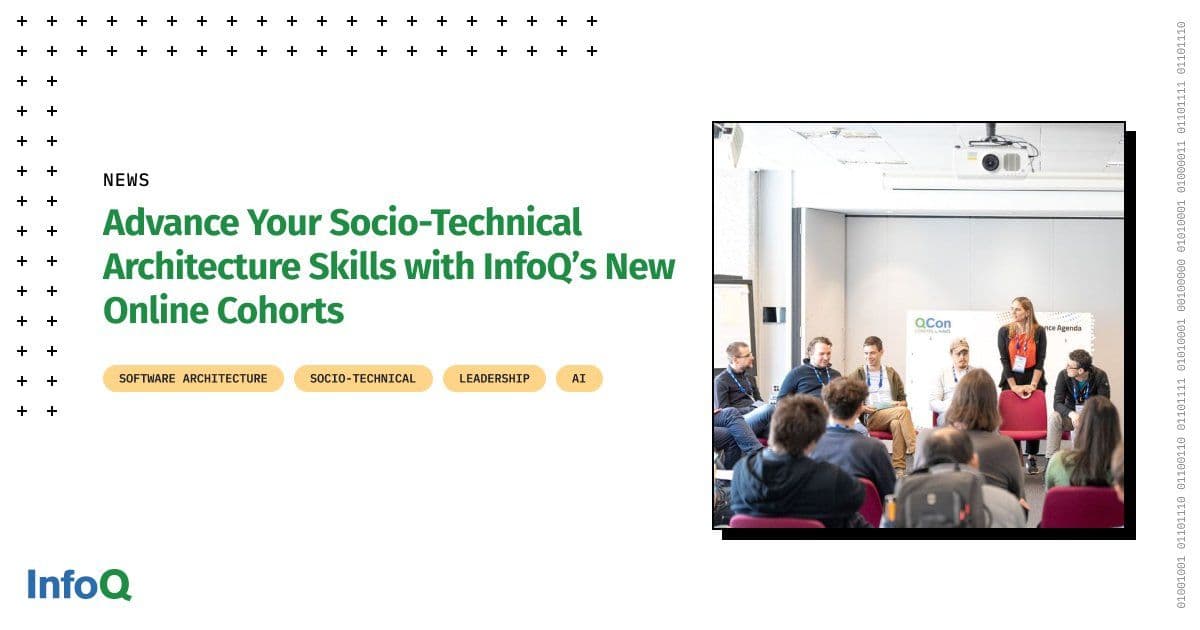
InfoQ launches three new online cohorts for its Certified Architect Program, helping senior engineers master the socio-technical aspects of architectural leadership through practical frameworks and peer collaboration.
InfoQ is opening registration for three new intakes of the online Certified Architect Program, designed to help senior technical practitioners scale their impact beyond code and systems design. The cohorts begin on April 15, May 7, and June 10, 2026, and are facilitated by Luca Mezzalira, Principal Solutions Architect and author of 'Building Micro-Frontends'.
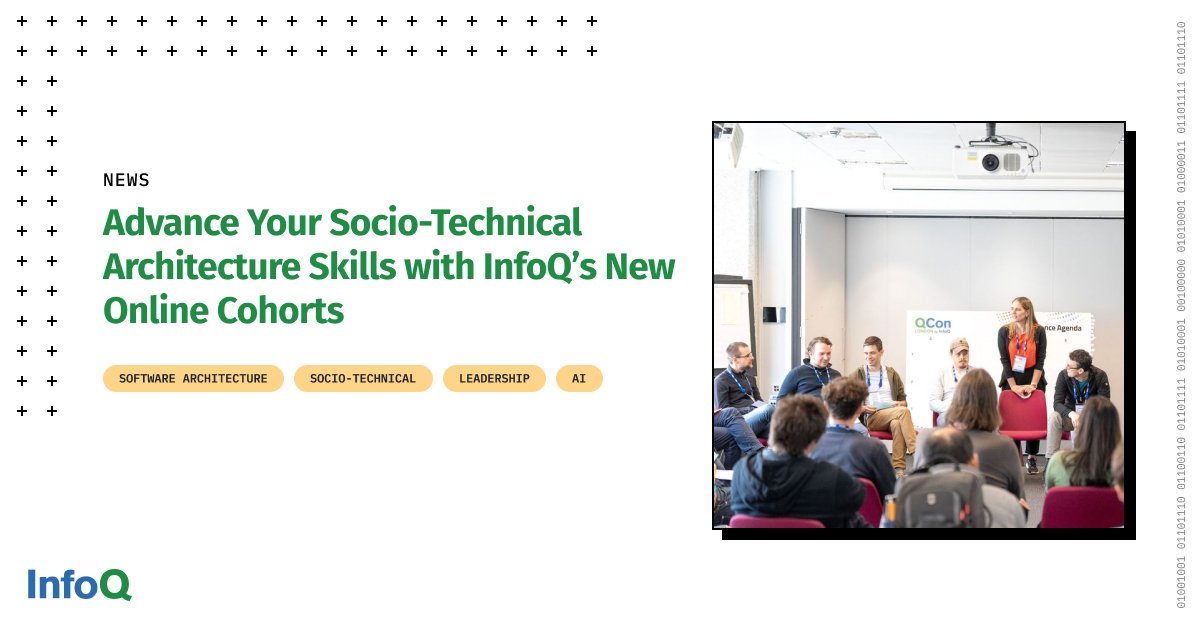
For senior technical practitioners, scaling impact goes beyond writing better code or designing increasingly complex systems. The bottleneck is usually socio-technical: moving from designing software systems to leading strategic conversations, explaining trade-offs, and building consensus across an organization.
The five-week online program provides senior engineers and software architects with a structured environment for mastering the socio-technical side of architectural leadership. Each cohort offers two time-zone options to accommodate global schedules:
- April 15: 9:30 AM BST / 10:00 AM EDT
- May 7: 9:30 AM BST / 10:00 AM EDT
- June 10: 9:30 AM BST / 10:00 AM EDT
The program targets practitioners with at least five years of experience who want to drive organizational alignment. The five-week structure leaves room between sessions to address the gap between understanding a concept and applying it under real constraints.
Applying Frameworks to Live Projects
Participants apply frameworks such as Architecture Decision Records (ADRs) or the Architecture Canvas in their actual projects, then return to the peer group to pressure-test the results. Live sessions run for four hours per week, with a few hours for homework. The groups operate as confidential peer environments, kept small so participants can discuss sensitive architectural decisions privately.
The curriculum covers:
Week 1: Architecture and Trade-offs. Formulating architectural decisions and communicating trade-offs to non-technical stakeholders.
Week 2: Decentralized Decision-Making. Implementing ADRs and RFCs to balance team autonomy with system-wide coherence.
Week 3: Platform Engineering. Treating platform engineering as a sociotechnical practice to drive genuine developer adoption rather than just tooling adoption.
Week 4: AI in the Workflow. Applying systems thinking to AI agents and multi-agent architectures, with an emphasis on architectural constraints and trade-offs rather than capability evaluation.
Week 5: Capstone Presentations. Participants synthesize their learning into a technical article.
Chinmay Sawaji, a Senior Software Engineer at Klaviyo and a recent cohort graduate, noted that he can now articulate trade-offs more effectively, which improves his proposals at work.
Sharing Knowledge With the Community
The program's capstone project requires participants to document their learning. After the first six cohorts, past attendees published articles on InfoQ covering topics such as designing for fast flow and the architects' role in the era of AI. The strongest capstone articles from these upcoming cohorts will also be published on InfoQ.com to contribute to the broader practitioner community.
Graduates also earn the InfoQ Certified Software Architect in Emerging Technologies (ICSAET) certification.
Enrollment Details
The program fee is $1,470. Most employers reimburse the cost through professional development budgets because the curriculum applies directly to daily work. Practitioners can reserve their place in an upcoming cohort here.
For practitioners who prefer an in-person format, Luca Mezzalira also facilitates the certification cohort at QCon London 2026, March 16-19, and QCon San Francisco 2026, November 16-20.
This program addresses a critical gap in technical career development: the transition from individual contributor to influential leader requires mastering not just technical frameworks, but the human dynamics of decision-making, consensus-building, and strategic communication. By combining practical application with peer learning, the Certified Architect Program helps senior engineers develop the socio-technical skills needed to drive meaningful organizational change.
Comments
Please log in or register to join the discussion