Python's power lies not in its simplicity but in sophisticated tools for memory-efficient iteration, mathematical computation, and standardized data exchange. These three curated LabEx labs bridge the gap between basic scripts and professional-grade applications, providing immediate practical feedback in an interactive environment.
Python's reputation as a powerhouse for modern development isn't just about its simple syntax; it's about the sophisticated tools it provides for handling data flow and complex logic. For developers transitioning from basic scripts to professional-grade applications, mastering the nuances of memory-efficient iteration, mathematical computation, and standardized data exchange is non-negotiable.
This curated selection of hands-on labs from the LabEx Python path focuses on these core pillars, bridging the gap between writing code that works and writing code that excels.
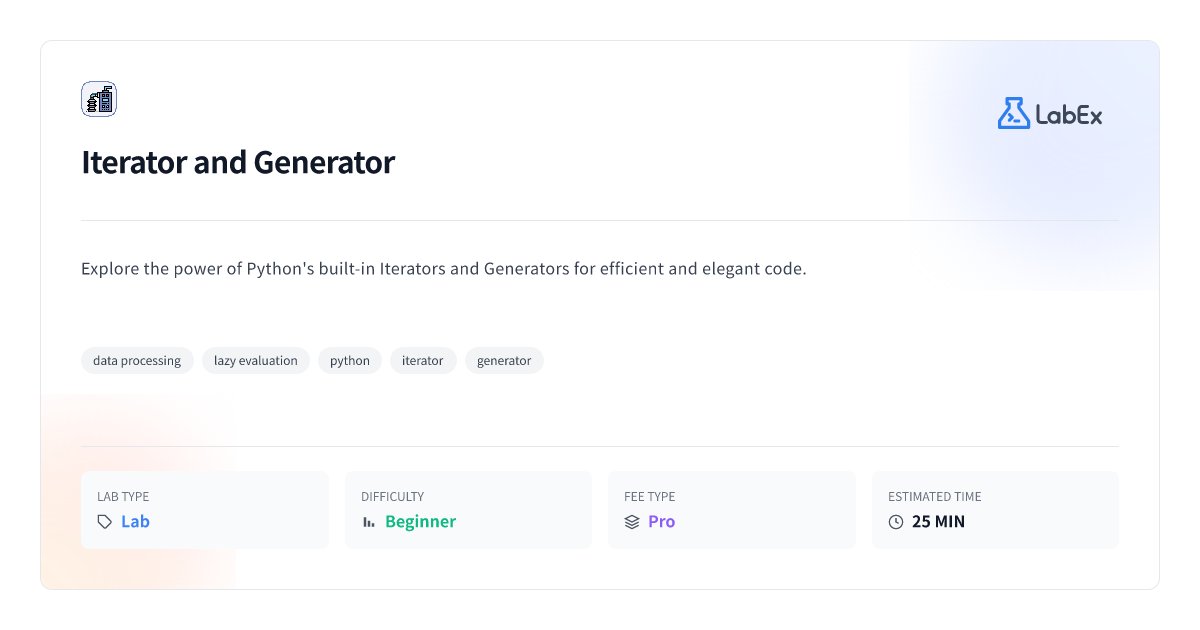
Iterator and Generator
Difficulty: Beginner | Time: 25 minutes
In this lab, we will learn about Python's built-in Iterators, Generators, and Generator Expressions. We will see how these constructs can be used to write efficient and elegant code in Python.
Practice on LabEx → | Tutorial →
When dealing with large datasets or infinite sequences, traditional list-based approaches quickly become memory-prohibitive. Iterators and generators provide a solution by computing values on-demand rather than storing entire collections in memory. This lazy evaluation pattern is fundamental to writing scalable Python applications.
Consider processing a log file with millions of lines. A generator expression like (process(line) for line in open('logfile.txt')) creates an iterator that yields one processed line at a time, consuming minimal memory regardless of file size. This pattern extends to custom iterator classes implementing the __iter__() and __next__() methods, giving you fine-grained control over iteration behavior.
Exploring Python's Built-in Math Functions
Difficulty: Beginner | Time: 15 minutes
In this lab, we will explore various built-in Python functions for performing mathematical operations. We will start with basic operations such as addition, subtraction, and multiplication, and then move on to more advanced concepts like trigonometry, logarithms, and other mathematical functions. By the end of this lab, you should have a good understanding of how to use these functions in your code.
Practice on LabEx → | Tutorial →
Python's math module provides access to C-standard mathematical functions, offering both performance and precision. Beyond basic arithmetic, functions like math.sin(), math.log(), and math.sqrt() enable complex scientific computing without external dependencies. The module also includes constants like math.pi and math.e for precise calculations.
For statistical operations, the statistics module offers functions like mean(), median(), and stdev() that work with any iterable, making them ideal for data analysis pipelines. Understanding when to use these built-in functions versus implementing custom logic is crucial for writing maintainable, performant code.
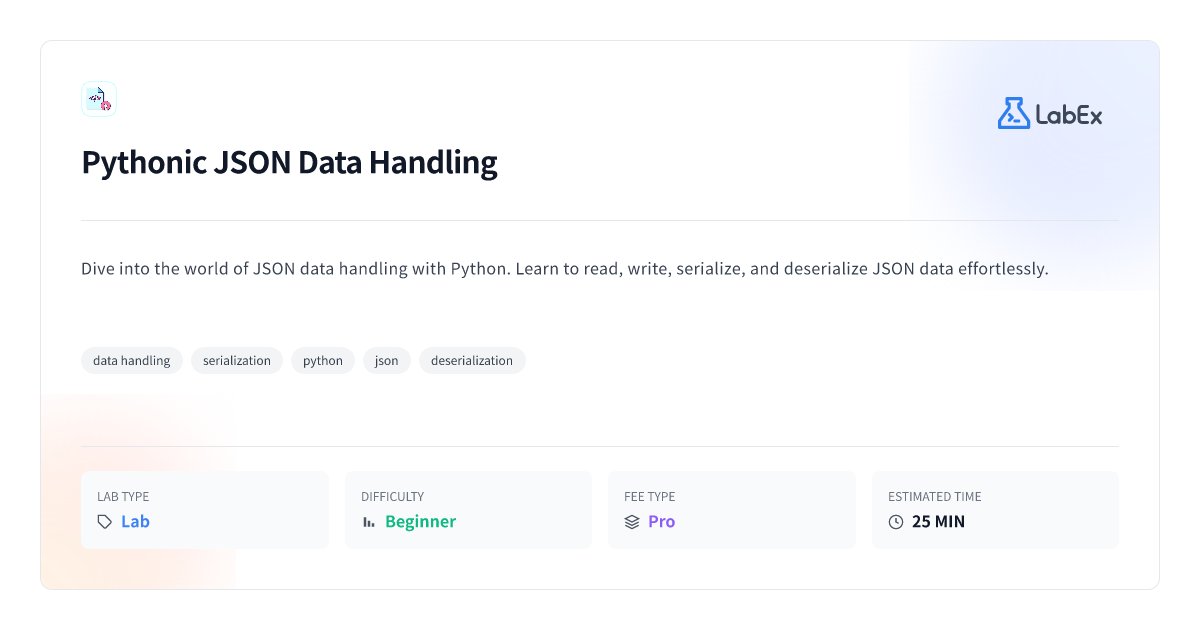
Pythonic JSON Data Handling
Difficulty: Beginner | Time: 25 minutes
JSON (JavaScript Object Notation) is a popular data format for storing data in a serialized and human-readable form. It is commonly used for transmitting data between a server and a web application and is also a great choice for storing data in a NoSQL database. In Python, we can use the json module to work with JSON data.
Practice on LabEx → | Tutorial →
The json module provides seamless serialization and deserialization between Python objects and JSON strings. The json.dumps() function converts Python dictionaries to JSON strings, while json.loads() parses JSON strings back into Python objects. For file operations, json.dump() and json.load() handle reading and writing JSON data directly to files.
Beyond basic serialization, the module supports custom encoders and decoders through the JSONEncoder and JSONDecoder classes, enabling you to handle complex Python objects like datetime instances or custom classes. This flexibility makes JSON an ideal format for configuration files, API responses, and data interchange between services.
Building Professional Python Applications
Mastering these three domains—efficient iteration, mathematical precision, and standardized data handling—will significantly sharpen your technical edge. Each lab is designed to provide immediate, practical feedback in an interactive environment.
Whether you are optimizing a data pipeline or building a web API, these foundational skills are the building blocks of a successful Python career. The iterator and generator patterns enable memory-efficient processing of large datasets, the math functions provide reliable numerical computation, and JSON handling ensures seamless data interchange between systems.
Dive into these labs today and start writing more efficient, professional Python code. The investment in understanding these core concepts pays dividends across all areas of Python development, from data science and web development to system automation and beyond.
DEV Community Build Apps with Google AI Studio 🧱
This track will guide you through Google AI Studio's new "Build apps with Gemini" feature, where you can turn a simple text prompt into a fully functional, deployed web application in minutes.
Read more →
Comments
Please log in or register to join the discussion