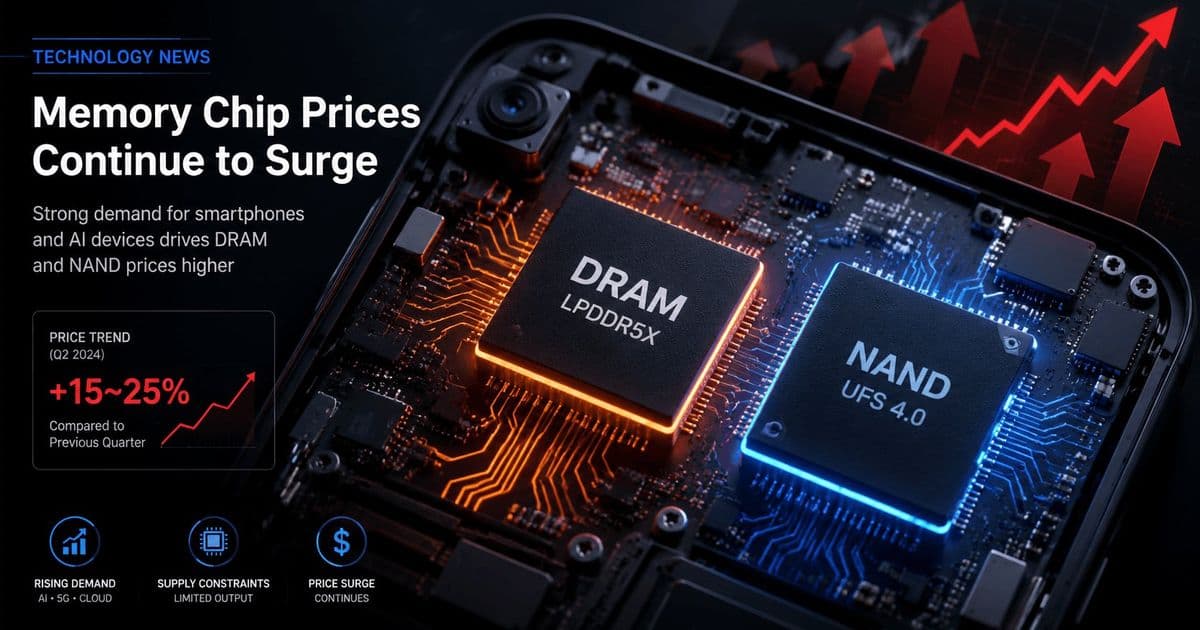
The useful signal is not that cheap phones are suddenly worse, it is that AI infrastructure has made DRAM and NAND allocation a first-order product decision for consumer hardware.
What's claimed
Pandaily reports that Chinese smartphone makers are backing away from entry-level configurations such as 12GB RAM and 256GB storage, with some budget devices returning to 6GB+128GB. The stated cause is the sharp rise in DRAM and NAND flash pricing, with TrendForce and Counterpoint Research data cited for large quarter-over-quarter increases in late 2025 and early 2026.
The headline sounds like a simple regression in cheap Android hardware. The more accurate reading is harsher: memory has stopped behaving like the boring part of the bill of materials. For several years, low-cost phones benefited from falling LPDDR and UFS prices. Brands could advertise 8GB, 12GB, or even fake-expanded RAM tiers while still competing on price. That pricing assumption is now breaking.
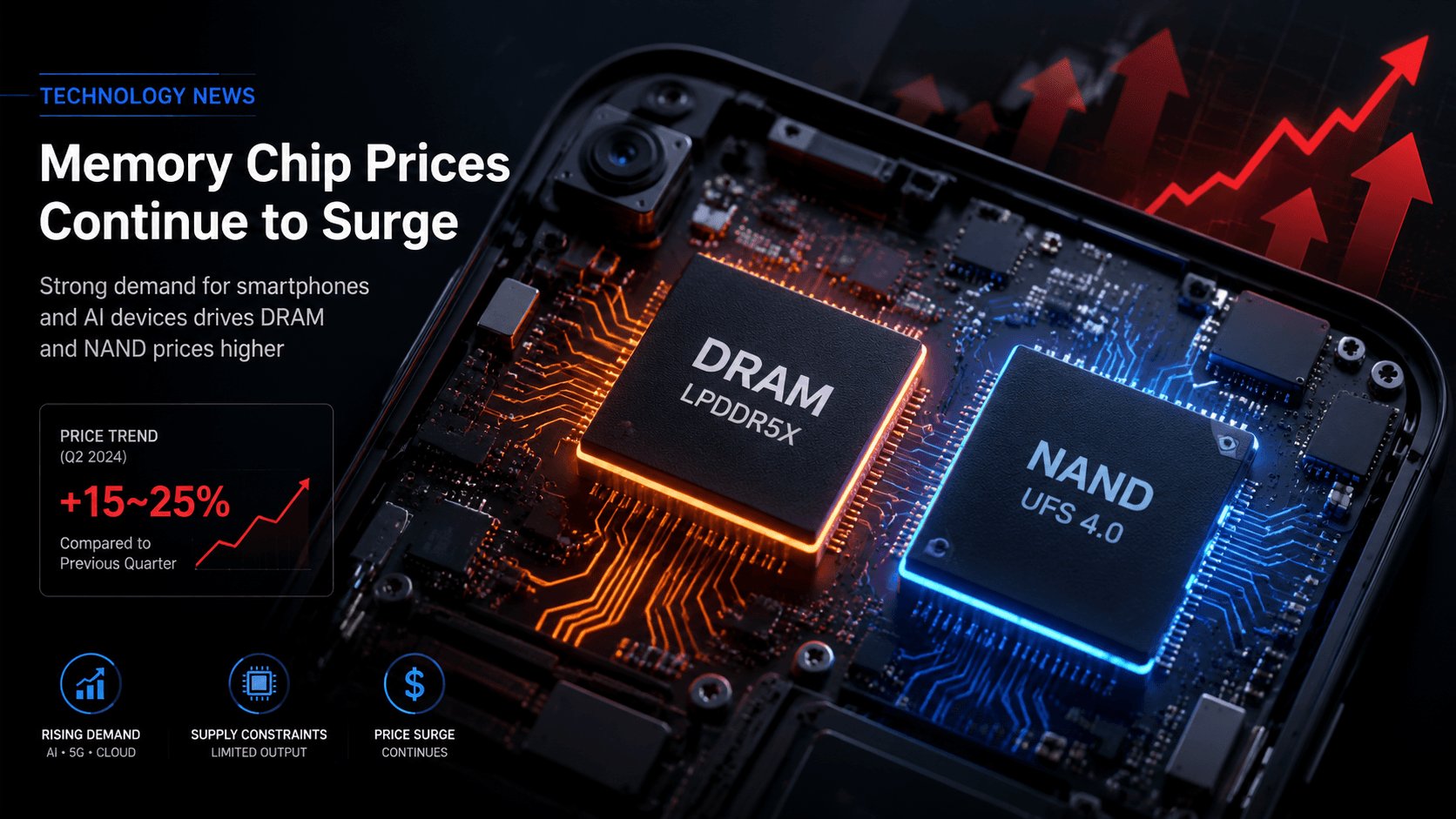
The pressure is not isolated to phones. TrendForce has reported steep contract-price increases across DRAM and NAND categories, while coverage of its surveys puts Q1 2026 conventional DRAM increases around 90% to 95% quarter over quarter, followed by expected Q2 increases of 58% to 63% for DRAM and 70% to 75% for NAND. Counterpoint Research has also been cited for record NAND revenue in Q1 2026, with enterprise SSD demand from AI data centers absorbing a growing share of supply.
The reason this belongs in an AI column, not just a smartphone column, is that phones are being repriced by the same supply chain feeding accelerators such as NVIDIA H100, H200, B200, GB200 NVL72, AMD Instinct MI300X, and newer HBM-heavy systems. HBM3E and HBM4 do not directly replace the LPDDR5X in a phone, but they compete for wafer starts, packaging capacity, capital spending, supplier attention, and long-term allocation contracts. When hyperscalers commit to multi-quarter purchases for AI clusters, a low-margin 1,000 yuan handset does not sit at the front of the queue.
What's actually new
The new part is not that component prices move cyclically. DRAM and NAND are famously cyclical. The new part is that the current cycle is being distorted by AI infrastructure demand at the high end of the memory stack, then propagating into consumer devices through allocation and product planning.
A useful mental model is to split memory into three related markets. First, there is HBM, used in AI accelerators where bandwidth and proximity to the GPU are critical. NVIDIA's H200 uses 141GB of HBM3E, while Blackwell-class systems move even further toward memory-rich rack-scale designs. Second, there is server DRAM and enterprise SSD storage, needed for inference servers, retrieval systems, vector databases, checkpoint storage, and data pipelines. Third, there is client memory, including LPDDR in phones and UFS storage. These are different products, but they share suppliers and manufacturing constraints.
That is why the downgrade from 12GB to 6GB matters. It is not just a spec-table embarrassment. It changes the operating envelope of the device. A 6GB Android phone has less room for background apps, camera pipelines, local AI features, browser tabs, and heavier messaging apps. Android memory compression and swap can hide some pain, but swap pushes pressure onto flash storage and increases latency. A 128GB storage tier also constrains app installs, video capture, offline media, and OS update headroom.
The AI link is practical rather than mystical. Modern LLM serving is memory-hungry. In inference, especially autoregressive decoding, each generated token requires reading model weights and key-value cache data. That is why accelerator buyers care about HBM capacity and bandwidth, not only raw FLOPS. A 2026 paper on batch-1 LLM decode, Memory-Bound but Not Bandwidth-Limited, tested 7B to 8B-class GQA transformer models across NVIDIA H100, A100-80GB, L40S, and L4. On Qwen2.5-7B at 2048 context, the author reports that L4 reached about 81% of its analytic memory floor, while H100 reached only 27%. CUDA Graphs improved H100 decode latency by 1.259x, compared with 1.028x on L4. That benchmark result is a good reminder that buying faster memory does not automatically turn into proportional application speed. Software overhead, kernel launch cost, quantization implementation, and batching policy still matter.
Other benchmarks point in the same direction from a different angle. A Blackwell microbenchmark study, Microbenchmarking NVIDIA's Blackwell Architecture, reports that B200 achieved 1.56x higher mixed-precision throughput and 42% better energy efficiency than H200 in the tested workloads. That helps explain why cloud buyers keep chasing newer accelerator platforms. The performance gains are real enough to justify huge orders. The consumer side effect is that memory suppliers can earn more by serving AI infrastructure than by preserving last year's budget-phone configurations.
For smartphone vendors, the product decision tree is ugly. They can raise prices, reduce memory and storage, use older displays or camera sensors, cut margins, or narrow the number of SKUs. Budget brands usually have less room to absorb cost than Apple, Samsung flagships, or enterprise hardware vendors. That is why the cheapest models show the regression first. A premium phone can hide a higher memory bill inside margin, financing, trade-ins, and carrier subsidies. A low-end phone cannot.
This also changes how to read product launches. A 6GB+128GB base model in 2026 is not automatically a bad phone, but it is a sign that the vendor optimized for bill-of-material survival. A 12GB+256GB model may become a paid upsell again rather than the default. Consumers should compare real RAM, storage type, and update policy instead of trusting marketing labels such as virtual RAM expansion. Virtual RAM is swap. It is not a replacement for physical LPDDR.
Limitations
The Pandaily report is directionally plausible, but the exact scope needs caution. It says multiple Chinese sub-brands are reverting to 6GB+128GB, but the provided text does not name specific phone models, launch dates, or SKU tables. Without those, the claim should be treated as an industry signal rather than a fully audited device list.
The pricing numbers also mix categories. DRAM contract pricing, NAND contract pricing, LPDDR phone memory, UFS storage, HBM, and enterprise SSDs are related, but not interchangeable. A 90% rise in a broad DRAM category does not mean every phone maker pays exactly 90% more for every RAM package. Large buyers negotiate differently. Some hold inventory. Some prepay. Some redesign SKUs months before retail buyers notice.
There is also a risk of over-attributing every consumer hardware downgrade to AI. Memory suppliers were already managing cyclicality, inventory correction, process transitions, and capital spending discipline. AI demand is the accelerant, not the only variable. Trade policy, export controls, smartphone demand weakness, and supplier margin strategy all affect what reaches the shelf.
The practical application is still clear. For developers, assume lower-end Android phones may ship with less real memory than last year's spec trend suggested. Test app cold starts, background retention, camera plus ML workloads, and on-device inference paths on 6GB devices, not only 12GB review units. For buyers, prioritize physical RAM and storage when the device is expected to last several years. For AI infrastructure teams, the smartphone regression is an externality of the same procurement race that makes HBM, enterprise SSDs, and high-capacity server DRAM strategic inputs.
The substance behind the story is not that budget phones suddenly forgot how to improve. It is that the AI buildout has made memory scarce enough that even boring entry-level SKUs now expose the economics of training clusters, inference servers, and supplier allocation.
Comments
Please log in or register to join the discussion