
A Wall Street Journal survey reveals a stark disparity in AI productivity benefits, with over 40% of executives gaining more than eight hours weekly from AI adoption while two-thirds of non-management staff report saving less than two hours.
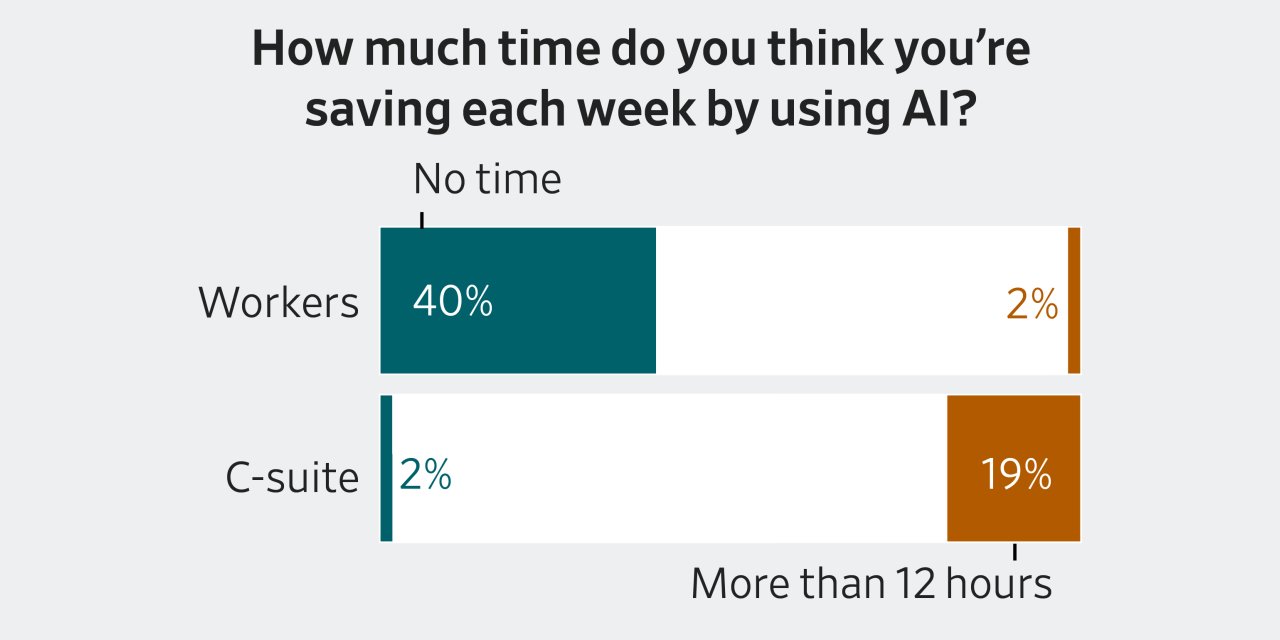
New survey data exposes a growing divide in how artificial intelligence tools impact different organizational tiers. According to a Wall Street Journal report analyzing enterprise AI adoption, 41% of executives reported saving over eight hours per week through AI tools—equivalent to reclaiming an entire workday. Meanwhile, 66% of non-management employees indicated they gained fewer than two hours weekly from AI implementation.
This productivity chasm emerges amid record corporate investment in generative AI systems. Companies globally spent an estimated $301 billion on AI solutions in 2025 according to IDC data, with projections exceeding $500 billion by 2027. Executives frequently cite productivity gains as primary justification for these expenditures, yet the survey suggests benefits concentrate disproportionately among leadership tiers.
Several structural factors drive this imbalance. Executives typically leverage AI for high-impact strategic functions like financial forecasting, market analysis, and decision support—tasks where minor efficiency improvements yield outsized time savings. Tools like OpenAI's enterprise ChatGPT and Anthropic's Claude enable rapid synthesis of complex data that previously required cross-departmental coordination. In contrast, frontline workers often use AI for discrete operational tasks like email drafting or meeting summarization, where time savings remain incremental.
Training disparities compound the gap. A McKinsey analysis shows executives receive 3x more AI upskilling resources than junior staff. This manifests in adoption metrics: While 78% of executives report using AI tools weekly, just 43% of non-managers do so consistently according to the survey.
The implications extend beyond productivity metrics. Firms risk declining ROI on AI investments if worker adoption stagnates. For context, Anthropic recently revised its projected 2025 gross margin from AI services downward from 50% to 40%, citing unexpectedly high inference costs relative to adoption rates—a pattern potentially linked to uneven tool utilization.
Corporate technology officers now prioritize closing this gap through three key initiatives: workflow-integrated tooling (like Microsoft's Copilot integrations), granular training programs targeting task-specific efficiencies, and incentive structures rewarding employee-led process innovation. As AI transitions from executive toy to enterprise infrastructure, bridging this productivity divide becomes critical for realizing the technology's promised $4.4 trillion annual economic impact forecast by McKinsey.
Comments
Please log in or register to join the discussion