A deep dive into how the AWS SDK for Rust can be adapted to work with S3-compatible APIs from various cloud providers, revealing the power of standardized interfaces in cloud computing.
The emergence of S3-compatible APIs across cloud platforms represents one of the most significant developments in object storage interoperability in recent years. This pattern, where cloud providers implement Amazon's S3 API interface to varying degrees, creates a fascinating bridge between proprietary ecosystems and open standards. The author's experience with their Rust-based CLI utility 'shuk' provides an excellent case study in how developers can leverage this compatibility to build applications that transcend single-cloud dependencies.
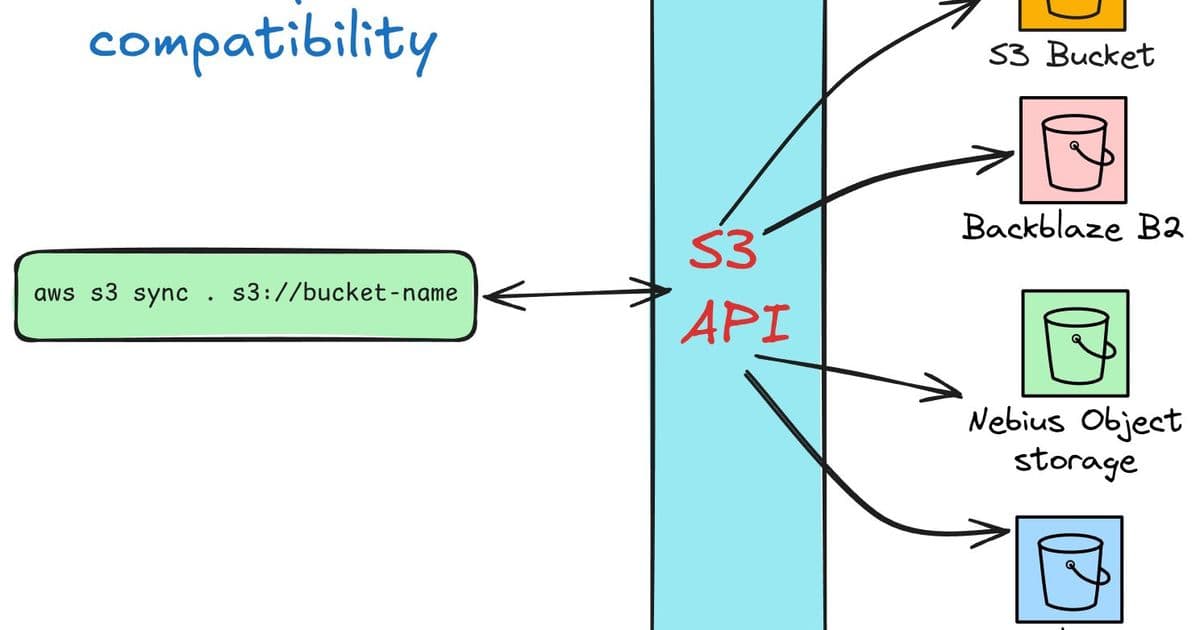
At its core, the S3 API has become a de facto standard for object storage operations. What began as Amazon's proprietary interface has evolved into a widely adopted specification that numerous cloud providers now implement. This includes established players like Backblaze B2, Cloudflare R2, Akamai Object Storage, Digital Ocean Spaces, and newer entrants like Nebius Object Storage. The implications of this compatibility are profound: it reduces vendor lock-in, simplifies multi-cloud strategies, and allows developers to build applications that can seamlessly migrate between providers without significant rewrites.
The technical implementation details revealed in the author's journey highlight a crucial lesson in AWS SDK configuration. Initially, the author manually cherry-picked credentials and region information from AWS profiles, which resulted in failures when attempting to use alternative cloud providers. The SDK was defaulting to standard AWS endpoints rather than respecting the custom endpoint URLs configured for other providers. The solution elegantly demonstrates the importance of using the SDK's full profile loading capabilities through the .profile_name() method, which allows the SDK to properly interpret all configuration elements including custom endpoints.
The corrected implementation showcases how the AWS Rust SDK's configuration system can be elegantly simplified when properly utilized. Rather than manually constructing providers for credentials and regions, the developer can now delegate this responsibility to the SDK's configuration chain, which automatically handles environment variables, profile files, instance metadata service, and fallback values. This approach not only resolves the immediate issue with S3-compatible APIs but also represents a more robust and maintainable pattern for configuration management in cloud applications.
From a broader perspective, this compatibility pattern reflects a maturing cloud ecosystem where standardization begins to outweigh proprietary advantages. The existence of S3-compatible APIs across diverse providers suggests that the market is moving toward a model where interfaces matter more than implementation details. This benefits developers by reducing the learning curve associated with adopting new cloud services and enables more sophisticated architectures that can dynamically select providers based on cost, performance, or geographic considerations.
However, it's important to acknowledge the limitations of this approach. As the author notes, not all S3 features are uniformly supported across providers. Advanced capabilities like multipart uploads, bucket policies, or lifecycle management may vary significantly between implementations. Developers must carefully evaluate which features their applications require and verify compatibility with their chosen provider. Additionally, while basic operations like uploads and presigned URLs may work seamlessly across providers, more complex interactions might require provider-specific adjustments.
The case study also illuminates the broader implications for cloud-native application design. By building applications with S3-compatible APIs in mind, developers create a layer of abstraction that allows for greater flexibility in infrastructure decisions. This approach aligns with the principles of cloud-agnostic development, where applications are not tightly coupled to specific cloud providers but can instead leverage standardized interfaces that multiple providers implement.
For organizations evaluating multi-cloud strategies, this pattern offers a practical starting point. Rather than attempting to replicate entire cloud services across providers, focusing on standardized interfaces like S3 for object storage allows for incremental migration and reduces the complexity of multi-cloud management. The AWS SDK for Rust, with its robust configuration system and support for custom endpoints, provides an excellent toolset for implementing such strategies.
Looking ahead, we may see further standardization efforts around cloud APIs, potentially extending beyond object storage to other services like compute, databases, and messaging. The success of S3 compatibility suggests that the industry recognizes the value of standardized interfaces in reducing switching costs and fostering innovation. Developers and cloud providers alike benefit from this ecosystem, where competition is based on implementation quality and pricing rather than proprietary lock-in.
The author's 'shuk' utility, available on GitHub and crates.io, serves as a practical example of how these concepts can be implemented in real-world applications. Similarly, those interested in seeing the AWS SDK for Rust pushed to its limits might explore the author's other work on downloading 10,000 files concurrently, which demonstrates the performance capabilities of this approach.
As cloud computing continues to evolve, the ability to build applications that can seamlessly work across multiple providers will become increasingly valuable. The S3 compatibility pattern, as demonstrated through the AWS SDK for Rust, represents a significant step toward this goal, offering developers a practical path to cloud-agnostic object storage solutions that balance flexibility, performance, and maintainability.
Comments
Please log in or register to join the discussion