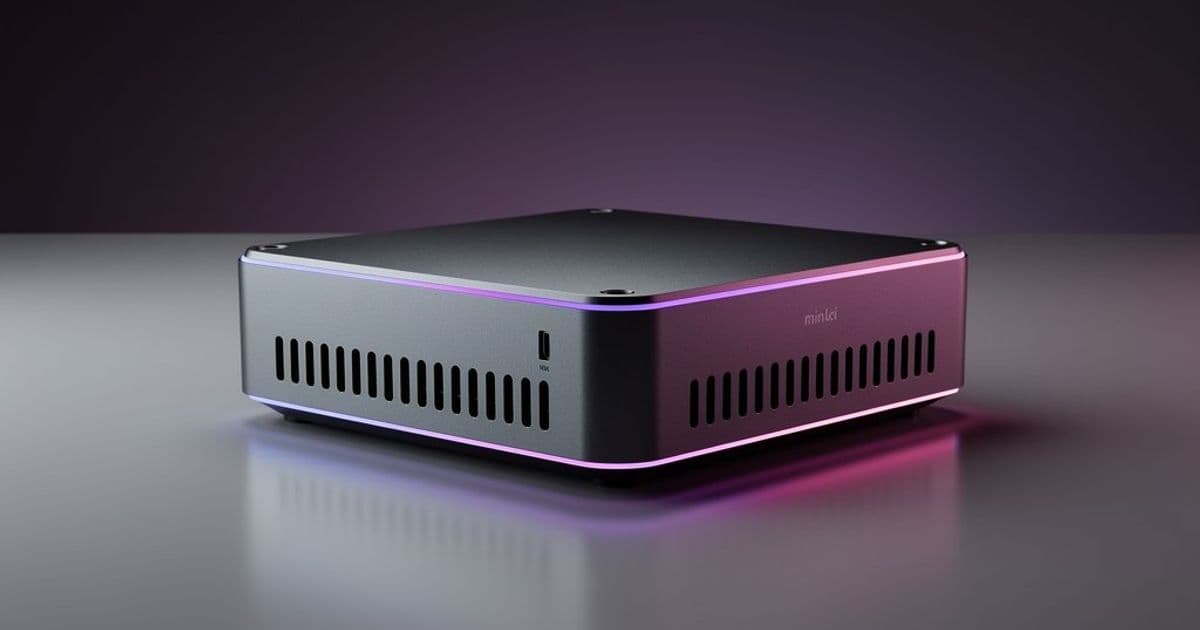
AMD has unveiled the Ryzen Halo mini PC, a compact AI development workstation featuring the Ryzen AI Max+ 395 processor with up to 128GB RAM, positioned as a competitor to NVIDIA's DGX Spark.
AMD is making a strategic entry into the specialized mini PC market with its new Ryzen Halo – a compact desktop computer designed explicitly for AI development. While bearing AMD branding, this isn't aimed at mainstream consumers but rather positions itself as the company's answer to NVIDIA's DGX Spark "AI SuperComputer" launched last year.

The Ryzen Halo centers around AMD's Ryzen AI Max+ 395 processor (codenamed "Strix Halo"), the same chip powering high-end mini PCs, laptops, and handheld gaming devices. This powerhouse combines a 16-core/32-thread Zen 5 CPU (boost up to 5.1GHz) with 40 RDNA 3.5 GPU cores and a 50 TOPS NPU. Crucially, it supports up to 128GB of LPDDR5x-8000 RAM via a 256-bit interface, delivering 256 GB/s bandwidth – essential for memory-intensive AI workloads.

Here's how it compares to NVIDIA's offering:
| Feature | AMD Ryzen AI Halo | NVIDIA DGX Spark |
|---|---|---|
| Processor | Ryzen AI Max+ 395 | GB10 Grace Blackwell |
| CPU | 16c/32t Zen 5 (5.1GHz) | 20c Arm (Cortex-X925/A725) |
| GPU | Radeon 8060S (40 cores) | Blackwell w/Tensor Cores |
| NPU | 50 TOPS | N/A (GPU handles AI) |
| RAM Support | 128GB LPDDR5x-8000 | 128GB LPDDR5x |
| TDP | 45-120W | Up to 140W |
| OS Support | Windows & Linux | NVIDIA DGX OS (Linux) |
| Dimensions | Not specified | 150 x 150 x 50.5mm |
| Price | TBA | $3000 |
Performance comparisons reveal nuanced strengths: NVIDIA claims 1,000 TOPS FP4 throughput while AMD touts 60 TOPS FP16 on its NPU. Real-world superiority depends heavily on specific AI tasks and frameworks. The Ryzen Halo's Windows/Linux flexibility contrasts with NVIDIA's locked DGX OS, potentially broadening its developer appeal.
With pricing unannounced and availability slated for Q2 2025, AMD's play targets developers seeking desktop-scale AI computation in a compact form factor. Its use of commercially available silicon suggests potential cost advantages over NVIDIA's specialized Blackwell chip, though final value hinges on AMD's pricing strategy.
Comments
Please log in or register to join the discussion