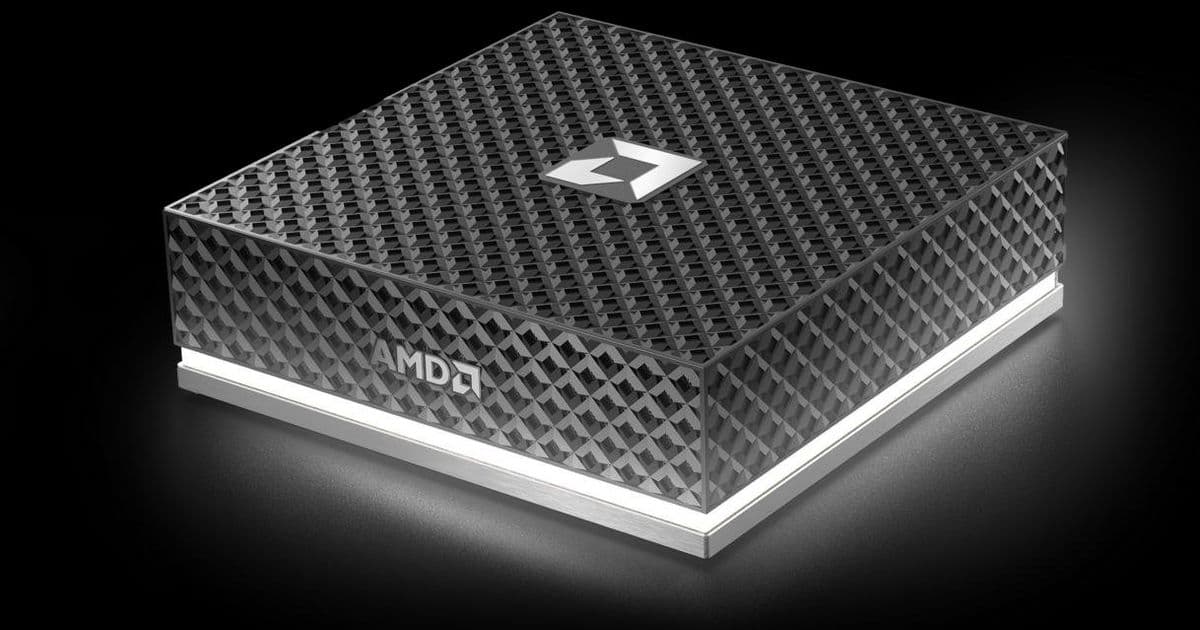
AMD officially unveils the Ryzen AI Halo mini-PC, a $3999 AI development workstation featuring the Ryzen AI Max+ 395 processor with an integrated software ecosystem designed to compete with NVIDIA's DGX Spark.
AMD has formally unveiled the Ryzen AI Halo, their first entry into the AI mini-PC market, positioning it as a comprehensive local AI inference workstation and development box. Announced at CES 2026 and now launching with pre-orders beginning in June at $3999, the Halo represents AMD's attempt to bundle their AI technologies into a single, optimized system.
Hardware Specifications
The Ryzen AI Halo is built around AMD's Strix Halo silicon, which also powers the Ryzen AI Max 300 series of chips. The specific configuration includes:
- Processor: AMD Ryzen AI Max+ 395 (5.1GHz)
- Memory: 128GB LPDDR5X-8000 (soldered)
- Storage: 2TB SSD (PCIe Gen4 x4)
- GPU: Radeon 8060S Graphics (40 CUs)
- Form Factor: Mini-PC measuring 150 x 150 x 43.2 mm (5.9 x 5.9 x 1.7 in)
- Weight: Just over 1kg (2.2lbs)
- Connectivity: Wi-Fi 7 (2×2) + Bluetooth 5.4
- Ports: 1x HDMI 2.1, 4x USB-C (data rates to be confirmed), 1x 10GbE LAN (RJ45)
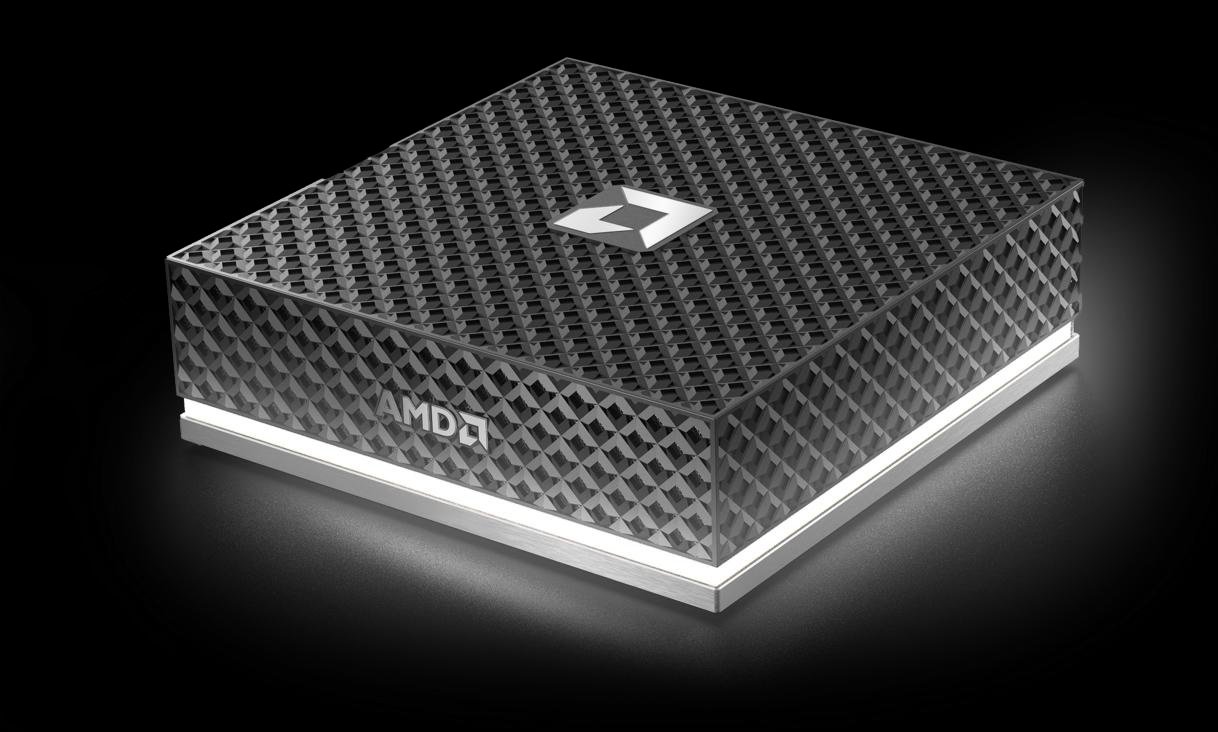
Notably, the physical implementation is remarkably compact, with the Halo measuring just 43.2mm tall and weighing slightly over a kilogram. This makes it potentially the smallest and lightest implementation of a Ryzen AI Max system to date.
Software Ecosystem: The Real Differentiator
While the hardware specifications are comparable to other Ryzen AI Max systems already on the market, AMD's primary value proposition lies in the software ecosystem. The Ryzen AI Halo represents AMD's first attempt at creating a complete ecosystem box, a departure from their previous approach of providing silicon for partners to build upon.
The centerpiece of this ecosystem is the AMD Ryzen AI Development Center. This unified interface serves as:
- A starting point for new users
- A package manager for AI software
- A hub for system updates and management
- A validation point for all distributed software
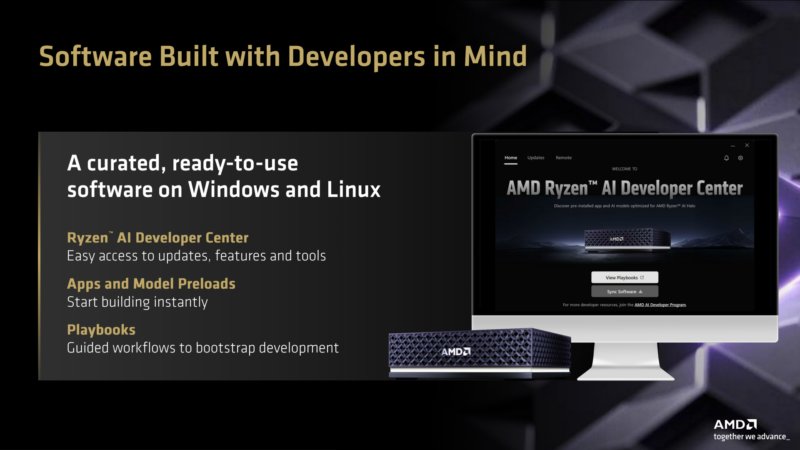
AMD is supporting both Windows 11 and Linux (specific distribution to be determined) out of the box, ensuring parity between operating systems. This dual-OS approach distinguishes the Halo from NVIDIA's DGX Spark, which primarily targets Linux users.
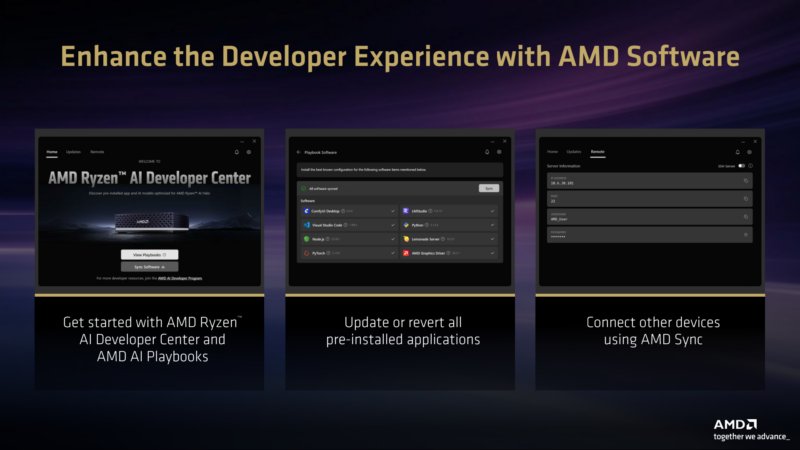
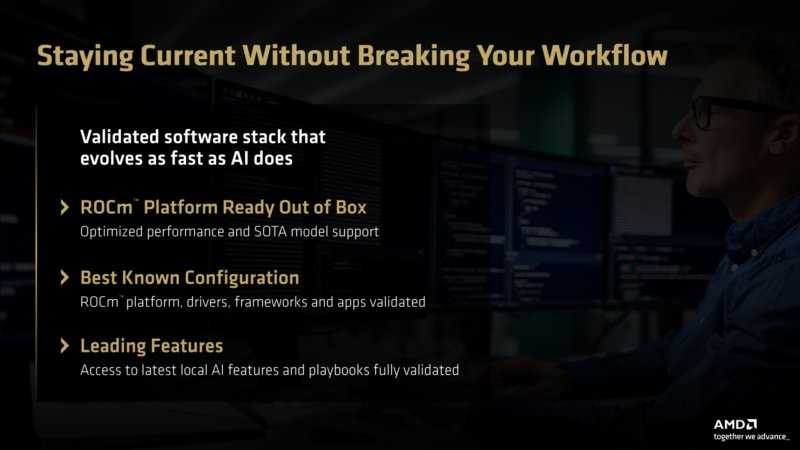
The Development Center will provide pre-built packages specifically optimized for AMD hardware. This approach mirrors NVIDIA's CUDA ecosystem but focuses on AMD's ROCm stack. The validation process is a key differentiator, as AMD will test and certify all software distributed through their platform, aiming to reduce the friction often encountered in setting up AI development environments.
AMD has also developed comprehensive documentation and AI playbooks. Five playbooks will be pre-loaded on the system, with an additional ten available on AMD's website. These guides will help users navigate the ROCm ecosystem, implement various models, and accomplish specific AI-powered tasks.
Market Positioning and Competition
AMD is positioning the Ryzen AI Halo directly against NVIDIA's DGX Spark, the current market leader in AI development mini-PCs. However, this comparison presents both advantages and challenges for AMD.
Hardware Advantages and Disadvantages:
The Ryzen AI Max silicon offers some advantages over NVIDIA's solutions, particularly in general compute performance. However, it lacks dedicated tensor hardware for matrix multiplication operations and doesn't support specialized datatypes like FP8/FP6/FP4 that NVIDIA's hardware accelerates efficiently. This could impact performance for certain AI workloads, particularly those heavily reliant on these specialized operations.
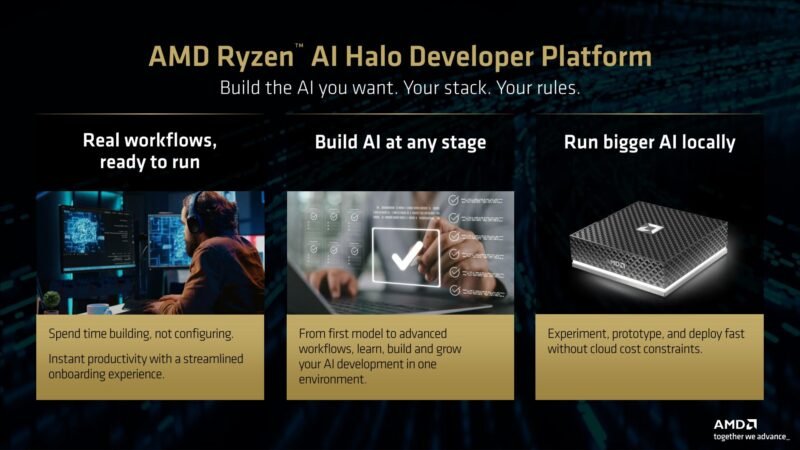
AMD's approach emphasizes the performance advantages of their architecture while acknowledging the software ecosystem gap. The company is highlighting the comprehensive nature of their software stack as a key differentiator.
Target Audience:
Besides competing directly with DGX Spark, AMD is targeting users who have been purchasing Macs for local AI inference. Interestingly, this market segment may be shifting quickly, as AMD notes that Apple has discontinued all Mac Studios and Mac Minis with more than 96GB of RAM, effectively placing Apple and AMD in different market segments for the moment.
Value Proposition: Operating Costs vs. Initial Investment
AMD's primary marketing angle focuses on total cost of ownership, particularly comparing local inference with cloud services. The company's "power math" argument suggests that while the initial investment is substantial, the long-term operational costs for local inference can be significantly lower than cloud-based solutions, especially for high-volume token processing.
This argument relies heavily on usage patterns. For users generating or processing large numbers of tokens, the linear scaling of cloud costs can quickly surpass the initial hardware investment. However, for those with more moderate usage patterns, the economics may not be as favorable.
The $3999 price point represents a premium of approximately $700 over comparable Ryzen AI Max+ 395 systems from other manufacturers like Minisforum. This premium is justified by AMD through their integrated software stack, technical support, and ecosystem validation rather than superior hardware specifications.
When compared to NVIDIA's ecosystem, the pricing puts the Halo in direct competition with partner systems like ASUS's Ascent GX10, which offers similar specifications at nearly identical price points. AMD appears to be positioning the Halo as a premium product within their ecosystem rather than attempting to undercut NVIDIA's offerings.
Future Outlook: The 192GB Halo
AMD has already confirmed plans for future Halo systems based on the upcoming Ryzen AI Max PRO 400 chips. These systems will leverage the higher performance and increased memory capacity (up to 192GB) of the newer chips, suggesting AMD is planning a rapid refresh cycle for their Halo product line.
This approach mirrors the strategy seen in other hardware segments, where initial versions serve as entry points while more capable follow-up products are already in development. For early adopters, this means the first-generation Halo may have a relatively short lifespan as the premium product in the lineup.
Conclusion
The Ryzen AI Halo represents a significant strategic shift for AMD, moving beyond silicon supplier to full system provider in the AI development space. While the hardware specifications are competitive but not revolutionary, the comprehensive software ecosystem and validated environment could address real pain points for AI developers.
At $3999, the Halo commands a premium over comparable systems, with the value proposition resting heavily on the software integration and support. Whether this approach can successfully challenge NVIDIA's well-established ecosystem remains to be seen, but it demonstrates AMD's commitment to the AI development market and their recognition that hardware alone is insufficient to capture significant market share.
For developers and organizations evaluating local AI inference solutions, the Ryzen AI Halo presents a compelling option that balances capable hardware with a streamlined software experience. The pre-orders beginning next month will provide the first real-world test of AMD's ecosystem approach and market reception.
For more information on the Ryzen AI Halo, visit AMD's official product page or explore the Ryzen AI Development Center documentation.
Comments
Please log in or register to join the discussion