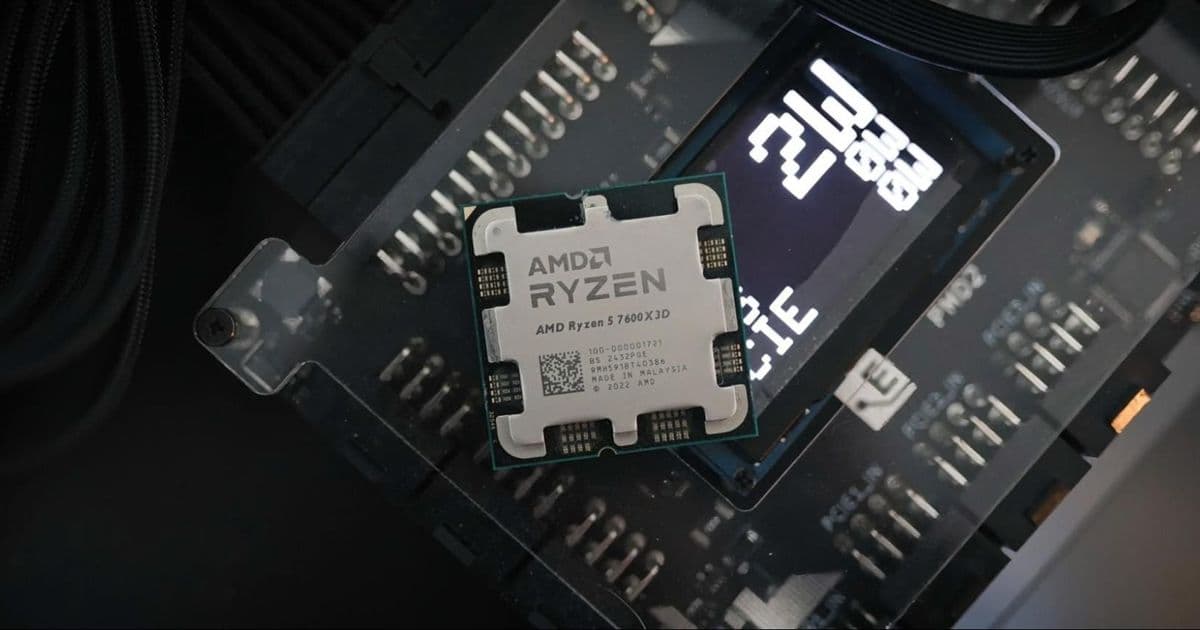
The Ryzen 5 7600X3D continues to deliver exceptional gaming value 18 months after launch, leveraging AMD's 3D V-Cache technology to outperform competitors in the $200-$250 price segment while maintaining impressive power efficiency.
The AMD Ryzen 5 7600X3D processor continues to demonstrate remarkable staying power in the gaming CPU market, maintaining its position as the best value gaming option despite being based on last-generation Zen 4 architecture. The processor leverages AMD's second-generation 3D V-Cache technology to deliver gaming performance that rivals more expensive alternatives, establishing a compelling price-to-performance ratio that has remained competitive for 18 months.
Technical Architecture and Performance Characteristics
The Ryzen 5 7600X3D operates with a 65W TDP and 88W Peak Power Tracking (PPT), significantly lower than standard Zen 4 processors. This reduced power envelope comes at the cost of peak clock speeds, topping out at 4.7 GHz compared to the 5.3 GHz found in the standard Ryzen 5 7600X. The processor maintains 6 cores and 12 threads with a total cache of 102 MB, combining 96 MB of 3D V-Cache with 6 MB of L2 cache.
The 3D V-Cache implementation in this generation differs from AMD's newer Zen 5 X3D processors, which feature a revised SRAM placement underneath the die rather than on top. This original design places the extra SRAM as an insulating layer between the cores and the Integrated Heat Spreader (IHS), contributing to the processor's thermal efficiency but limiting overclocking potential due to the locked multiplier.
Market Position and Competitive Landscape
In the $200-$250 price segment, the Ryzen 5 7600X3D faces limited competition for gaming-specific workloads. Intel's Core Ultra 5 250K Plus offers approximately twice the multithreaded performance at a similar price point, but falls behind in gaming scenarios. The processor's availability has improved since its initial 2024 launch as a Micro Center exclusive, now accessible through Amazon with a current price of $240 compared to the $200 in-store price.
The Ryzen 5 7600X3D delivers gaming performance that is only marginally behind the more expensive Ryzen 7 7800X3D, making it an attractive option for budget-conscious gamers. Its power efficiency is particularly notable, often consuming less than 70W during gaming sessions, positioning it as one of the most energy-efficient gaming CPUs on the market.
Productivity Limitations and Future Outlook
While the Ryzen 5 7600X3D excels in gaming scenarios, its limitations become apparent in productivity applications. The combination of a six-core configuration on last-generation architecture, combined with the X3D design optimization that prioritizes cache over clock speeds, results in performance that lags behind both Intel's current offerings and AMD's own non-X3D processors like the Ryzen 5 7600X and 9600X.
AMD has yet to introduce a direct replacement for the Ryzen 5 7600X3D in its Zen 5 lineup, with most 3D V-Cache attention focused on higher-end SKUs such as the Ryzen 7 9850X3D and Ryzen 9 9950X3D. This leaves the Ryzen 5 7600X3D in a unique position as an aging yet highly competitive option in the mid-range gaming CPU market.
The processor's continued relevance underscores the significant impact that 3D V-Cache technology has had on gaming performance, demonstrating how architectural optimizations can extend the competitive lifecycle of a processor design even as manufacturing processes advance and new architectures emerge.
Comments
Please log in or register to join the discussion