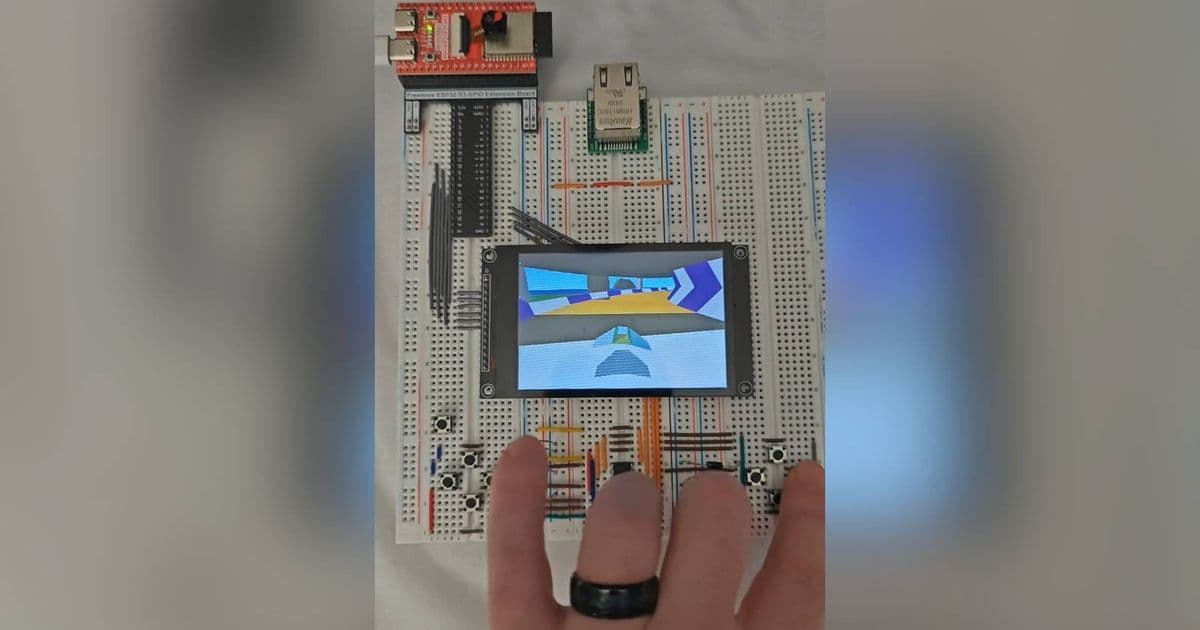
A remarkable Wipeout-style 3D racing game has been developed for the ESP32-S3 microcontroller, achieving smooth 60FPS performance on a 480x320 interlaced display. The project features procedural track generation, AI opponents with collision avoidance, and custom dual-core rendering optimizations.
This Amazing ESP32 Game Runs at 60FPS on a 480x320 Screen
The ESP32 microcontroller continues to impress developers with its capabilities, and the latest achievement comes in the form of a Wipeout-style 3D racing game that runs at a buttery-smooth 60FPS on a 480x320 interlaced display. This remarkable feat showcases the true potential of the ESP32-S3 when properly optimized, pushing the boundaries of what we thought possible on such a small, low-power device.
Technical Breakdown: How It Works
The project, developed by PhonicUK, demonstrates impressive engineering that squeezes maximum performance out of the ESP32-S3. The key to achieving 60FPS lies in the custom dual-core 3D engine that leverages both CPU cores effectively.
The rendering pipeline uses an interlaced approach with two half-height buffers. While one CPU core handles the graphics rendering for the next frame, the other core manages the input/output operations, creating a seamless pipeline that maximizes throughput. This parallel processing approach is essential for maintaining smooth frame rates on a device with limited computational resources.
The display used in this project is the ST7796 SPI display, a popular choice for ESP32 projects due to its good color reproduction and resolution support. The interlaced rendering technique is particularly clever for this display, allowing the game to achieve higher perceived resolution while maintaining smooth performance.
Game Features and Mechanics
Beyond the technical achievements, the game itself is quite impressive for a microcontroller project:
Procedural Track Generation: Each game session starts with a newly generated track, ensuring replayability without requiring large storage space for multiple track layouts. This is particularly important on devices with limited storage like the ESP32.
AI Opponents: The game features three AI-controlled racers that not only follow the track but also implement collision avoidance. This creates dynamic racing experiences where AI ships can nudge each other around, adding an element of unpredictability to races.
Physics and Collision System: The game includes a physics engine that allows ships to interact with each other realistically. Ships can bump into each other, affecting their trajectories and creating opportunities for strategic racing maneuvers.
The ESP32-S3 Advantage
This project specifically utilizes the ESP32-S3 variant, which offers several advantages over the original ESP32:
Dual-core processors: While the original ESP32 also has dual cores, the S3 variant offers improved performance and better cache utilization.
Higher clock speeds: The ESP32-S3 can operate at up to 240MHz, providing more computational power for complex tasks like 3D rendering.
Enhanced peripherals: The S3 includes additional hardware accelerators that can assist with graphics operations.
Increased RAM: With up to 512KB of SRAM, the ESP32-S3 has more memory for frame buffers and game state.
Cross-Platform Considerations for Developers
For developers looking to create similar projects, there are several important considerations:
Memory Management: The ESP32 has limited RAM, so efficient memory usage is crucial. The interlaced buffer approach used in this project is a smart way to reduce memory overhead while maintaining visual quality.
SPI Display Optimization: Working with SPI displays requires careful optimization to avoid bottlenecks. The dual-core approach used in this project helps balance the computational load.
Code Optimization: For performance-critical applications like 3D games, developers need to be mindful of code efficiency, avoiding expensive operations and leveraging hardware accelerators where possible.
Asset Management: On devices with limited storage, procedural generation and compression techniques become essential for creating rich content without exceeding storage limitations.
The Future of ESP32 Gaming
This project represents what's possible when developers push the ESP32 to its limits. As the community continues to explore the capabilities of this versatile microcontroller, we can expect to see even more impressive gaming projects in the future.
The success of this Wipeout-style racing game demonstrates that the ESP32 is capable of more than just simple IoT applications. With proper optimization, it can handle complex 3D graphics, AI, and physics - tasks typically reserved for much more powerful hardware.
Getting Started with ESP32 Game Development
For developers interested in creating their own ESP32 games, this project provides an excellent reference point. While the source code for this particular project hasn't been released yet, the technical details shared by the creator offer valuable insights into optimization strategies.
Key resources for ESP32 game development include:
- The ESP32 SDK for hardware-level optimization
- Arduino libraries for rapid prototyping
- PlatformIO for advanced project management
- Community forums like the ESP32 subreddit where developers share their projects and insights
As the ESP32 ecosystem continues to evolve, we can expect to see more sophisticated applications that leverage the full potential of this remarkable microcontroller. The 60FPS racing game is just the beginning of what's possible when developers combine creativity with technical expertise.
Comments
Please log in or register to join the discussion