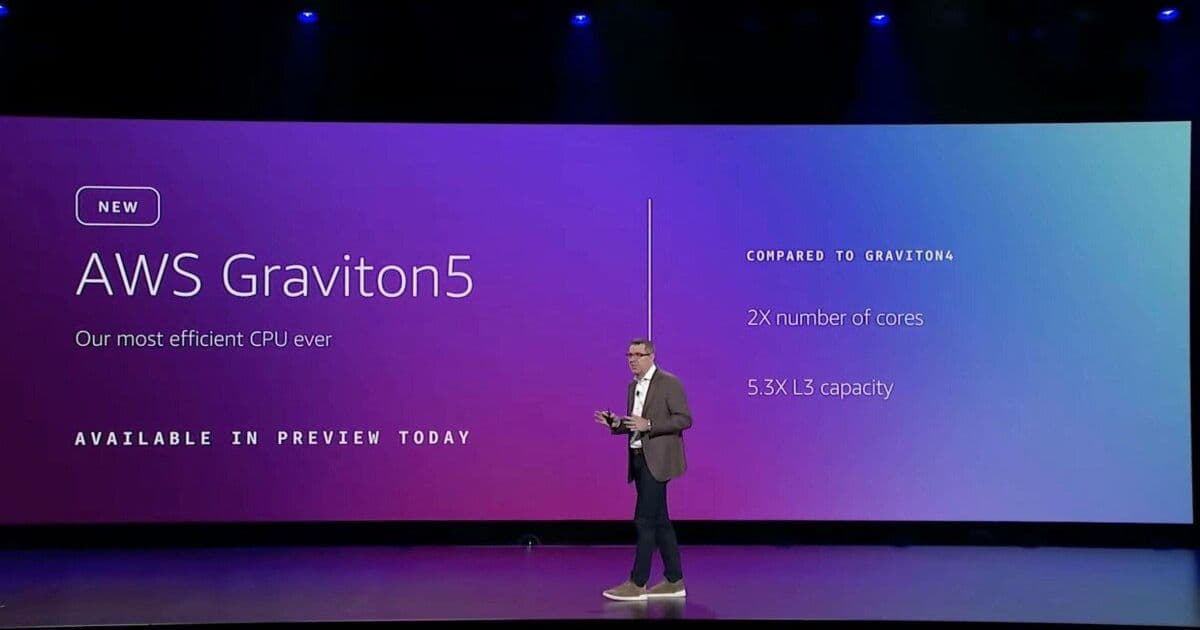
Amazon's newest Arm processor posts double-digit performance improvements across general computing, inference, and database work, but the marketing around it muddies what the chip actually is and who benefits from upgrading.
Amazon Web Services has released Graviton 5, the latest generation of its in-house Arm-based processor, and the performance figures are strong enough to stand on their own. The problem is how the chip is being sold. AWS and parts of the financial press have folded Graviton into the broader marketing push around artificial intelligence, describing the line as silicon "for the Agentic AI era." That framing misrepresents what Graviton is and risks confusing the customers who would actually benefit from it.
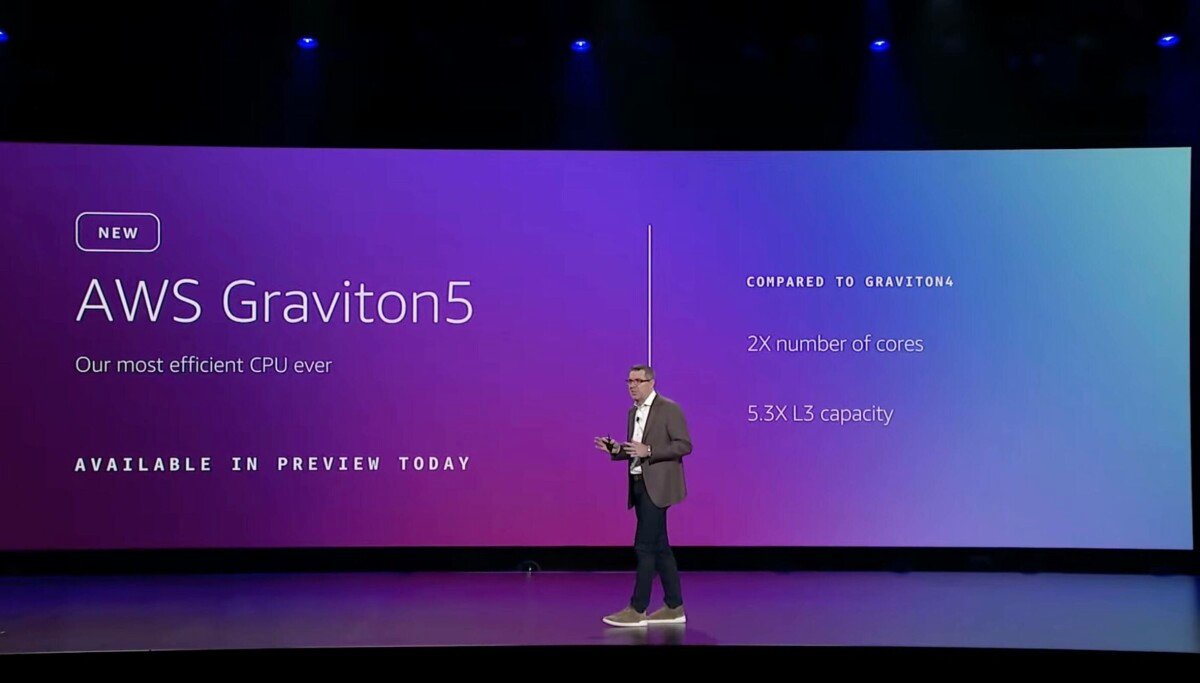
What Graviton Actually Is
Graviton is a general purpose CPU built on the Arm architecture by Annapurna Labs, Amazon's chip design division. It is the workhorse behind a large and growing share of AWS compute instances. It runs web applications, databases, batch jobs, and the ordinary server workloads that make up most of the cloud. It can run machine learning inference, but so can almost any modern CPU. Using Graviton primarily for AI is comparable to using a spreadsheet as a database. Possible, occasionally convenient, but not the point.
The genuine AI accelerator in Amazon's portfolio is Trainium, a separate product designed for training and inference at scale. Trainium is not a GPU and not a CPU. It is a systolic array, a hardware structure optimized for the dense matrix math that neural networks depend on. When the Wall Street Journal reported that Snowflake's $6 billion AWS commitment was for "agentic computing chips," and when AWS's own announcement leaned on AI language, both were describing Graviton. A reader could be forgiven for assuming something GPU-shaped was involved. Nothing of the sort is.
The Performance Numbers
For years Amazon declined to publish competitive benchmarks for its Arm line, which led many observers to assume the results were unimpressive. The opposite turned out to be true. Early real-world testing showed 35 to 40 percent better performance than comparable Intel-based instances across a range of workloads. AWS has since grown comfortable promoting the gains directly.
For Graviton 5, the company states that applications run 35 percent faster, machine learning inference runs 35 percent faster, and databases run 30 percent faster. The honest part of this claim is the baseline. Rather than comparing against an aging predecessor, AWS is measuring against Graviton 4, which was already a capable chip. Posting double-digit improvements over your own recent generation is a real engineering achievement, not a benchmarking trick. You can read the details on the AWS Graviton processor page.
The Pricing Catch
Graviton 5 instances cost about 9 percent more than the previous generation. This breaks a pattern that AWS customers relied on for years. Moving from a c4.large to a c5.large once meant both better performance and a roughly 15 percent lower price. Upgrading was an obvious decision. That dynamic has reversed. New generations now carry higher sticker prices.
Amazon's response is that price-per-unit-of-work still improves, because faster instances finish jobs sooner or handle more load per node. For some customers this holds. If you operate large fleets running at high CPU utilization, migrating to Graviton 5 can lower your total bill even at the higher hourly rate. The math works when the workload scales with available compute.
The math does not work for everyone. Consider a database company that gives each customer a fixed number of replicas, or an architecture that mandates three nodes, one per availability zone, regardless of utilization. These users need a set count of instances. For them, the 9 percent increase is simply a 9 percent increase, with no offsetting efficiency to claim. Faster hardware does not reduce a node count that is dictated by redundancy requirements rather than throughput.
That puts a segment of customers in a difficult spot. They can absorb the higher cost on new instance families, or they can stay on older generations and accept that availability for that hardware will tighten over time as AWS stops racking the older chips. Neither option is comfortable.
Cost Pressure Across the Industry
The price bump does not exist in isolation. Component costs have climbed sharply as large buyers compete for fabrication capacity. An 8GB Raspberry Pi now sells for around $175, more than double its $85 launch price. AWS operates inside the same constrained supply environment.
What stands out is restraint. By Amazon's own account, two companies each offered to buy the entire annual Graviton supply. With that level of demand, AWS had room to raise prices far more aggressively than 9 percent. It chose not to, and availability has stayed broad enough that even small accounts can upgrade without friction. The chip division continues to ship high volumes of competitive silicon while holding the line on access.
The Takeaway
Graviton 5 is a good processor, and Annapurna Labs deserves credit for delivering meaningful generational improvements year after year. The frustration is that this steady, unglamorous progress gets buried under AI marketing language that does not describe what the chip does. The infrastructure that actually runs the modern cloud keeps improving quietly while attention flows elsewhere. For teams evaluating an upgrade, the decision comes down to one question: does your workload scale with compute, or is your node count fixed? The answer determines whether Graviton 5 saves you money or costs you a little more for the privilege of going faster.
Comments
Please log in or register to join the discussion