
A hand-cranked Raspberry Pi running local language models can answer questions and translate speech with no cloud, no account, and no data leaving the box. Behind the gag is a serious argument about who controls your AI and your data.
Most conversations about AI privacy circle the same problem: the moment you type a question into a chatbot, your words travel to someone else's servers, get logged, and may be used to train the next model. A pair of AI researchers built a deliberately absurd machine to make that problem visible. It is called CrankGPT, and it runs entirely on muscle power.

The device is a 3D-printed box with a hand crank bolted to the side. Turn the crank and you generate electricity. Stop, and you have roughly 20 seconds of stored charge in an onboard capacitor board before the whole thing dies. In between, a voice agent listens to your questions, answers them, and even translates speech into other languages, all without touching the internet. According to its makers, computer scientist Katrin Tomanek and former Google Advanced Technology and Projects technical lead Alex Kauffmann, it takes about 30 seconds of cranking to go from a dead box to an actual conversation.
Why a privacy-focused project starts with a crank
The joke has a target. Cloud-hosted AI assistants are convenient precisely because the heavy computation happens somewhere else, on hardware you never see, paid for by a business model that often depends on retaining and analyzing what you send. CrankGPT inverts that arrangement. Every byte of speech recognition, language generation, and text-to-speech happens on the device sitting in front of you. There is no API call, no telemetry, no third party in the loop. If you want an answer, you supply the power yourself.
That design makes the privacy properties unusually easy to verify. A cloud service can promise it does not store your prompts, and you have to trust the promise. A box with no network connection cannot leak what it never transmits. For anyone thinking about data minimization, the principle that systems should collect and retain only what they strictly need, CrankGPT is an extreme but honest illustration: the most private system is the one that physically cannot send your data anywhere.
"Asking Claude to add two numbers for you is like swatting a fly with a wrecking ball," Kauffmann told The Register, capturing the second half of the argument. Sending trivial requests to enormous hosted models is wasteful in compute, energy, and exposure. The pair's actual company, Squeez, builds small, specialized models that run on cheap local hardware and, in their words, are "customized, efficient, and private." Think a voice recognizer tuned for a speaker with a strong accent or a speech impediment, or a model trained to be a subject-matter expert on gardening or auto repair that simply refuses to wander outside its domain.
What is actually inside the box
The brain is a stock Raspberry Pi 5 with 8 GB of RAM, a cooling fan HAT, and a dedicated audio I/O HAT built for voice assistants. Power comes from an off-the-shelf 20W switchable-voltage hand crank, the kind sold for emergency USB charging, feeding into the custom capacitor unit the pair built.
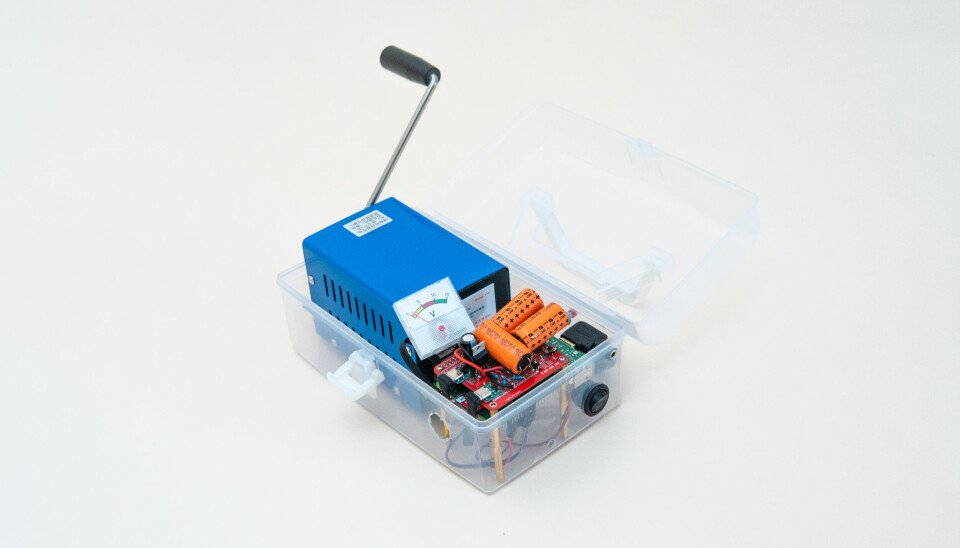
The software stack is deliberately minimal. The device boots a stripped-down build of DietPi into a working userspace in about three seconds. Speech recognition runs on Moonshine, picked for raw speed, while text-to-speech uses Piper, chosen for running well on low-resource edge hardware. The language work splits across two compact models: Liquid's LFM2 1.2B handles general-purpose question answering, and Gemma 3 1B handles translation. A knob on the enclosure switches between modes, including a couple of conversational games like two truths and a lie.
The genuinely novel piece is the voice agent itself, written from scratch and published on GitHub for anyone who wants to tinker. "We wanted to understand the system end to end and have as few dependencies as possible," the project documentation notes. Fewer dependencies is also a security posture: every external library is a component you have to trust and keep patched, and a small, auditable codebase is one you can actually reason about.
The most charming detail is tactile. "The neatest part of the whole thing is that you can actually feel the inference," Kauffmann said. The crank gets noticeably harder to turn when the board is generating tokens and eases off when the model sits idle waiting for input. The compute cost of AI, usually abstracted away into a monthly bill or a distant datacenter, becomes something you feel in your forearm.
What it changes for users
CrankGPT is a gag, and its makers are clear about that. Squeez has no plans to sell pedal-powered AI to development teams, though Kauffmann noted that "a good biker can maintain a steady 120W output, so a class of twenty could power a Blackwell" if someone insisted on funding the experiment. The serious point underneath is that capable language models no longer require a hyperscale datacenter or a persistent cloud account. Translation worked well with "no fine tuning, it's just a two-line prompt," Kauffmann said, on a model running on a board that costs a few hundred dollars.
That shifts the calculus for anyone who cares about data sovereignty. A local model means your queries, your documents, and your voice stay under your control, governed by your own choices rather than a provider's terms of service or a jurisdiction's data-retention rules. For sensitive use cases, medical questions, legal matters, anything involving children or vulnerable users, the ability to run inference with zero network egress is a meaningful protection rather than a marketing line. It is the difference between trusting a privacy policy and not having to.
Kauffmann and Tomanek plan to release full plans and schematics in the coming days, with the voice agent already available. The estimated build cost has climbed to roughly $300, up from the $150 Kauffmann spent last year, thanks to the recent surge in RAM prices. For that, you get a standalone AI box that keeps working when the grid, or the cloud, goes dark. The crank is a punchline, but the architecture it points toward, small models running privately on hardware you own, is a serious answer to a real question about who gets to see what you ask.
Comments
Please log in or register to join the discussion